



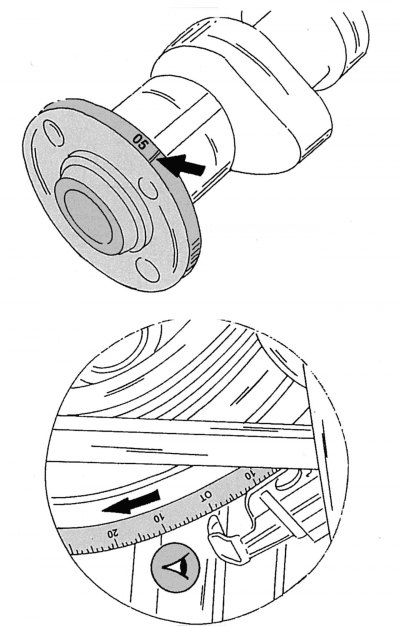
Figure 108. Numerical identifier indicating the corresponding modification or size group of the camshaft (top). Correct direction of rotation of the crankshaft (bottom) for setting the TDC position
Not all versions of this engine have the same camshaft. The number stamped on the shaft, which is shown in the figure 108 place, indicates its belonging to a specific type of engine. Camshafts of the so-called repair size groups (1st and 2nd repair sizes) are also supplied with a corresponding numerical identifier.
Only the camshaft that has a specific identification number can be installed on your vehicle's engine. The camshaft is mounted on bearings in the cylinder head. The lower part of the bearings is cast in the form of sockets integral with the cylinder head, to which the bearing caps are bolted.
The camshaft is removed after the bearing cap fasteners have been removed and its drive sprocket has been removed. The front of the vehicle is disassembled accordingly to provide access to the components and parts required to perform the work. Removal and installation of the camshaft must be carried out in the following order:
- disconnect the ground wire from the battery;
- remove the air intake pipe;
- remove the cylinder head cover. It is attached with 6 bolts to the top of the engine;
- turn the engine shaft until the piston of the first cylinder stops at TDC, while the "zero" mark on the belt pulley should be positioned opposite the installation indicator. The engine shaft is turned by the central bolt securing the crankshaft pulley using a socket wrench with a ratchet;
Caution! Never attempt to turn the crankshaft by the central camshaft sprocket mounting bolt using a wrench. The crankshaft should always be turned only in the working direction of its rotation. Having stopped the crankshaft in the required position, pay attention to the position of the marks on the upper side of the camshaft, they should be opposite each other, as shown in the figure 102.
- completely remove the chain tensioner (subsection 2.12.1);
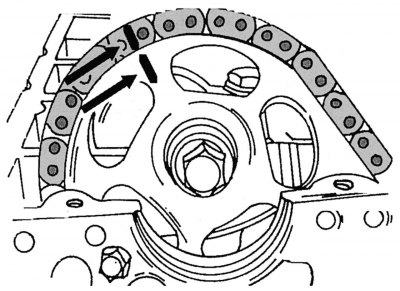
Figure 99. Marks on the camshaft drive sprocket and drive chain
- on the camshaft sprocket and on its drive chain, it is necessary to apply marks with paint - two stripes in one line, as shown by two arrows in the figure 99;
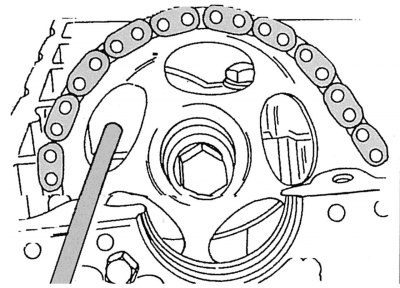
Figure 100. Fixing the camshaft drive sprocket
- unscrew and remove the bolt securing the sprocket to the camshaft together with the washer. To prevent the camshaft from turning when unscrewing the bolt between the sprocket spokes, insert a strong screwdriver or a thick bolt, as shown in the figure 100. At the same time, you can involve an assistant who will fix the crankshaft from turning by the flywheel ring gear from below through the flywheel oil pan (torque converter);
- remove the sprocket from the camshaft, keeping the drive chain taut at all times to prevent it from disengaging from the crankshaft sprocket;
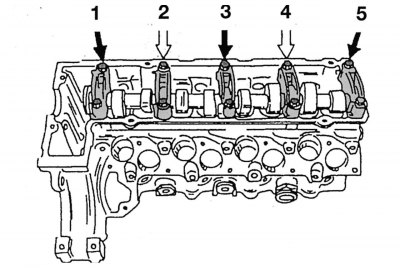
Figure 109. Sequence of removal of fastening bolts of bearing caps of camshaft of four-cylinder engine
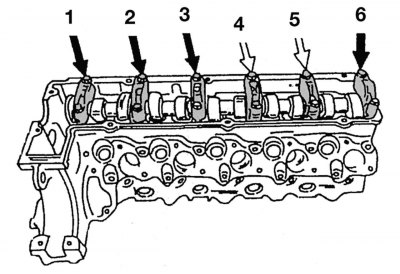
Figure 110. Sequence of removal of fastening bolts of bearing caps of camshaft of five-cylinder engine
- unscrew the camshaft bearing cap mounting bolts one by one in several steps and remove the bearing caps from the bearing stands in a specific order. On a four-cylinder engine, the alignment shown in the figure should be followed 109 sequences for unscrewing and removing bearing caps. First, unscrew the bolts securing the covers of the first, third and fifth bearings (bolts marked with black arrows), and then the bolts securing the second and fourth bearing caps are loosened alternately in a crosswise pattern (indicated by white arrows) until the force on the camshaft disappears. On a five-cylinder engine, the diagram for dismantling the mounting bolts and removing the bearing caps is shown in the figure 110. The bolts of the first, second, third and sixth bearing caps are unscrewed first (black arrows), and then the bolts securing the fourth and fifth bearing caps are loosened alternately in a crosswise pattern (white arrows) until the moment the force on the camshaft disappears;
- lift the camshaft from the bearing supports;
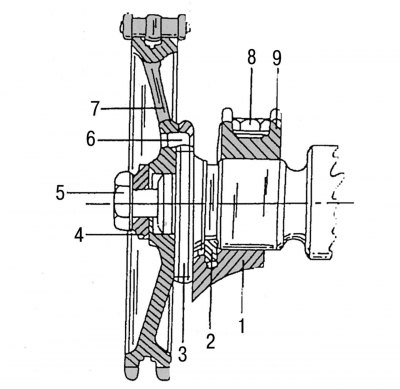
Figure 111. The camshaft and its fastening in the cylinder head: 1 - cylinder head; 2 - thrust half ring; 3 — camshaft; 4 - washer; 5 — bolt M10x50 mm for fastening the camshaft drive sprocket; 6 - landing pin; 7 — camshaft drive sprocket; 8 — bolt M8x45 mm for fastening the camshaft bearing cover; 9 — camshaft bearing cap
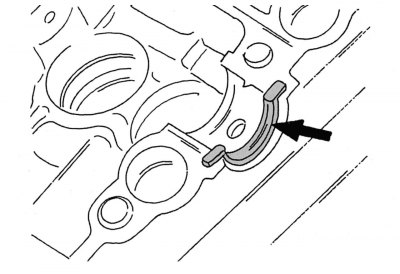
Figure 112. Thrust half ring for axial fixation of the camshaft
- remove the camshaft thrust half ring from the cylinder head groove. Figure 111 shows a section of the camshaft flange with a thrust half ring limiting the axial clearance of the camshaft. The seat groove of the half ring is shown in the figure 112.
- To check the hydraulic valve lifters, they can be pulled out of the wells using a suction cup. After checking, install the tappets in their original places.
- When replacing the camshaft or cylinder head, you should first generously lubricate the shaft and, having installed it in the bearings, turn it several times in order to identify possible jamming areas. This work should be carried out in the following order:
- install the thrust half ring on the cylinder head as shown in the figure 112. If the edges of the half ring are worn out, it must be replaced with a new one;
- lubricate the camshaft journals and lower it onto the cylinder head bearing supports. The tappets must be removed from their mounting sockets for this check;
- install the bearing caps into the corresponding sockets and tighten the fastening bolts to a torque of 25 N·m. Start tightening with the bolts of the middle bearings and gradually move towards the edges;
- screw an M10x30 mm bolt into the threaded hole for the sprocket mounting bolt, and then use this bolt to turn the camshaft. If it seems that the shaft is turning hard, try loosening the mounting bolts of individual bearings one by one while continuing to turn the camshaft. When you reach the bearing cap that is causing the camshaft to rotate stiffly, the bearing cap must be removed and the clearance measured using the recommendations for crankshaft bearings. The clearance in the bearings should be between 0.050 and 0.081 mm. Otherwise, the cause of jamming may be partial deformation of the camshaft (when installing a new camshaft, such a reason is excluded);
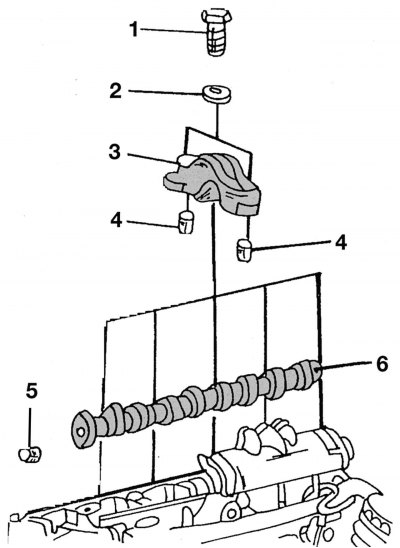
Figure 113. Installing the camshaft: 1 — bearing cover mounting bolt, 23 Nm; 2 - washer; 3 — camshaft bearing cap; 4 - landing bushings; 5 - seat pin for camshaft sprocket; 6 — camshaft
- dismantle the camshaft again. Its subsequent installation can be carried out using the drawing 113. This figure shows the camshaft of a four-cylinder engine;
- generously lubricate and install the valve tappets into the appropriate mounting wells;
- install the camshaft into the sockets and onto the thrust half ring in the cylinder head;
- tighten the fastening bolts of the second and fourth bearing caps of the four-cylinder engine camshaft uniformly and crosswise to a torque of 25 N·m, as shown in the figure 109. After this, install the remaining bearing caps into the sockets and tighten their mounting bolts to the same torque;
- tighten the fastening bolts of the second and fourth bearing caps of the five-cylinder engine camshaft evenly and crosswise, one after the other, to a torque of 25 N·m, as shown in the figure 110. After this, install the remaining bearing caps into the sockets and tighten their mounting bolts to the same torque;
- place the drive sprocket together with the drive chain on the camshaft, making sure that the marks previously applied with paint match and that the camshaft mounting pin fits into the corresponding hole on the sprocket;
- measure the length of the camshaft sprocket mounting bolt from the bottom edge of the bolt head to the end of the threaded section. If the measurement result exceeds 53.6 mm, a new bolt must be used. Tighten this bolt to a torque of 25 Nm, after first securing the sprocket from turning using a bolt (or a strong screwdriver), inserted into the hole between the spokes of the sprocket, as shown in the figure 100. After this, it is necessary to finally tighten this bolt by another 85–95°;
- install the chain tensioner, tightening it to a torque of 80 Nm;
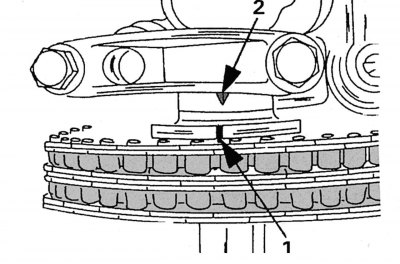
Figure 102. Location of marks when the piston of the first cylinder is at TDC
- check the timing marks on the camshaft to ensure that it is correctly installed in the position of the piston of the first cylinder, which is at TDC. The mark on the camshaft should be opposite the protruding mark on the cover of the first camshaft bearing when the piston of the first cylinder is installed at TDC. These marks are clearly visible when looking at the camshaft from above, as shown in the figure 102;
- install the cylinder head cover in its place;
- all other work should be done in the reverse order of dismantling;
- start the engine and check it for oil leaks.