
Cars BMW Cars Volkswagen Cars Chevrolet Cars Land Rover Cars Lada Cars Honda Cars Peugeot
English Русский
Български
Беларускі
Український
Српски
Hrvatski
Română
Polski
Slovenský
Magyar
Bookmark News and articles Sitemap Feedback Site search
MercedesMan.ru


A-Class C-Class E-Class G-Class M-Class S-Class Others
Sprinter (1995-2000, diesel) Vito 1 (1996-2003) Vito 2 (2003-2014, diesel) Vario 814D (1996-2003, diesel)
  • Main
  • Mercedes-Benz
  • Sprinter (1995-2000)
  • Power unit
  • Engine repair
  • Hydraulic valve lifter compensators — device

Hydraulic valve lifter compensators — device (Mercedes-Benz Sprinter 903)

0
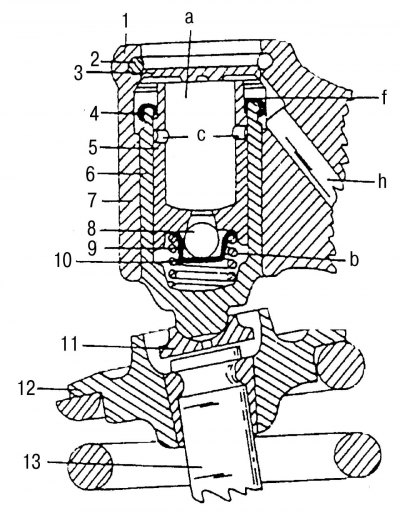
Figure 114. Hydraulic valve lifter: 1 — rocker arm; 2 - retaining ring; 3 - washer; 4 — cap; 5 -…

Figure 114. Hydraulic valve lifter: 1 — rocker arm; 2 - retaining ring; 3 - washer; 4 — cap; 5 - push rod; 6 - guide bushing; 7 - ball guide channel; 8 - ball with a diameter of 4 mm; 9, 10 — pressure springs; 11 — ball bearing; 12 — valve spring plate; 13 — valve; a — oil chamber; b — working chamber; c — leak return channels; f — annular groove; h — oil channel


The task of hydraulic valve lifters is to compensate for the clearance in the valves, which changes as a result of thermal expansion and wear of the valve timing system components. The rocker arms are in constant contact with the camshaft, so the noise level from the valve mechanism is kept low. Hydraulic compensators are installed in the rocker arms and act on the valves through the ball seat 11 (figure 114). The hydraulic valve clearance compensation system consists of the following main elements:
  • push rod 5 with oil chamber a and oil return channels with a check ball valve, parts 8, 9 and 10. The ball valve separates the oil chamber from the working chamber;
  • guide sleeve 6 with working chamber b, pressure spring 9 and closing cap 4.

When the engine is stopped, if the compensator is under constant pressure from the camshaft cam, it can be completely unloaded (compressed). The oil squeezed out of the working chamber b flows into the oil chamber a through the annular gap - through the gap between the guide sleeve and the pressure rod. When the top of the cam comes off the rocker arm, the load is removed from the pressure rod 5. Spring 9 moves the rod upward until the rocker arm comes into contact with the cam. The vacuum created in the working chamber from the movement of the rod opens the ball valve, and oil can flow from the oil chamber into the working chamber. The ball valve closes as soon as the rocker arm rests against the cam, and the load on the push rod begins to increase. The oil in the working chamber now acts as a rigid hydraulic connection, which opens the corresponding valve.


When the engine is running, depending on the engine speed and the position of the cam, the pressure rod drops by an insignificant amount. The oil required for the operation of the compensators is supplied through an oil line running along the cylinder head and then through transverse channels leading to the rocker arm bearing supports. Next, from the bearing pillars, oil is supplied to the rocker shaft, and from it through channel h in the rocker arm to the corresponding compensator. Oil is supplied to the oil chamber through spline washer 3. The amount of oil in oil chamber a is always sufficient to fill the working chamber b in any operating mode of the engine. Excess oil and air inclusions (air bubbles in oil) can exit through the annular gap between washer 3 and the rocker arm. Oil squeezed out of the working chamber flows down the annular gap (along the ring channel) between the guide sleeve and the pressure rod and then through the return channels into the oil chamber. When dismantling hydraulic tappets, it is necessary to remember the following points:
  • hydraulic tappets should always be stored in an upright position - with the open side facing up.
  • after dismantling the hydraulic tappet (subsection 2.13.2) it should be marked with the cylinder number and the pusher well.
This article is available at: russian, bulgarian, belarusian, ukrainian, serbian, croatian, romanian, polish, slovak, hungarian
The article has been verified: Levin Kirill Glebovich
Share with friends:
◀ Previous
Mercedes Sprinter / Engine repair
Next ▶

Gas distribution mechanism
Removal and installation the camshaft
Removal and installation the crankshaft sprocket
Dismantling and installation of drive chain dampers
Removal and installation the chain tension shoe
Checking the serviceability of hydraulic tappets
Removal and installation of hydraulic tappets
Diesel Engine Specifications
More similar articles for repairing other models

☛ Service notification and control device Mercedes W168 (1997-2004)
☛ Hydraulic valve body — removal and installation Mercedes W202 (1993-2000)
☛ Design and specification of the valve timing mechanism Mercedes W123 (1976-1985)
☛ Removal and installation the expansion valve Mercedes W463 (1999-2019)
☛ Removal and installation the expansion valve Mercedes W163 (1997-2005)
☛ Checking and replacing the hydraulic valve clearance compensator Mercedes W126 (1979-1991, petrol)
Link in different formats to this article
Comments and feedback from visitors
No comments yet


How much will 27 + 30 ?


Vario 814D (1996-2003, diesel) 
  • General information
  • Maintenance
  • Power unit
  • Engines 602.984/985
  • Engines 904.908/914/923/936
  • Transmission
  • Clutch
  • Manual gearbox 711.613
  • Manual gearbox 710.64/66
  • Manual gearbox 715.051
  • Automatic gearbox 723.345
  • Power take-off box
  • Chassis
  • Front suspension
  • Rear suspension
  • Steering
  • Brake system
  • Body and electrical equipment
  • Interior (internal elements)
  • Exterior (external elements)
  • Heater and air conditioner
  • Electrical diagrams
Vito 2 (2003-2014, diesel) 
  • General information
  • User manual
  • Maintenance
  • Diesel engine OM646
  • Engine repair
  • Cooling and lubrication system
  • Power and exhaust system
  • Transmission
  • Clutch
  • Car gearbox
  • Chassis
  • Front suspension
  • Rear suspension
  • Steering
  • Brake system
  • Body
  • Body elements
  • Electrical equipment
  • Equipment and devices
  • Security systems
  • Electrical circuits
Vito 1 (1996-2003) 
  • General information
  • User manual
  • Maintenance
  • Petrol engines 2.0 l
  • Engine repair
  • Lubrication system
  • Cooling system
  • Power and control system
  • Petrol engines 2.8 l
  • Engine repair
  • Lubrication system
  • Cooling system
  • Power and control system
  • Diesel engines 2.3 l
  • Engine repair
  • Cooling system
  • Lubrication system
  • Turbocharging and recycling
  • Power and control system
  • Diesel engines 2.2 l
  • Engine repair
  • Cooling system
  • Lubrication system
  • Turbocharging and recycling
  • Power and control system
  • Transmission
  • Clutch
  • Mechanical gearbox
  • Automatic gearbox
  • Chassis
  • Front suspension and wheels
  • Rear suspension
  • Steering
  • Brake system
  • Body
  • Exterior (external elements)
  • Interior (internal elements)
  • Electrical equipment
  • Equipment and devices
  • Heater and air conditioner
  • Electrical circuits
Sprinter (1995-2000, diesel) 
  • General information
  • Introduction to the guide
  • Maintenance
  • Power unit
  • Engine repair
  • Lubrication system
  • Cooling system
  • Power and exhaust system
  • Transmission
  • Clutch
  • Mechanical gearbox
  • Automatic gearbox
  • Front axle
  • Rear axle and cardan
  • Chassis
  • Car suspension
  • Steering
  • Brake system
  • Tires and wheels
  • Electrical equipment
  • Equipment and devices
  • Headlights and lighting
  • Power devices
  • Electrical circuits
 
MercedesMan.ru © 2017–2026 · Mobile version · Read about Mercedes · Sitemap: EN BG BY UA RS HR RO PL SK HU · Feedback · Site search · Bookmark A-Class (W168) · C-Class (W201) · C-Class (W202) · C-Class (W203) · E-Class (W123) · E-Class (W124) · E-Class (W210) · G-Class (W463) · M-Class (W163) · S-Class (W116, petrol) · S-Class (W126, petrol) · S-Class (W140) · S-Class (W220) · Sprinter · Vito 1 · Vito 2 · Vario 814D ·
 
We only use cookies without which some of the site's features may not be available.