



Crank mechanism of a 4-cylinder gasoline engine
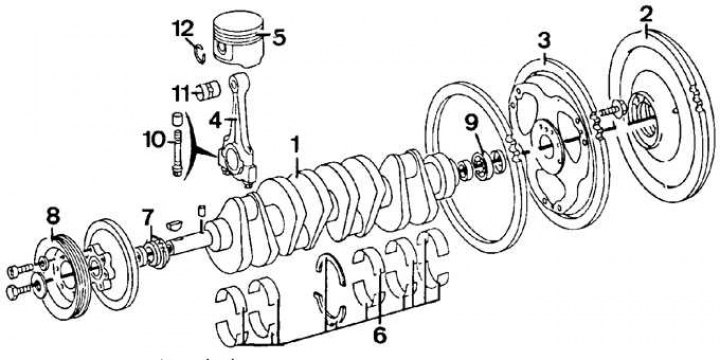
1 – crankshaft; 2 – flywheel (manual transmission); 3 – drive plate (automatic transmission); 4 – connecting rod; 5 – piston; 6 – main bearings and thrust half rings; 7 - asterisk; 8 – pulley; 9 – bearing; 10 – bolt; 11 – piston pin; 12 – retaining ring
Crank mechanism of a 4-cylinder diesel engine
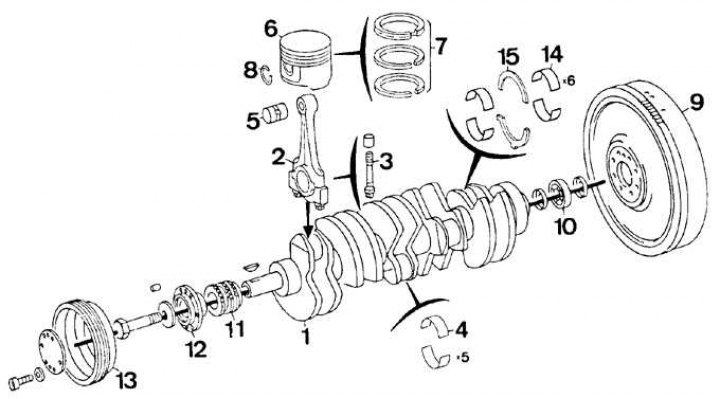
1 – crankshaft; 2 – connecting rod; 3 – bolt; 4 – connecting rod bearings; 5 – piston pin; 6 – piston; 7 – piston rings; 8 – retaining ring; 9 – flywheel; 10 – bearing; 11 – asterisk; 12 – hub; 13 – pulley; 14 – main bearings; 15 – thrust half rings
Location of connecting rod and connecting rod cap markings
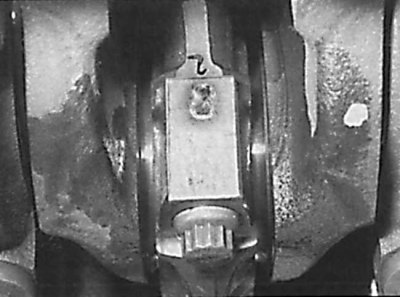
Orientation mark on the piston bottom
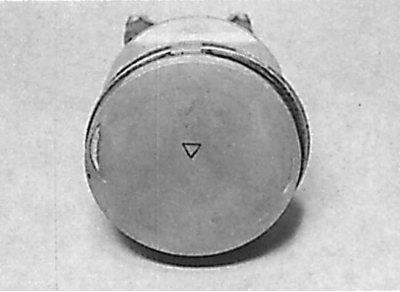
The orientation mark on the piston crown must face the drive chain.
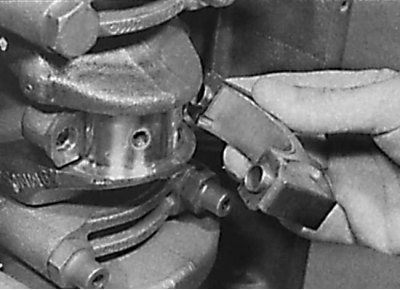
Removal the lower connecting rod cover
1. On 4-cylinder gasoline engines, remove the cylinder head and oil pan.
2. On 6-cylinder SOHC gasoline engines, remove the cylinder head, oil pan and oil pump.
3. On 6-cylinder DOHC gasoline engines, remove the cylinder head, oil pan, oil pump and oil catch plate.
4. On diesel engines, remove the cylinder head, oil pan, oil pump and oil catch plate.
5. On all models, if there is carbon deposits on the top of the cylinder, remove them with a soft scraper. The presence of a step on the top of the cylinder indicates excessive cylinder wear and the need to rebore the engine cylinders.
(Article borrowed from the web portal: www.mercedesman.ru)
6. Check for markings on the connecting rods and connecting rod caps. The markings are located on the intake manifold side (see Fig. Location of connecting rod and lower connecting rod cap markings). If there is no marking, use a hammer and center punch or paint to mark the position of the connecting rod and lower connecting rod cap.
7. Check for orientation marks on the piston crown. The arrow on the piston crown should point in the direction of the drive chain (see fig. Orientation mark on piston bottom). Often the orientation mark is not visible due to the presence of carbon deposits, so the piston bottom must be cleaned beforehand. If there is no orientation mark on the piston bottom, use a scriber to apply it.
8. Turn the engine crankshaft to such a position that pistons 1 and 4 (4-cylinder engines), 1 (5-cylinder engines), or 1 and 6 (6-cylinder engines) were set at bottom dead center.
9. Unscrew the bolts securing the lower connecting rod head cover of the first cylinder and remove the lower connecting rod cover (see fig. Removing the lower connecting rod cover).
10. Using the handle of a hammer, push the piston up the cylinder block and remove it from the cylinder block.
11. Install the connecting rod cap onto the lower connecting rod head and screw it on with bolts, which will keep them together and prevent them from getting mixed up.
12. Remove the piston of the fourth cylinder in the same way (4-cylinder engines) or the piston of the sixth cylinder (six-cylinder engines).
13. Turn the crankshaft to set the remaining pistons to bottom dead center and remove the pistons in the same manner.