



Typical bearing defects
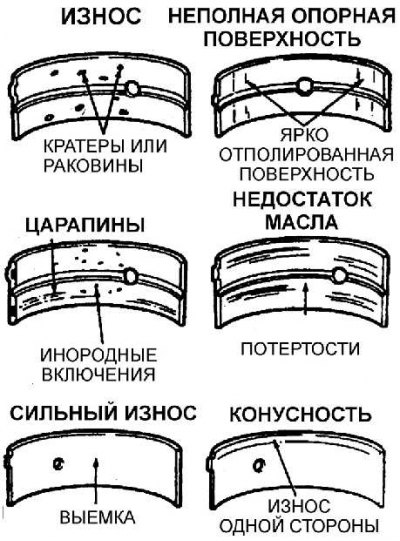
Even though the main and connecting rod bearings are subject to replacement during an engine overhaul, they should be carefully inspected as they can provide valuable information regarding the condition of the engine.
Bearing failure can occur due to lack of lubrication, presence of dirt or other foreign particles, engine overload or corrosion (see fig. Typical bearing defects). Regardless of the cause of bearing failure, the cause that caused the bearing failure must be corrected before the engine is reassembled.
When inspecting the bearings, remove them and arrange them in the same order as they were installed on the engine. This will help identify the corresponding crankshaft journal and make troubleshooting easier.
Foreign particles can enter the engine in a variety of ways. Metal particles can be found in the engine oil as a result of normal engine wear. Small particles can enter the bearings along with the engine oil and easily become embedded in the soft bearing material. Large particles entering the bearing will scratch the bearing or crankshaft journal. The best way to prevent bearing failure for this reason is to thoroughly clean all internal engine surfaces and keep them clean when assembling the engine. Frequent and regular oil changes with filter are also recommended.
Insufficient lubrication of the crankshaft journals can be caused by many different reasons, such as high oil temperatures, engine overload and oil leaks.
The driving style also affects the durability of the bearing. A fully open throttle valve at low engine speeds creates a high load on the bearings and squeezes out the oil film from the contact area. These loads lead to cracks in the working part of the bearing, which weakens the bearing and can lead to the antifriction layer being torn off from the steel base.
Short-distance driving causes bearing corrosion because the engine does not reach a stabilized operating temperature, which removes water vapor and corrosive gases. These vapors and gases condense in the engine oil, forming acid and sediment. The acid gets to the bearings along with the engine oil, and bearing corrosion begins.
Incorrect selection of bearings during engine assembly also leads to bearing failure. Bearings installed with preload leave insufficient bearing operating clearance, resulting in a reduced or absent oil layer for lubrication.
Main bearing cap mounting bolts
Measuring the length of the main bearing cap bolt
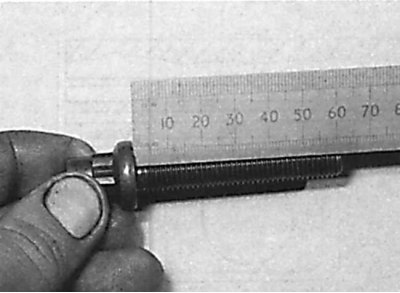
On 6-cylinder DOHC gasoline engines, it is necessary to measure the length of the main bearing cap bolts. On other engines, it is recommended to use new main bearing cap bolts.
1. Measure the length of each bolt from the base of the head to the end of the threaded portion of the bolt (see fig. Measuring the length of the main bearing cap bolt). If the length of even one bolt exceeds the permissible limits, all bolts in the set must be replaced.
Connecting rod bearing cap fastening bolts
Location for measuring the minimum diameter of the connecting rod bearing cap bolt of a 4-cylinder gasoline engine
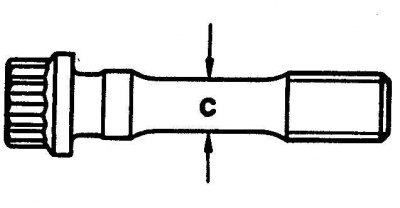
1. Measure the length of the connecting rod bearing cap bolts. However, it is always advisable to replace the bolts with new ones when assembling the engine.
2. Press the bolts out of the connecting rods.
3. On 4-cylinder gasoline engines, measure the bolt diameter at its narrowest point (see fig. Location of measurement of the minimum diameter of the connecting rod bearing cap mounting bolt of a 4-cylinder gasoline engine). If the bolt diameter is less than the permitted value, replace the bolts as a set.
4. On other engines, measure the length of the bolt from the base of the head to the end of the threaded portion. If the bolt length exceeds the permissible limits, the bolts must be replaced as a set.