



Examination
1. Even if you decide to replace the main and connecting rod bearing shells, you need to inspect them very carefully, since they can say a lot about the general condition of the engine.
2. Bearing failure occurs due to insufficient lubrication, dirt ingress, engine overload and corrosion (see fig. 16.2). The causes of bearing failure must be identified and corrected before engine assembly to prevent recurrence.
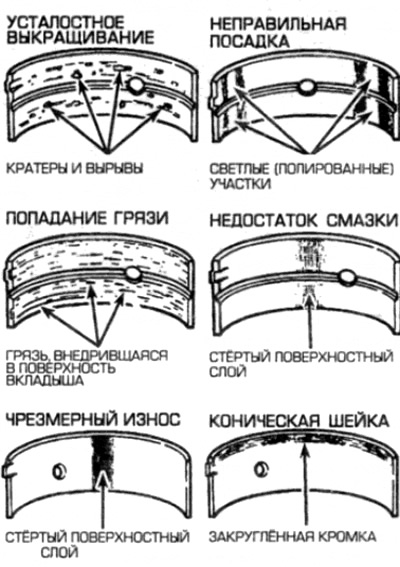
Fig. 16.2. Typical bearing defects
3. To inspect the bearing shells, they must be removed from the cylinder block seats and the lower connecting rod heads, then laid out on a clean surface in the order in which they are installed in the engine. This will allow you to match the defects of the shells with the corresponding journals. Do not touch the working surfaces of the shells with your hands during inspection - they can be easily scratched.
4. Dirt and other foreign matter can get into the engine in different ways. They could have been left in the engine during its previous assembly, they can get through the filter or through the crankcase ventilation system. They can get into the oil, and along with it - into the bearings. The oil may contain metal particles from mechanical processing of the engine, as well as from natural wear of the engine during its operation. Sometimes the oil may contain abrasive left after repairs, especially if the engine was not thoroughly washed afterwards. Regardless of their origin, such particles can penetrate the soft surface of the liner and can be easily detected. Large particles do not penetrate the bearing, but can leave scratches on it and on the shaft journal. The best way to avoid these troubles is to thoroughly wash all engine parts before assembly and maintain cleanliness during the assembly process. It is also recommended to change the oil filter regularly and often.
5. Insufficient lubrication or loss of oil supply also has several causes. Engine overheating (it leads to a decrease in the thickness of the oil film), overload (which squeezes oil out of the gap in the bearing) and oil leaks (due to excessively large clearances, wear of the oil pump or high engine speed) — all this leads to deterioration of lubrication. Blocking of oil holes due to incorrect arrangement of liners during assembly can also leave the bearing without lubrication and lead to its destruction. With insufficient lubrication, the material of the liner can be worn out or smeared from the surface of the steel base. The temperature in the bearing can increase to a level where the color of the steel base of the liner turns blue.
6. The life of bearings is also affected by the driving characteristics of the car. Full opening of the throttle valve at low engine speeds creates high loads on the bearings, from which the oil film is squeezed out. Such loads can cause the surface layer of the liner to flow, forming small cracks (fatigue failure). Gradually, the liner material may fall apart and come off the steel base.
7. Short distance driving can cause bearing corrosion because the engine does not warm up enough to evaporate water condensation and remove corrosive gases. These products collect in the oil, forming acid and sediment. The acid then gets into the bearings along with the oil and causes their corrosion.
8. Incorrect installation of liners during engine assembly also leads to bearing failure. Overtightening of the bearing leads to a decrease in clearance and oil starvation. Dirt and foreign inclusions are captured by the bearing's oil wedge, accumulate on its surface in the form of large spots, which eventually lead to damage.
9. Do not touch the working surfaces of the liners during assembly, as this may scratch the surfaces or leave dirt on them.
10. As noted at the beginning of this paragraph, the bearings must definitely be replaced when the engine is overhauled. Not changing them is a bad economy. Refer to paragraph 19 for information on selecting liners.
Main bearing cap bolts
11. Manufacturers have not provided clear recommendations on how to check the main bearing bolts. However, as a precautionary measure, we recommend replacing the bolts on all engines, although the final decision is made by the individual owner.
Connecting rod bearing cap bolts
12. The manufacturer recommends measuring the connecting rod bearing cap bolts to determine if the bolts need to be replaced. However, some owners will want to replace the bolts regardless of their condition. It is strongly recommended that all bolts be replaced as a set.
13. Press or knock out the bolts from the connecting rods.
14. On 4-cylinder engines, measure the diameter of the bolts at their narrowest point (see fig. 16.14). If the diameter is less than required by technical data, replace the bolts.
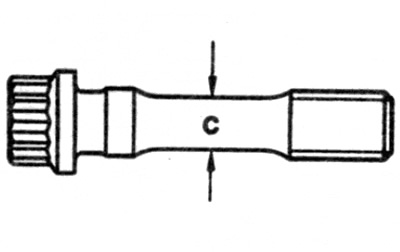
Fig. 16.14. Measure the diameter of the connecting rod bearing cap bolt at its narrowest point (c) - 4-cylinder engines
15. On all engines except 4-cylinder gasoline engines, measure the length of each bolt from the base of the head to the end of the rod. If the bolt length is greater than the maximum allowable, the bolts must be replaced.