
Cars BMW Cars Volkswagen Cars Chevrolet Cars Land Rover Cars Lada Cars Honda Cars Peugeot
English Русский
Български
Беларускі
Український
Српски
Hrvatski
Română
Polski
Slovenský
Magyar
Bookmark News and articles Sitemap Feedback Site search
MercedesMan.ru


A-Class C-Class E-Class G-Class M-Class S-Class Others
190 (W201) (1982-1993) W202 (1993-2000) W203 (2000-2007)
  • Main
  • C-Class
  • W201 (1982-1993)
  • Power unit
  • Engine overhaul
  • Crankshaft — Checking the condition

Crankshaft — Checking the condition (Mercedes-Benz C-Class W201)

0
Contents: Checking the axial play of the…↡ Checking the status ↡

Checking the axial play of the crankshaft


1. When checking the axial play of the crankshaft, the latter must be installed in the cylinder block, but at the same time be able to move freely (see paragraph 12).

2. Measure the axial play using a dial indicator, the tip of which rests against the end of the crankshaft. Move the crankshaft to the stop in one direction and set the device to zero. Move the crankshaft in the opposite direction and determine the value of the axial displacement. The result must be compared with the permissible value given in the technical data. Based on the comparison, it is possible to determine the need to replace the thrust washers (see fig. 15.2). Please note that all thrust washers must be the same thickness - refer to the Technical Data section to determine which washers are available.
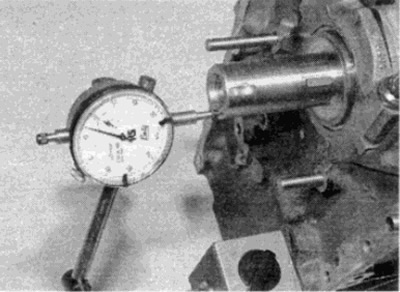
Fig. 15.2. Checking the axial play of the crankshaft using a dial indicator

Fig. 15.2. Checking the axial play of the crankshaft using a dial indicator


3. If you do not have a device, you can use flat feeler gauges. Move the crankshaft as far as it will go towards the flywheel/drive faceplate and use a feeler gauge to determine the clearance between the thrust washer and the crankpin cheek #3 of the crankshaft connecting rod journal on 4-cylinder engines, between cheek #4 and the thrust half ring on 5-cylinder engines, and between cheek #5 of the crankpin and the thrust half ring on 6-cylinder engines (see fig. 15.3).
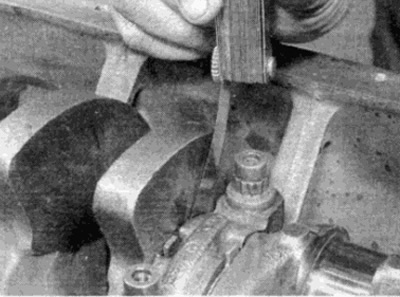


Fig. 15.3. Checking the crankshaft play using a flat feeler gauge

Fig. 15.3. Checking the crankshaft play using a flat feeler gauge


Checking the status


4. Wash the crankshaft with kerosene or other suitable solvent and dry it well, preferably with compressed air. Pay special attention to ensure that all oil holes are well cleaned.

Warning: Protect your eyes when using compressed air!


5. Carefully inspect the main and connecting rod journals and make sure that there are no visible signs of wear, scoring, pitting or cracks.

6. Wear of the connecting rod journals is the cause of a noticeable metallic knock during engine operation, especially noticeable when accelerating from low speed, as well as a slight decrease in pressure in the lubrication system.

7. Wear of the main journals causes strong vibration of the engine, turning into a roar when the engine accelerates, and again, a decrease in pressure in the lubrication system.

8. Check for unevenness on the journal surfaces by running your finger over them without pressing. If there are large unevennesses and wear on the crankshaft journals, they must be ground down, if this is still possible, or the entire shaft must be replaced.


9. If the crankshaft has been ground, check for burrs around the crankshaft oil holes (usually oil holes have a chamfer, and if the grinding was done properly, there are no problems with burrs). Remove all burrs with fine sandpaper or a scraper and thoroughly clean the oil holes as described earlier.

10. Using a micrometer, measure the diameters of the main and connecting rod journals (see fig. 15.10) and compare the measurement results with the "Technical Data". By measuring the journal diameter at several points around the circumference, you can determine its ovality. To determine the taper of the journal, measure its diameters at the opposite cheeks. Compare the measurement results with the "Technical Data". If there is no data on the wear of the shaft journals in the "Technical Data" section, consult an engine repair specialist.
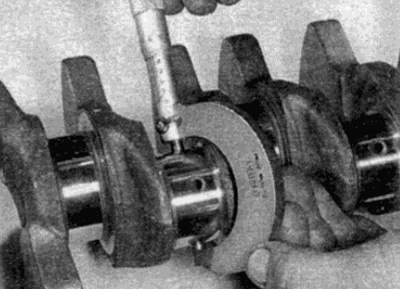
Fig. 15.10. Measure the crankshaft journal diameters with a micrometer

Fig. 15.10. Measure the crankshaft journal diameters with a micrometer


11. Check for wear or damage where the crankshaft contacts the sealing cups. If any of the cups have worn a deep groove in the journal, consult an engine repair specialist: is it possible to restore the shaft or does it need to be replaced.

12. On some models, if the crankshaft has not been ground, it is possible to restore the crankshaft and install oversize bearings (see paragraph 19). If there are no repair size liners and the crankshaft wear exceeds the limit set by the technical data, the only option left is to replace the shaft. Consult with specialists about what parts are currently available.
This article is available at: russian, bulgarian, belarusian, ukrainian, serbian, croatian, romanian, polish, slovak, hungarian
The article has been verified: Lukyanov Nikita Ilyich
Share with friends:
◀ Previous
C-Class 190 (W201) / Engine overhaul
Next ▶

Pistons and connecting rods — condition check
Cylinder Block/Crankcase — Cleaning and Inspection
Crankshaft — Removal
Pistons and connecting rods — removal
Cylinder head — assembly
Main, connecting rod bearings and bearing cap mounting bolts — inspection and defect detection
Engine Repair — Assembly Procedure
Piston rings — installation
Crankshaft — installation and checking of clearance in main bearings
Pistons and connecting rods — installation and checking clearance in the lower head bearings of the connecting rods
More similar articles for repairing other models

☛ V-belt — checking condition Mercedes W168 (1997-2004)
☛ Checking the condition of the rear wheel drive shaft mudguards Mercedes W210 (1996-2002)
☛ Checking the condition of tires and their pressure, designating tires… Mercedes W463 (1999-2019)
☛ Checking the condition of tires and their pressure, designating tires… Mercedes W163 (1997-2005)
☛ Checking the condition of the crankshaft Mercedes W140 (1991-1998)
☛ Checking the crankshaft Mercedes Sprinter (1995-2000, diesel)
Link in different formats to this article
Comments and feedback from visitors
No comments yet


How much will 47 + 46 ?


W203 (2000-2007) 
  • General information
  • Introduction to guide
  • User manual
  • Maintenance
  • Power unit
  • Gasoline engines
  • Diesel engines
  • Cooling system
  • Ventilation and heating
  • Supply system
  • Injection system (gasoline)
  • Injection system (diesel)
  • Exhaust system
  • Ignition and control system
  • Charge and launch systems
  • Transmission
  • Mechanical gearbox
  • Automatic gearbox
  • Clutch and drive shafts
  • Differential
  • Chassis
  • Brake system
  • Car suspension
  • Steering
  • Body
  • Exterior (external elements)
  • Interior (internal elements)
  • Electrical equipment
  • Equipment and devices
  • Lighting system
  • Electrical diagrams (2000)
  • Electrical diagrams (since 2001)
W202 (1993-2000) 
  • General information
  • User manual
  • Driving a car
  • Car care
  • Maintenance
  • Power unit
  • Gasoline engines
  • Diesel engines
  • Lubrication system
  • Cooling system
  • Heating and ventilation
  • Ignition system
  • Fuel system
  • Injection system (gasoline)
  • Injection system (diesel)
  • Exhaust system
  • Transmission
  • Clutch
  • Car gearbox
  • Chassis
  • Suspension, wheels and tires
  • Steering
  • Brake system
  • Body
  • Exterior (external elements)
  • Interior (internal elements)
  • Doors and windows
  • Electrical equipment
  • Equipment and devices
  • Power devices
  • Lighting system
  • Electrical circuits
190 (W201) (1982-1993) 
  • General information
  • Introduction to the guide
  • Operation and care
  • Maintenance (gasoline)
  • Maintenance (diesel)
  • Troubleshooting
  • Power unit
  • Petrol engine I4
  • Petrol engine V6
  • Diesel engines
  • Engine overhaul
  • Cooling and heating
  • Power system (carburetor)
  • Injection system (gasoline)
  • Injection system (diesel)
  • Exhaust system
  • Charge and start system
  • Ignition system (I4)
  • Ignition system (V6)
  • Diesel heating system
  • Transmission
  • Clutch
  • Mechanical gearbox
  • Automatic gearbox
  • Cardan shaft and axle shafts
  • Chassis
  • Brake system
  • Car suspension
  • Steering
  • Body
  • Exterior (external elements)
  • Interior (internal elements)
  • Doors, locks and windows
  • Electrical equipment
  • Equipment and devices
  • Electrical circuits
 
MercedesMan.ru © 2017–2026 · Mobile version · Read about Mercedes · Sitemap: EN BG BY UA RS HR RO PL SK HU · Feedback · Site search · Bookmark A-Class (W168) · C-Class (W201) · C-Class (W202) · C-Class (W203) · E-Class (W123) · E-Class (W124) · E-Class (W210) · G-Class (W463) · M-Class (W163) · S-Class (W116, petrol) · S-Class (W126, petrol) · S-Class (W140) · S-Class (W220) · Sprinter · Vito 1 · Vito 2 · Vario 814D ·
 
We only use cookies without which some of the site's features may not be available.