



Contents: Finding Oil Leaks ↡ Cooling system - check ↡
A visual inspection of the condition of the following pipelines, hoses, and their connections should be carried out to ensure that they are tight, free of chafing, porosity, and fragility:
- a) fuel hoses;
- b) cooling system hoses;
- c) brake hoses;
- d) power steering pipelines;
- d) air conditioning pipelines.
Finding Oil Leaks
If oil consumption is increased, all possible leakage areas should be checked. To do this:
1. Unscrew the oil filler cap and check the condition of its gasket for damage and porosity.
2. Vehicles with diesel engine: Check the fastening of the return oil hose between the cylinder block and the oil separator.
3. Check the cylinder head cover gasket.
4. Check the cylinder head gasket.
5. Check the oil filter gasket.
6. Check the gasket on the threaded plug of the engine oil drain hole.
7. Check the oil pan gasket.
8. Check the tightness of the joint between the engine and gearbox (flywheel or gearbox shaft seal).
Since oil usually spreads over a large area on the engine surface when there is a leak, it can be difficult to determine the location of the leak at first glance. The following search method is recommended:
9. Wash the engine. To do this, spray the engine with an aerosol cleaner and, after letting it work, rinse with water. If the engine is sprayed with a cleaning agent from under the car, then cover the generator with a plastic bag.
Attention! Engine washing should only be performed at self-service car washes equipped with an oil separator.
10. Sprinkle the outside of the engine connecting joints and their gaskets with lime or talc.
Note: In specialized workshops, a special spray is used to detect oil leaks.
11. Check the oil level again and top up if necessary.
12. Take a test drive. Since the oil liquefies when the engine is hot and therefore leaks more quickly, it is best to take this drive on a highway, covering a distance of about 30 km.
13. Inspect the engine after the test drive, using a flashlight to illuminate it, identify leaks and correct any faults.
Cooling system - check
14. Check the cooling system hoses for porosity by squeezing and bending them. Replace any hardened or swollen hoses. The hoses should not sit too shallowly on the connecting fittings.
15. Check the strength of the hose clamps. If necessary, replace the old clamps with new ones.
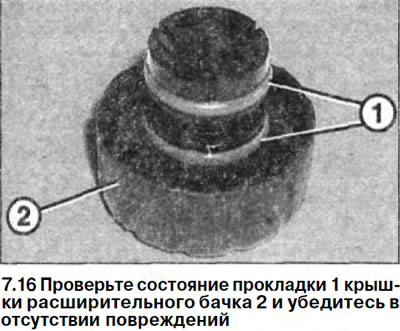
16. Check the condition of the gasket 1 of the expansion tank cap 2 and make sure there is no damage (see illustration).
Attention! The reason for the drop in the coolant level may be an incorrectly screwed expansion tank cap.
17. Check the coolant itself and make sure that no oil has entered the cooling system and the liquid is not contaminated. Noticeable loss of coolant and/or the presence of oil in it, as well as white clouds of exhaust gases when the engine is warm, indicate a defect in the cylinder head gasket.
Attention! It is sometimes difficult to find the leak location. In this case, you should contact a workshop, which has a special device for this purpose, with the help of which the cooling system is tested under pressure. In this case, you can also check the pressure reducing valve on the expansion tank cap.