



Precautionary measures
If the prescribed procedure is not followed, there is a risk of burns from acid released from the battery. In addition, there is a risk of injury and damage if the battery explodes. Damage to the electrical equipment of the car is also possible.
- Avoid contact with eyes, skin, clothing and vehicle bodywork. It is corrosive. If electrolyte gets into contact with your eyes, skin, clothing or vehicle bodywork, rinse it with clean water and seek medical attention if necessary.
- Do not allow sparks or open flames near the battery.
- Use protective glasses.
- Protect the jumper battery cable from damage by rotating parts such as radiator fan blades.
The cross-section of the cable to facilitate starting of an internal combustion engine with a volume of up to 2.5 l must be at least 16 mm² (diameter about 5 mm).
For diesel engines and internal combustion engines with a displacement of over 2.5 litres, the cross-section must be at least 25 mm².
In this case, you need to focus on a car with a discharged battery. The cross-section of the wires is usually indicated on the packaging of the jump starter cables. Both batteries must have a nominal voltage of 12 volts.
Please note: The battery in A-class vehicles is located in the footwell on the passenger side behind the bulkhead.
A discharged battery can freeze at -10°C. Before connecting the jump starter cable, the frozen battery must be thawed. The discharged battery of the vehicle to be started must be properly connected to the vehicle's electrical system.
1. Check the electrolyte level in the discharged battery. If necessary, add distilled water and screw in the plugs.
2. Place the cars in such a way that their metal parts do not touch each other, otherwise a current may occur when the positive poles are connected.
3. Apply the parking brake on both vehicles. Set the manual transmission to neutral and the automatic transmission to "P" ="Park".
4. Turn off all electrical consumers, including the phone in the car.
5. Start and let the engine of the supply vehicle idle. This prevents damage to the vehicle's alternator due to voltage spikes when starting the second vehicle.
6. Open the positive battery terminal cover, if applicable.
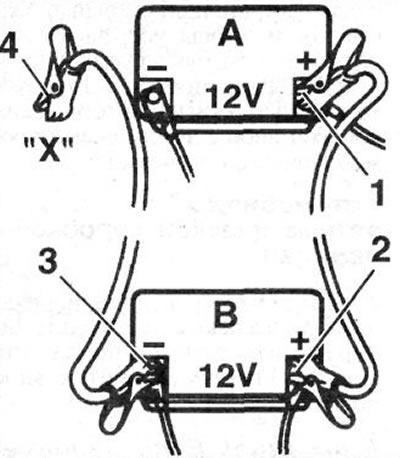
2.7 The order of connecting the wires for facilitating engine starting
1 - positive (+) pole terminal of the receiving battery A
2 - positive (+) pole terminal of the power battery B
3 - negative (-) pole terminal of the power supply battery B
4 - ground point (-) X on the receiving vehicle
7. Connect the starting aid wires in the following sequence (see illustration):
- connect red wire 1 to the positive pole of the discharged battery A;
- connect the other end of red wire 2 to the positive terminal of the supply battery B;
- connect black wire 3 to the negative pole (-) of the power battery B;
- connect the other end of black wire 4 to a reliable ground X on the receiving vehicle.
[Text republished from the website: MercedesMan]
Caution: Do not connect the cable to the negative terminal of a discharged battery.
The best way to do this is with a metal part that is firmly screwed to the power unit.
When connecting a wire to the negative terminal of a discharged battery, under unfavorable conditions it may explode due to sparking and the formation of detonating gas.
Caution! The terminals of the connected jump starter cables must not contact each other. The terminals of the cables from the positive battery terminal must not touch any metal parts (body or frame), forming a short circuit to ground (-).
8. Start the engine of the car with a discharged battery and let it idle. When starting, operate the starter continuously for no more than 10 seconds, since the terminals and wires heat up due to high current consumption. Therefore, it is necessary to provide "cooling" pauses lasting at least half a minute.
If the engine starts with difficulty, do not use the starter for a long time unless necessary. When starting, fuel is constantly injected into the system. It is better to establish the cause of the difficult start.
After successfully starting the engine of a car with a discharged battery, leave the engine running at idle speed and do not remove the "electric bridge" for at least 3 minutes.
To avoid voltage spikes when disconnecting auxiliary wires, turn on the interior air conditioning and rear window heating on a vehicle with a discharged battery. Do not turn on the headlights, otherwise the bulbs will burn out.
9. Disconnect the auxiliary wires after starting the engine in the reverse order of connection. First, disconnect the black wire (-) 4 from the receiving vehicle, and then from the power supply.
The red (+) wire is first disconnected from the supply battery and then from the receiving battery (see illustration 2.7).