



Contents: Towing rules ↡ Cars with automatic transmission ↡ Attaching a rope or towing bar to…↡ Towing cars with automatic…↡ Towing for the purpose of starting…↡
The towing rope should only be attached to the installed towing hooks.
Towing rules
1. Turn on the ignition on the towed vehicle. This is necessary so that the steering, turn signals and brake lights function. It should be borne in mind that when the engine is not running, the power steering and brake drives do not work.
Accordingly, more force will need to be applied when braking and steering, and the braking distance in this case may be longer than usual.
2. Set the gear shift lever to neutral position, in a car with an automatic transmission - to position "N".
3. Turn on the warning lights on both the towing and towed vehicles.
It is recommended to use a towing bar. Its use eliminates the risk of collision between the towing and towed vehicles.
The towing rope must be flexible enough to protect both the towed and towing vehicle from damage. Use only a rope made of synthetic fibers or with elastic intermediate links.
Cars with automatic transmission
4. Turn on the ignition by turning the key in the lock to position 2 and move the gearshift lever to neutral.
Attention! If the voltage in the on-board network is less than 7 V, the clutch does not engage and the gears do not change. In this case, a new fully charged battery should be installed.
Attaching a rope or towing bar to the hooks
5. Cars produced before 2/01 The front towing hook 3 is covered by a cover 1 on the bumper. Press the cover fastening at the top (see arrows in the illustration) and open it.
Original material on the website MercedesMan
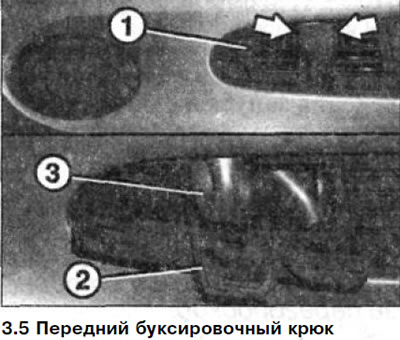
When installing, secure cover 2 at the bottom, close and lock it by pressing on it.
6. Classic cars from 01/03 onwards. Press the cover from the top right. The cover will release and can be removed.
7. Long wheelbase vehicles: Reach into the opening on the right side of the bumper and remove the latch located on the left side of the opening.
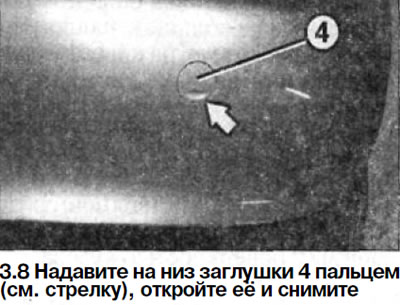
The hole for attaching the towing hook at the rear is located under the rear bumper on the right side and is covered with a decorative plug.
8. Press the bottom of the plug with your 4th finger (see arrow in illustration), open it and remove it.
9. Screw in the towing hook, which is included in the on-board tool kit.
Towing cars with automatic transmission
10. Move the gearshift lever to the "N" position.
The maximum permissible towing speed is 50 km/h.
The maximum permissible towing distance is 50 km.
If the gearbox is faulty or if the vehicle is being moved beyond the maximum permitted distance, the vehicle should be towed using the partial loading method (with raised drive wheels), since when the engine is not running, the pump that ensures the circulation of transmission oil does not function, and as a result, the required degree of lubrication of the gearbox is not ensured.
Caution: When towing using the partial loading method, to avoid damage to the transmission, never tow the vehicle with its drive wheels rotating in the opposite direction.
Towing for the purpose of starting the engine of the towed vehicle
Towing a vehicle with an automatic transmission for the purpose of starting the engine is not permitted.
Caution! To avoid damaging the catalytic converter, do not tow or push the vehicle to start the engine when the engine is warm. Use an auxiliary battery to start the engine.
11. Turn on the hazard warning lights.
12. Turn on the ignition, turn the key in the ignition switch to position 2.
13. Cars with manual transmission: Engage 3rd gear, press and hold the clutch pedal.
14. Cars with automatic transmission.
Place the automatic transmission control lever in position N.
15. Proceed to tow or push the vehicle.
16. Release the clutch pedal smoothly when both vehicles begin to move. On a vehicle with an automatic transmission, engage gear.
Once the engine starts, press the clutch pedal and shift out of gear to avoid hitting the towing vehicle.