



Contents: Jacking up ↡ Towing ↡ Towing a damaged vehicle ↡ Models with AT ↡ All models ↡ Towing for the purpose of starting…↡ Models with manual transmission ↡ Models with AT ↡
Jacking up
The car jack is located in an additional compartment under the trunk floor, next to the spare tire.
To move the jack into the working position, remove it from the luggage compartment, push it up and turn the drive handle to the right until it stops.
Before placing the jack in the luggage compartment, bring it to the transport position: turn the stop pin towards the jack support, push the handle up and turn it to the left until it stops.
Attention! The standard jack is intended only for short-term lifting of the car when changing a wheel! Before performing any work under the car, it must be installed on special supports.
The heel of the jack should be placed on a flat and hard surface. If the ground is loose, use a special pad (in winter it is useful to have a piece of wide board in the car).
Park the car on a level, horizontal surface, if possible with a hard surface.
Firmly apply the parking brake.
If equipped, move the AT selector lever to position "P".
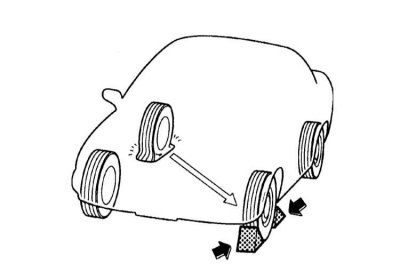
Chock the wheel diagonally opposite the one to be replaced.
Attention! When performing the procedure on a slope, place chocks under both wheels of the second axle on the downhill side.
Remove the necessary tools from the trunk (jack, wheel wrench) and a spare wheel (see Chapter User manual). Assemble the two-section wheel wrench.
If equipped, remove the wheel cover, then loosen the wheel mounting bolts.
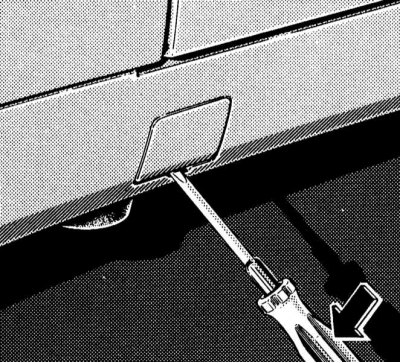
Using a screwdriver, remove the plug of the hole for installing the jack. The holes for installing the jack are located in the body sills behind the front wheel arches and in front of the rear wheel arches.
Rotate the drive crank until the wheel to be replaced is completely lifted off the ground.
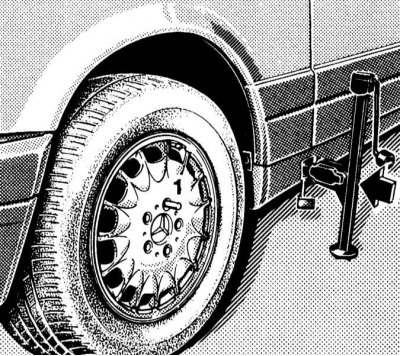
Insert the jack support pin all the way (completely) into the sill receiving hole. Bring the jack to a strictly vertical position (even if the car is parked on a slope).
Remove the top wheel mounting bolt and replace it with the centering pin from the on-board tool kit. Remove the remaining bolts and replace the defective wheel.
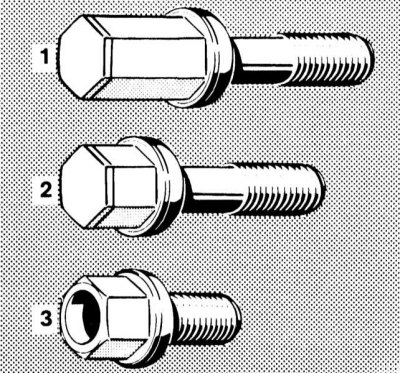
Only original bolts with the Mercedes-Benz logo must be used to secure the wheels
1 - Bolts used to secure 8 Ѕ Jx18 wheels with 5-hole AMG rims
2 - Bolts used to secure 7 Ѕ Jx16 wheels with stamped discs with 5 or 6 holes
3 — Bolts used to secure 7 Ѕ Jx16 wheels with cast disks
Place the broken wheel and tool in their proper places in the trunk of the car.
Towing
Transportation of a damaged vehicle on a tow truck platform.
Towing eyes can be used to load the emergency vehicle onto the tow truck - if equipped, do not forget to move the AT selector lever to the "N" position.
The vehicle is secured only by wheels/disks.
Attention! To avoid damage, do not secure the vehicle by the suspension elements under any circumstances!
Towing a damaged vehicle
Strictly speaking, a damaged vehicle should be towed with the drive (rear) wheels off the ground (even better - on a tow truck platform).
Models with AT
Vehicles equipped with AT can be towed forward on all four wheels at a speed not exceeding 50 km/h and for a distance of not more than 50 km.
Caution: Failure to comply with maximum towing speed or distance may result in transmission damage.
Before towing, check the transmission fluid level (see section Checking ATF level, replacing AT filter Chapters Routine maintenance), - if the ATF level is insufficient, the necessary adjustments should be made, or the vehicle should be towed only with the drive wheels off the ground.
Attention! Towing a vehicle equipped with an AT over long distances, as well as with a failed transmission, should only be done with the drive wheels off the ground, or with the cardan shaft disconnected! Ideally - on a tow truck platform. Perform the following preparatory procedures:
- a) Release the parking brake;
- b) Start the engine;
- c) Move the selector lever to position "D", then to neutral ("N");
- d) Turn off the engine;
- e) Turn the ignition key to position 2 (do not leave it in position 0 under any circumstances);
- f) The "Automatic door locking while driving" function can be switched off.
All models
When towing a damaged vehicle, use only a towing rope specifically designed for this purpose. The use of modern synthetic materials has made it possible to produce elastic towing ropes that minimize the risk of breakage due to the sling getting under the wheels of the towed vehicle.
Attention! The most convenient and safe means of towing a car on wheels is a rigid towing bar.
Towing element (cable/rod) must be attached only to the special towing eye, and never to the bumper or suspension elements.
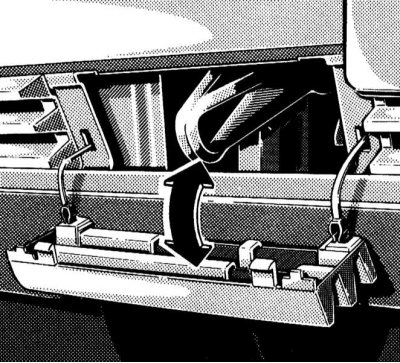
The rear towing eye is located on the right under the bumper, the front towing eye is on the right under the decorative cover. Insert your hand into the groove of the cover and remove the latter, leaving it suspended on the safety straps.
Attention! When installing the decorative cover, make sure that the upper lock is securely latched.
The driver of the towing vehicle should try to move as smoothly as possible, smoothly releasing the clutch when changing gears and, especially, when starting off.
When driving a towed vehicle, make sure that the cable remains taut at all times while driving - when operating the foot brake, try to avoid sudden jerks and running over a loose cable.
Do not forget to turn the ignition key of the towed vehicle to the ON position, otherwise the steering column will inevitably lock. In addition, when the ignition is on, the turn signals and brake lights are also activated.
Warning! Activating the direction indicators while the hazard warning lights are on will temporarily disable the hazard warning lights.
Remember that when the engine is off, the car's braking efficiency is significantly reduced due to the fact that the brake booster stops functioning. In this case, you should press the foot brake pedal with significantly more force than usual. On models equipped with power steering, when maneuvering, you will have to apply more force to the steering wheel.
Before starting to move, drivers of both vehicles (towing and towed) the route should be agreed upon among themselves.
Movement should be carried out only at moderate speeds, along the shortest route and in compliance with traffic regulations. Avoid sudden braking, acceleration and maneuvering. Remember that when towing a car along the edge of a dirt road, there is always a risk of skidding to the side of the road.
Caution! After disconnecting the battery terminals or when the battery is discharged, the electronic key in the ignition switch no longer turns, and the AT selector lever remains locked in the "P" position. (Charging the battery is discussed in Chapter Routine maintenance or Starting the engine with a booster battery - refer to the materials Introduction to the Manual).
Warning! The electronic key can only be turned in the ignition switch when the battery is connected and charged. If the electronic key cannot be turned in the ignition switch, the AT selector lever remains locked in the "P" position.
Caution! When towing with the front axle raised or checking the parking brake on a brake test stand, the engine must be switched off. Otherwise, due to the active braking effect of the electronic skid control (ESP), damage to the rear axle brake system will occur.
Towing for the purpose of starting the engine
Before attempting to start the engine by towing the vehicle, try using an auxiliary power source if possible.
Warning! Try to avoid the situation of locking the keys in the passenger compartment when pushing the car - the door lock actuators are triggered by turning the left front wheel when the key is in position 2.
Models with manual transmission
Towing for the purpose of starting the engine must be carried out with the battery connected and the ignition key turned to position 2.
Push or tow starting should only be done when the engine and catalytic converter are cold. Avoid repeated, lengthy starting attempts.
Models with AT
Starting the engine of AT equipped vehicles by towing or pushing is not possible - if necessary, use an auxiliary power source.