



Contents: Draining engine oil ↡ Replacing the oil filter ↡ Refilling engine oil ↡ Diesel Engine Cars ↡
Required special equipment:
a) if the oil is taken away, then
- oil sampling device;
- oil collection container;
b) if the oil is drained, then
- inspection pit or lift and trestles;
- hAZET 2760-2 overhead wrench for unscrewing the drain plug;
- 27 mm socket head or HAZET 2169-27 head for unscrewing the oil filter cover;
- a container for collecting used oil with a capacity of at least 5 liters.
Materials required:
- approximately 4.5 liters of engine oil. Use only oil approved by Mercedes-Benz;
- oil filter;
- an aluminum sealing ring for the drain plug if the oil is to be drained rather than collected. This sealing ring is sometimes included with the replacement oil filter element.
For better control over the engine's efficiency, when changing the oil, you should fill in the same type of engine oil as the used one, and, if possible, the same brand. To avoid mixing, it is advisable to write down the brand, type and viscosity grade of the oil on a special tag when changing the oil, which should then be attached to the engine.
The indiscriminate use of oils of different types has an adverse effect on the condition of the engine. If possible, do not mix motor oils of the same type but different brands. If necessary, you can safely mix oil of the same brand and type but different viscosity.
Engine oil can be drawn off through the dipstick guide tube or drained through the hole in the oil pan.
In order to collect the oil, a special pump is needed. However, when selecting a pump, it is necessary to make sure that its hose diameter corresponds to the size of the hole in the guide tube of the oil level indicator rod.
Filling volumes when replacing engine oil and oil filter - 4.5 l
Attention! The indicated filling volumes are approximate. It is mandatory to check the oil level after filling with a dipstick or through the display on the instrument panel.
Draining engine oil
1. Warm up the engine to operating temperature. To do this, drive a short distance until the coolant temperature gauge starts showing the engine operating temperature.
Warning!. Jacking up a vehicle is dangerous. Read the relevant instructions in the chapter "Jacking up a car".
2. Jack up the car and place it horizontally on support stands or drive it into an inspection pit.
3. Remove the oil filler cap.
4. Vehicles with diesel engine: Remove the front part of the engine splash guard, see the relevant chapter.
5. Place a container under the engine to collect the used oil.
Caution! Be careful when unscrewing the threaded plug of the engine oil drain hole. Hot oil coming into contact with your skin may cause a burn.
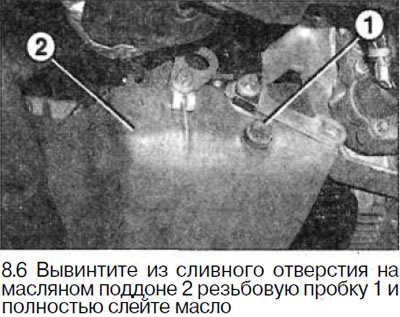
6. Unscrew the threaded plug 1 from the drain hole on the oil pan 2 and drain the oil completely (see illustration).
Caution! If large amounts of metal shavings and metal abrasion products are found in the engine oil, this indicates the presence of scoring, for example, in the crankshaft bearings or connecting rod bearings. To avoid further damage, after repairing the engine, it is necessary to thoroughly clean the oil channels and oil circulation hoses.
Replacing the oil filter
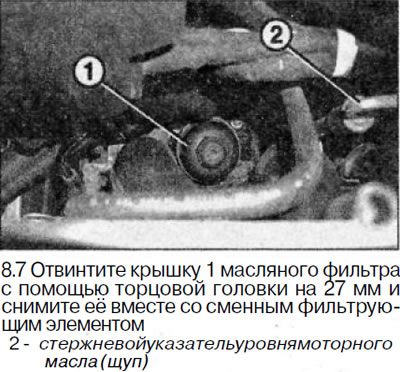
7. Unscrew the oil filter cover 1 using a 27 mm socket head and remove it together with the replaceable filter element (see illustration).
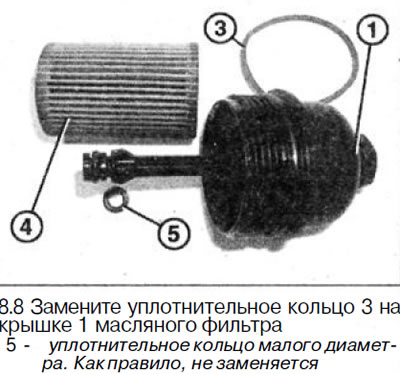
8. Replace sealing ring 3 on cover 1 of the oil filter (see illustration).
9. Attach the new replacement filter element 4 to the lid (see illustration 8.8).
10. Insert the replacement filter element together with the cover into the filter housing and tighten the cover with a force of 25 Nm.
Refilling engine oil
11. Screw in the drain plug, replacing the old sealing ring with a new one. The tightening torque of the plug is 30 Nm.
12. Vehicles with diesel engine: Reinstall the front section of the engine splash guard.
13. Lower the vehicle.
14. Fill with new engine oil through the oil filler neck in the cylinder head cover.
Attention! It is strongly recommended to first fill the oil 0.5 liters less than required. After that, warm up the engine and check the oil level using the dipstick 2 (see illustration 8.18). Add oil if necessary. Excess oil must be removed, otherwise the engine gaskets or catalytic converter may be damaged.
15. Start the engine and let it idle until the engine oil pressure indicator light goes out. Then turn off the engine.
16. Wait two minutes and check the engine oil level using the dipstick. Add oil if necessary.
17. Perform a test drive, and after it is completed, check the tightness of the oil filler cap and oil filter. If necessary, carefully tighten them.
Diesel Engine Cars
When draining engine oil from this engine using the extraction method, the following must be done:
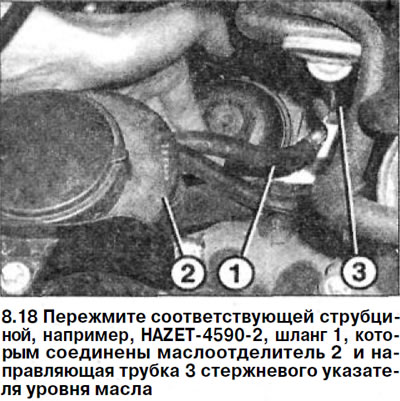
18. Clamp hose 1, which connects oil separator 2 and guide tube 3 of the oil level indicator rod, with a suitable clamp, for example, HAZET-4590-2, before starting to draw off the oil (see illustration).
19. Draw off the oil through the dipstick guide tube.
20. Remove the clamp from the hose.
Caution! Do not forget to remove the clamp before starting the engine. Otherwise, the oil drain into the oil pan will be blocked and the engine will suck oil, contaminating the air mass flow meter.