



- antifreeze;
- distilled water.
Examination
The coolant level should be checked regularly, approximately every 4 weeks and at least before each long trip.
To replenish the coolant, also in the warm season, you should use a mixture of antifreeze and distilled water.
Attention! In emergency situations, especially in summer, clean water can be poured into the cooling system. However, then, at the first opportunity, it is necessary to bring the concentration of antifreeze and anti-corrosion agent in the cooling liquid to the required level.
Caution! If possible, do not use additives, such as anti-corrosion or microleak sealants. Due to the deterioration of heat transfer from the cylinder head to the coolant, vapor locks may form, which in unfavorable conditions can lead to burning of the cylinder head gasket or even to a rupture of the head.
Caution! Do not remove the expansion tank cap when the engine is hot. Risk of burns! Check the coolant level only when the engine is cold and its temperature is approximately +20°C.
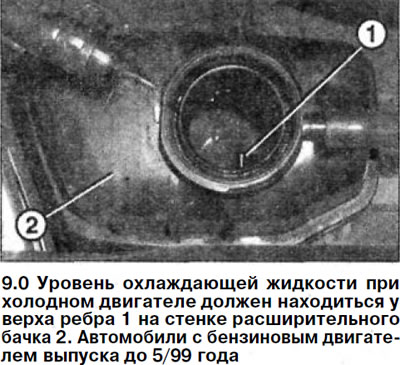
Cars with petrol engines manufactured before 5/99. When the engine is cold, the coolant level should be at the top of rib 1 on the wall of expansion tank 2 (see illustration 9.0). When the engine is warm, the coolant level should be approximately 1 cm above the rib.
Cars with petrol engines produced since 6/99. When the engine is cold, the coolant level should be at the 3 (MIN) mark on the wall of the expansion tank 1 (see illustration 9.0a).
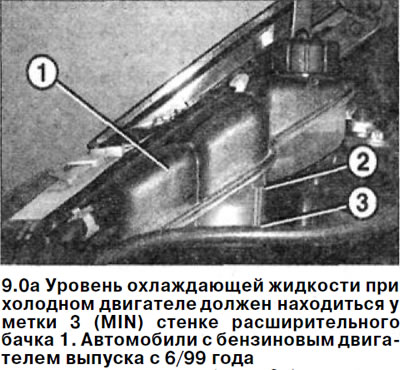
Attention! For cars with diesel engines manufactured since 6/99, the 3/2 (MIN/MAX) marks are stamped on the wall of the expansion tank (see illustration 9.0a).
Warning! Do not mix coolants of different brands and colors. This may cause significant engine damage. If the system is accidentally filled with coolant that does not meet the vehicle manufacturer's requirements, drain it immediately and flush the system with clean water.
If the coolant level has dropped below the MIN mark, fresh fluid should be added to the expansion tank.
Article borrowed from the web portal: Mercedesman.ru
1. Fill with cold coolant only when the engine is cold. Failure to do so may result in engine damage.
2. Loosen the expansion tank cap first by one turn, thereby releasing excess pressure, and only then unscrew it completely and remove it.
Caution: When unscrewing the expansion tank cap on a hot engine, place a thick cloth or rag on the cap.
3. Perform a visual check of the cooling system for leaks if the fluid level drops significantly within a short period of time.