



Tools required:
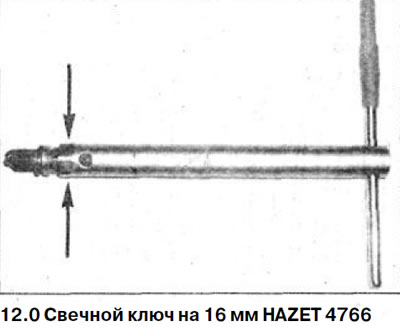
- long spark plug wrench 16mm (for example, HAZET 4766) with an outer tube diameter of 23 mm (see illustration 12.0).
Materials required:
- 4 spark plugs of the following specification.
Attention! Due to constant technical changes, it may turn out that spark plugs with different parameters are required for certain types of engines. To determine the required type of spark plugs, when purchasing them, specialists require the identification number of the vehicle and 3 numbers of the spark plug code. These numbers are indicated in the vehicle registration document. They should be provided when purchasing spark plugs.
Removal
1. Turn off the ignition.
Warning! Do not touch high voltage parts. Persons with a pacemaker are not allowed to work on the electronic ignition system.
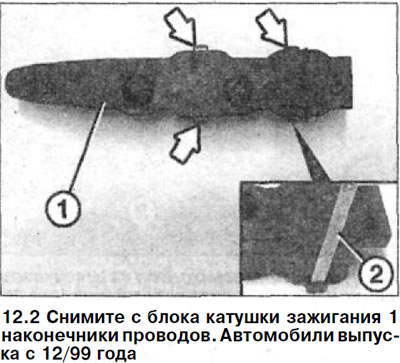
2. Cars manufactured since 12/99. Remove the wire tips from the ignition coil unit 1 by inserting four strips 2, 10 mm wide and 3 mm thick, into the slots provided for this purpose (see arrows in the illustration). Squeeze the strips to release the cover from the mount.
3. Blow out the spark plug seats with compressed air.
4. Disconnect the multi-pin plug 1 of the ignition coil block 5 by pressing the locking tab 2 (see illustration).
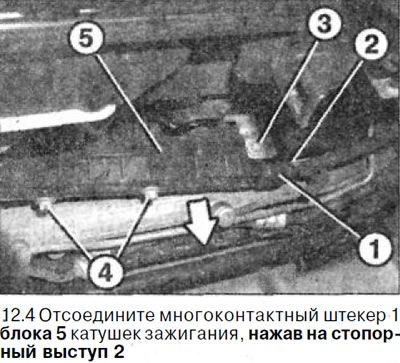
5. Unscrew bolt 3 using the E12 socket wrench with the HAZET 919-10 extension handle, and also bolts 4 using the E12 wrench.
6. Disconnect the 5 ignition coil assembly together with the built-in tips from the spark plugs by moving it in the direction of the arrow (see illustration 12.4).
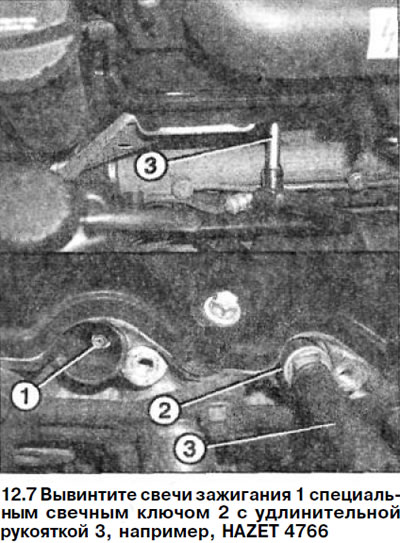
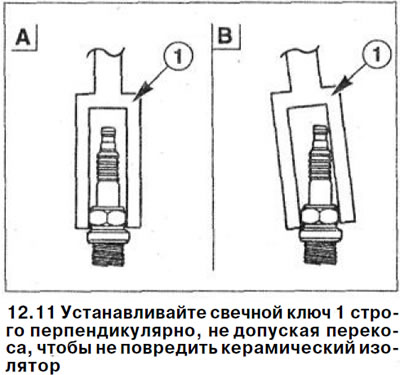
7. Unscrew the spark plugs 1 using a special spark plug wrench 2 with an extension handle 3, for example, HAZET 4766 (see illustration). In this case, the key must be installed on the spark plug perpendicularly, without distortions.
Examination
8. Inspect the removed spark plug. If the spark plug electrodes are covered with oil or wet, then there is a misfire or the piston rings are in poor condition (check the compression by contacting a workshop).
9. Check the gap between the electrodes using a template.
Attention! In new spark plugs, the gap between the electrodes is usually within the norm.
10. Bend the side electrode to adjust the gap. Bend by tapping the side electrode. To bend the side electrode, use a small screwdriver, resting it on the edge of the thread, but under no circumstances on the central electrode, otherwise it may be damaged.

Installation
11. Screw in the spark plugs by hand until they touch the cylinder head, then tighten them to 25 Nm.
Attention! Install spark plug wrench 1 strictly perpendicularly (see illustration, part A), without allowing any distortion to occur, so as not to damage the ceramic insulator.
12. Check the ignition coils by pressing on the spark plug tips with a plastic wedge. The spark plug tips and coil springs must not be damaged or deformed.
13. Replace the spark plug tips and make sure the rubber caps are securely seated on the tips. The caps must not be deformed. If the cap is loose, the spark plug insulator will not be protected from breakdown.
14. Install the ignition coil assembly together with the tips onto the spark plugs and secure the assembly.
15. Connect the multi-pin plug and secure it.
16. Screw in the ignition coil assembly mounting bolts and tighten them to 20 Nm.
17. Secure the coil pack holder with a tightening torque of 8 Nm.
18. Connect and secure the crankcase ventilation hoses.
19. Install the ignition coil block cover and secure it with bolts. Secure the crankcase ventilation hose in the holder.
Spark Plug Socket Thread Renewal
Attention! If it turns out that the thread of the socket on the cylinder head where the spark plug is screwed in is damaged, then this thread must be renewed. BERU offers a suitable set of tools for cutting a new thread. Using a special drill, grind down the damaged thread. The cylinder head does not need to be dismantled for this. Then cut a new thread in the socket and screw in the spark plug together with a special sealing insert. The inserts ensure a secure fit of the spark plugs and the required compression level.