



1. Cool the engine to a temperature that can be tolerated by hand.
2. Remove the air cleaner cross pipe.
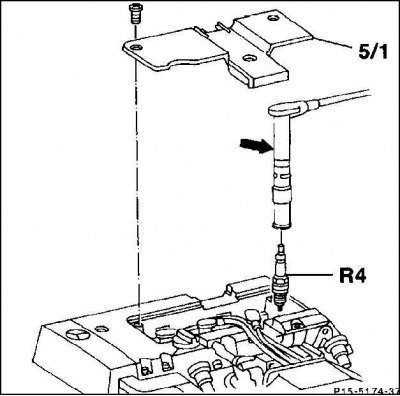
3. 4-cylinder engine: Unscrew the protective cover of the high-voltage wires (5/1) on the cylinder head cover.
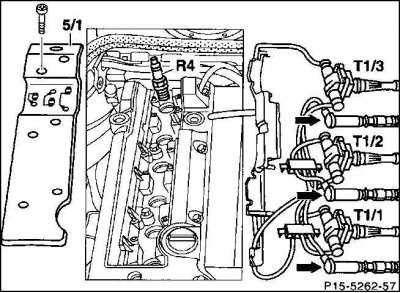
4. 6-cylinder engine: Unscrew the protective cover of the high-tension wires (5/1) on the cylinder head cover. Remove the ignition coils together with the connected control circuit wires and put them aside.
5. Loosen all spark plug boots, then remove them. Be sure to pull on the boots only, not the wires.
6. If possible, carefully blow compressed air into the spark plug wells.
7. Unscrew the spark plugs (R4) using a suitable spark plug wrench or HAZET 2776 wrench and check the appearance of the screw-in part of the spark plug. With some experience, you can draw conclusions about the working condition of the engine. The following rules apply.
Electrodes and insulators:
- medium gray color - normal combustion and normal operation of the spark plug.
- black color - too rich combustible mixture.
- light gray color - too lean combustible mixture.
- purple color - interruptions in the operation of the corresponding spark plug or bad piston ring seals.
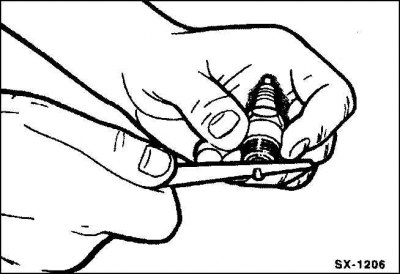
8. Check the gap between the electrodes with a feeler gauge. Specified value: 0.8 mm.
9. To set the gap between the contacts, bend the side electrode. To do this, tap the side electrode from the side. When bending, support the edge of the spark plug thread with a small screwdriver, but never the middle of the electrode, otherwise the electrode may be damaged.
10. Clean the threads on the spark plugs and in the cylinder head.
11. Screw the spark plugs in by hand until they are securely seated on the cylinder head.
Caution! When inserting the spark plugs, do not tilt them. This should be taken into account because the spark plugs of 4-valve engines sit deep in their sockets. For this reason, it is recommended to use the appropriate HAZET 2776 spark plug wrench specifically for Mercedes engines.
12. Tighten the spark plugs securely to 25 Nm.
Caution! Spark plugs that are too tightly tightened may break or damage the threads in the cylinder head when unscrewed. In this case, the threads of the screw-in part of the spark plug can be restored using UTC inserts (or Heli-Coil).
13. Install the spark plug contacts. Alternately move it back and forth to check the tight fit of the spark plug contacts and high-tension wires.
14. 6-cylinder engine: Install the ignition coils together with the wire sockets.
15. Screw the protective covers onto the cylinder head cover. Install the air cleaner cross pipe and secure it with hose clamps.
Coordination with fuel quality
C-class engines generally require unleaded petrol for high-performance engines with an octane rating of 96-98 (according to ROZ 95). If the supply of this fuel is not guaranteed, for example abroad, then it is possible to temporarily refuel with unleaded irregular petrol (according to ROZ 91). The octane number determined by ROZ indicates the detonation resistance of the fuel.
Material based on data from the portal: MERCEDESMAN
In 2.2 and 2.8 litre engines, the knock control system automatically matches the corresponding fuel quality.
For 1.8 and 2.0 litre engines, the adjustment is made by removing the alignment plug. This switches the ignition to a different ignition characteristic. This new ignition characteristic allows the vehicle to be operated with unleaded petrol for vehicles with moderately boosted engines, octane number up to 92 according to ROZ 91.
1. Loosen the plastic screw securing the windshield washer reservoir and lift the reservoir up.
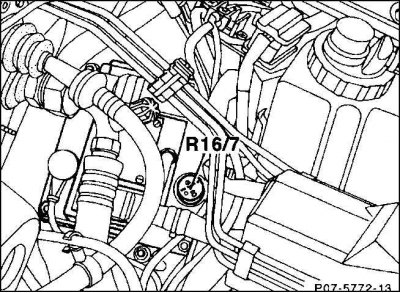
2. Remove the equalizing plug (R16/7) located next to the engine management system (PMS).
3. If high-performance gasoline with an octane rating of 96–98 is used again, fit the equalizing plug.
Warning! Using gasoline for cars with moderately boosted engines can reduce power and increase fuel consumption. Try to avoid full throttle.
Petrol with a higher octane rating, such as "Super Plus" (ROZ 98), can always be used without changing the equalising plug.