



- Brake system. Visually check the tightness and condition of the pipes, hoses, brake cylinders and their connections. Check the brake fluid level.
- Disc brakes. Check the thickness of the brake pads on the front right wheel.
- Brake discs. Check the remaining thickness of the front right wheel brake disc.
- Rear brake drums. Check the thickness of the rear brake pads.
- Parking brake. Check operation.
- Parking brake. Adjust.
- Brake fluid. Replace.
- Tires. Check the tire pressure, including the spare tire.
- Tire sealant "TTREFIT". If it is included in the kit, check the expiration date and renew if necessary.
- Tires. Check the remaining tread depth of the tires, including the spare tire, and the tire pressure. Check the wear and damage of the tires.
Brake lines - check
No special tool is required to perform the test.
Warning: Jacking up or jacking up a vehicle can pose a risk of injury, so please read the safety precautions before attempting to do so.
1. Place the car on jack stands.
2. Clean the brake lines if they are dirty.
[Article was obtained from the portal: mercedesman]
Attention! The brake system pipes are made of metal and are coated with a layer of polymer material to prevent corrosion. If the protective polymer layer is damaged, the pipe may rust. Therefore, cleaning the brake pipes with a metal brush or sandpaper is not allowed.
3 Check the tightness of the brake pipes running from the master cylinder to the ABS hydraulic unit and to the wheel brakes using a flashlight. The master cylinder is located in the engine compartment under the brake fluid expansion tank.
The ABS hydraulic unit is also located in the engine compartment under the brake fluid reservoir.
The brake system pipes must not have any kinks, dents or breaks. They must not have any corrosion pits or worn areas.
Otherwise, such a pipeline should be replaced with a new one up to the next joint. This work should be done in a workshop. Brake hoses connect the pipelines to the wheel brake cylinders and are laid near the moving parts of the car.
They are made of a material that can withstand high pressure, but over time they can become porous, swell, or cut on sharp objects. If at least one of these defects is present, the hose must be replaced.
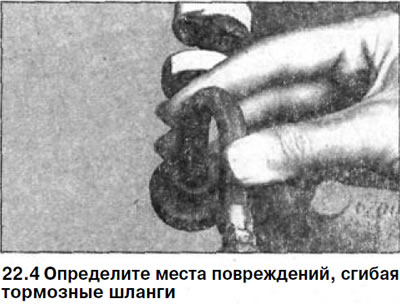
4. Identify the damaged areas by bending the brake hoses (see illustration). When installing, do not allow the hoses to twist and follow the color markings, if any.
5. Turn the steering wheel all the way to the left and then to the right. The brake hoses should not touch other parts of the car in any position of the wheels.
The joints of pipes and hoses should not be wet. The presence of moisture is evidence of a brake fluid leak.
6. Lower the car onto its wheels.