



- a socket wrench for unscrewing the bleed nipple of the brake hydraulic drive;
- transparent hose with an internal diameter of 6 mm;
- brake fluid collection container;
- inspection pit or platform for lifting a car.
Materials required:
- dOT 4 specification brake fluid.
Attention! The use of brake fluid of a different specification is not permitted.
Filling volumes:
- A-class - about 0.60 l
- VANEO (depending on the configuration) approximately 0.76 l or 0.83 l
Caution! Observe safety precautions when working with brake fluid.
Warning! Do not drink used brake fluid or dispose of it with household waste. Brake fluid must be taken to recycling centers.
Brake fluid absorbs moisture from the air through the pores in the brake hoses. Over time, this leads to a decrease in the boiling point of the brake fluid.
In such cases, when the brakes are subject to heavy loads, vapor locks may form in the pipelines, which significantly impairs the functioning of the brake system.
Brake fluid should be replaced every 2 years, preferably in the spring.
If you frequently drive in mountainous areas, or on roads where a sand-salt mixture is used in winter, or if you operate your vehicle in salty sea air, the brake fluid should be replaced at shorter intervals.
In a workshop or service station, bleeding of the brake system is carried out using a special device that pours new fluid into the expansion tank and simultaneously bleeds the brake system.
In this case, the brake pedal is held in the pressed position. It is possible to do without such a device. However, in this case, an assistant is needed who will press the brake pedal.
1. Disconnect the wire from the negative terminal of the battery. The ignition must be off.
Warning! If the radio has a security code, you must check and write down the code before disconnecting the battery.
2. Mark the brake fluid level on the expansion tank with a felt-tip pen. When replacing the fluid, fill the tank up to this mark. This will prevent the fluid from splashing out through the filler neck of the expansion tank when replacing the brake pads.
3. Remove the cap from the expansion tank. Before removing, wipe the cap with a clean rag.
4. Remove the brake fluid from the expansion tank, leaving a layer of liquid approximately 10 mm thick.
Caution! Do not remove all the brake fluid from the expansion tank, because this will allow air to enter the brake system. If one of the expansion tank chambers is empty, you should pour brake fluid into the expansion tank and remove air from the brake system. However, in this case, air removal should be carried out in a specialized workshop, and not independently.
5. Pour fresh fluid into the expansion tank up to the MAX mark.
Warning! Jacking up or jacking up a vehicle can be dangerous. It is therefore recommended that you familiarize yourself with the safety precautions outlined in Chapter "Jacking up a car".
6. Place the vehicle horizontally on jack stands.
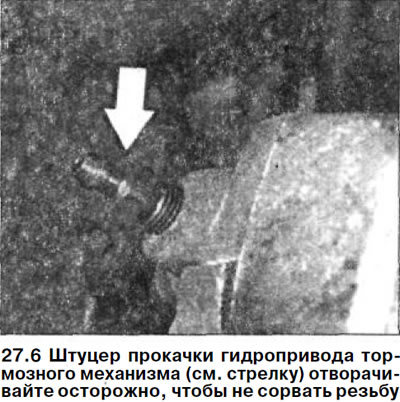
Attention! Bleed nipple of the brake mechanism hydraulic drive (see arrow in illustration) loosen the fittings carefully so as not to strip the threads. It is recommended to lubricate the fittings with a rust converter two hours before this. If you cannot unscrew the fittings, contact a workshop.
Pumping order:
- 1 - rear right wheel brake caliper;
- 2 - rear left wheel brake caliper;
- 3 - Front right wheel brake caliper;
- 4 - Front left wheel brake caliper;
- 5 - clutch cylinder.
7. Attach a suitable spanner to the nipple of the rear right wheel brake cylinder, and then place a clean hose onto the nipple.
8. Place the free end of the hose in a container filled with brake fluid. This container should be approximately 30 cm above the hydraulic drive bleed nipple so that the pressure is equalized and air does not enter the brake system through the nipple mounting thread. The end of the hose should always be in the brake fluid.
9. Ask an assistant to slowly press the brake pedal until resistance is felt.
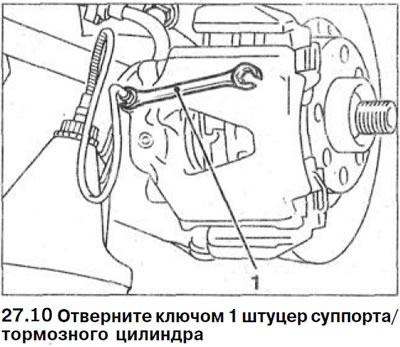
10. Using key 1, with the assistant pressing the brake pedal, unscrew the nipple of the right rear caliper/brake cylinder (see illustration). Tighten the nipple when the pedal reaches the forward extreme position and rests on the floor. Ask an assistant to remove his foot from the brake pedal.
11. Repeat this procedure (about 10 times) until fresh brake fluid without air bubbles flows through the hose on the nipple. Fresh brake fluid differs from used brake fluid by its lighter color.
Caution! The escaping brake fluid must be clear and free of air bubbles. Approximately 80 cm³ of brake fluid should come out of each caliper/wheel brake cylinder.
12. Tighten the nipple with a slight force. For nipples with a circular cross-section sealing ring, the tightening torque is 10 Nm, and without a ring - 7 Nm.
In a similar manner, remove the old brake fluid from the remaining calipers, strictly following the specified order for bleeding the hydraulic drive.
Caution! When removing air, constantly monitor the amount of fluid in the expansion tank and refill it. Do not allow the bottom of the tank to become exposed, otherwise air will enter the brake system again.
13. Lower the car onto its wheels.
14. Add brake fluid to the expansion tank up to the mark made before replacing the fluid.
15. Screw on the expansion tank cap.
16. Check the brakes. With the engine off, the brake pedal should be sufficiently elastic. If necessary, bleed the hydraulic drive again or contact a workshop.
17. Connect the ground (-) wire terminal to the negative battery terminal. The ignition must be off.
18. Enter the access code into the radio and set the clock.
Attention! Conduct a proper inspection of the vehicle and make sure that:
- a) the brake hoses are securely connected;
- b) the brake hoses are secured with clamps;
- c) the bleed nipples of the brake system hydraulic drive are screwed in;
- d) there is a sufficient amount of brake fluid in the expansion tank.
19. Start the engine and check the brake system for leaks.
To do this, press the brake pedal with a force of 200-300 N (20-30 kg) and hold it in this position for about 10 seconds. The brake pedal resistance should not decrease.
Check all connecting joints on the brake system for leaks.
20. Perform a test drive. Slow down several times as you drive. Slow down at least once until the car comes to a complete stop so that the ABS can operate. Perform this braking, for example, on an unpaved road. When the ABS is activated, you will feel a pulsation in the brake pedal.
Attention! When braking, make sure that you do not create a dangerous situation for the vehicle following you.