



Contents: Measuring the tread depth ↡ Tire pressure - check ↡ Tires and wheels - designations ↡ Date of manufacture of tires ↡ Wheel balancing ↡ Wheel replacement/replacement ↡ Removal the wheel ↡ Wheel installation ↡ Anti-skid chains ↡ Some recommendations for tire care ↡ Tire cleaning ↡ Tire storage ↡ Tire running-in ↡ Incorrect tire wear ↡ Tire sealant TIREFIT - checking…↡ Checking the tire valve ↡ Examination ↡
Depending on the model and configuration, MERCEDES A-class vehicles may be equipped with tubeless radial tires and wheels of different sizes. When installing tires or wheels that are not specified in the technical passport, a corresponding entry should be made in the vehicle documents. As a rule, permission from the manufacturer is required for this.
When replacing a disc, you should consider not only its width and diameter, but also the depth of pressing. The depth of pressing is the distance from the center of the disc to the surface where the wheel disc meets the brake disc. All disc wheels are made with an annular protrusion. The annular protrusion is a bead pressed onto the landing shelf, which does not allow the disc to squeeze the tubeless tire even when the car turns very sharply.
Measuring the tread depth
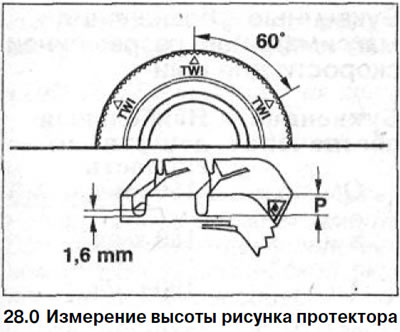
According to existing legislation, the use of tires with a residual tread height of at least 1.6 mm over the entire tread pattern is permitted.
For safety reasons, it is recommended to replace summer tires when the remaining tread height is 2 mm, and winter tires when it is 4 mm.
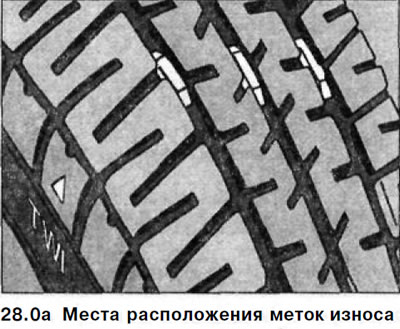
The tread depth should be measured at the points of greatest wear. There are tire wear marks (TWI) at the bottom of the longitudinal grooves of the tread. The locations of the marks are marked on the sidewall of the tire with the letters TWI or triangles (see illustration 28.0a). The height of the wear marks is 1.6 mm. When measuring the remaining tread pattern height, the height of the wear marks is not taken into account.
The determining factor is the height of the pattern P at the point of greatest wear (see illustration 28.0).
Tires on balanced wheels, when the prescribed pressure is maintained in them, the wheel alignment angles are correctly adjusted and the shock absorbers operate flawlessly, wear approximately evenly across the entire tread.
If wear is uneven, see the list of tire faults.
It is not possible to say anything definite about the service life of tires from different manufacturers, since this period depends on various factors, namely:
- road surface;
- tire pressure;
- driving character;
- weather conditions.
Rapid wear of the treads is primarily caused by sporty driving, rapid acceleration and sharp braking.
If the tread depth approaches the legally established minimum residual height of 1.6 mm, the tyre must be replaced.
Please note: M+S tyres are effective in mud and snow conditions only when the minimum remaining tread depth is 4 mm.
Attention! Check the tires for cuts and, if any, use a small screwdriver to determine their depth. If the cuts reach the frame, the steel cord of the tire begins to rust under the influence of penetrating water. Because of this, the tread may peel off from the frame and the tire will break. Therefore, if the tread is cut deeply, the tires must be replaced for safety reasons.
Tire pressure - check
The tire pressure is set by the vehicle manufacturer depending on various parameters. These include the vehicle load and the maximum permissible speed. For MERCEDES A-class vehicles, wheels of different tire and rim diameters are permitted (see table).
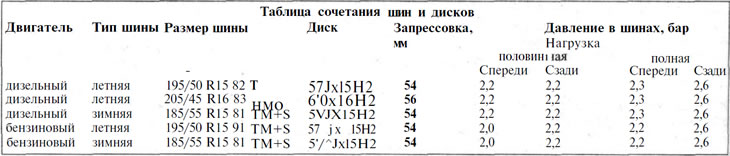
It is important to maintain the correct tire pressure for the correct size. The required tire pressure is indicated on the plate, which is attached to the inside of the fuel tank cap. Maintaining the prescribed tire pressure is of great importance for ensuring driving safety, as well as for the service life of the tires.
For this reason, it is recommended to check the tire pressure at least once a month and before each long trip (including the spare wheel).
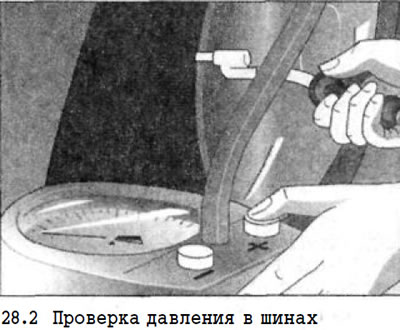
1. Unscrew the protective cap of the tire valve.
2. Check the pressure only when the tires are cold. This means that the maximum time the car is driven before checking the tire pressure should not exceed 5 minutes. Increased tire pressure that occurs as a result of a long trip should not be released.
During continuous driving, the tire pressure increases by approximately 0.2-0.4 bar. Winter tires are usually operated with excess pressure, i.e. approximately 0.2 bar higher than summer tires. It is necessary to observe the values recommended by the winter tire manufacturer.
If winter tyres have a speed limit, the corresponding maximum permissible speed must be indicated on a sticker that must be visible to the driver.
When driving with a trailer, the tire pressure should be adjusted to the values specified in the "Full load" column. The prescribed tire pressure is given in the vehicle's operating instructions. When checking the tire pressure as part of maintenance, the pressure in the spare wheel should also be checked.
3. Screw on the valve cap.
Tires and wheels - designations
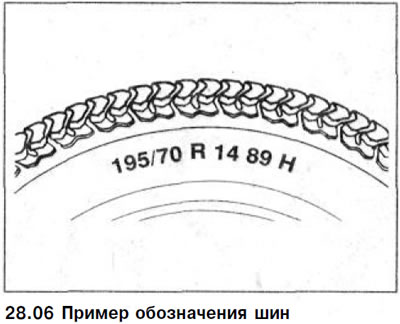
- 195 - tire profile width in mm;
- /70 - height to width ratio (the height of the tire profile is 70% of the width);
If there is no special designation of the profile height, (for example, 155 R13), this means that in this case the usual or "normal" ratio is used. For radial tires it is 82%.
- R - radial tire;
- 14 - landing diameter in inches;
- 89 is a number indicating the permissible load on the tire.
Attention! If there is M + S between the designations 14 and 89, then we are talking about a tire with a winter tread pattern.
- H - letter indicating the maximum permitted speed for these tires (in this case up to 210 km/h).
The letter indicating the maximum permitted speed for these tires comes after the tire size.
The maximum permitted speed designation applies to both summer and winter tyres (see illustration 28.06).
Letter designations of the maximum permitted speed for tires
| Letter designation | Maximum permissible speed |
| Q | 160 km/h |
| S | 180 km/h |
| T | 190 km/h |
| N | 210 km/h |
| V | 240 km/h |
| Z | over 240 km/h |
Attention! If the tire designation is followed by the word "reinforced", then we are talking about tires with a reinforced design.
Date of manufacture of tires
The date of manufacture is indicated on the tire as a manufacturer's code.
Example: DOT CUL2 UM8 5103 TUBELESS
- DOT - Department of Transport (US Department of Transportation).
- CU is an abbreviated designation of the tire manufacturer.
- L2 - tire size.
- VM8 - tire design.
- 5103 - date of issue,
- 51st working week 2003.
Note: If only a 3-digit code followed by an icon is given instead of a 4-digit numeric code, it means that the tire was manufactured in the past decade. For example, the designation 509 stands for the 50th production week of 1909.
- TUBELESS - tubeless tire (TUBETYPE - tube tire).
Attention! Starting from 10/98, new tires must additionally have the EEC control number (Economic Commission for Europe) UN, which is applied to the sidewall of the tire. This number confirms that the tire complies with the ECE standard. If, after 10/98, tires without the EZH control number are installed, the vehicle operating permit is cancelled.
Example of marking on disc wheels: 5½J x 15 H2
- 5½ - rim width in inches;
- J - letter indicating the height and contour of the side (B - low side); x - designation of a solid disk;
- 15 - landing diameter in inches;
- H2 - internal and external profile of the disc with an annular protrusion that prevents the tire from slipping off the disc.
Wheel balancing
Serially produced wheels are balanced at the factory. Balancing is necessary to equalize different weight distributions and material errors. Unbalanced wheels manifest themselves during movement through jolts and shaking. The steering wheel begins to shake at high speed.
Typically, this shaking only occurs within a certain speed range and stops when the speed increases or decreases. Over time, wheel imbalance can cause problems with the suspension, steering, and shock absorbers.
Wheel balancing must be performed after each tire repair because tire wear and repairs cause changes in the weight distribution of the tire material.
Wheel replacement/replacement
Changing the direction of rotation of the tires when replacing wheels is not advisable, since the tires are adjusted to the new direction of rotation only after significant wear. If the front wheels are noticeably more worn, it is recommended to swap them with the rear ones. This ensures approximately equal service life for all four wheels.
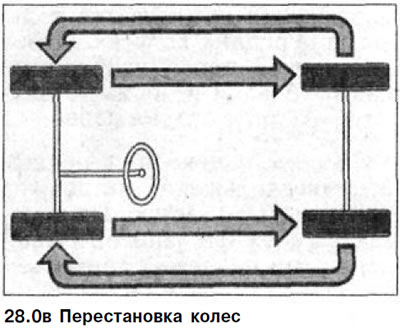
Attention! Do not change tires individually, but at least tires of both wheels of one axle. In this case, tires with a greater residual tread depth should always be installed at the front. Only tires of the same type with the same tread pattern, from the same manufacturer, should be installed on both wheels. Tires that have been manufactured for more than 6 years should be installed only in case of emergency and at the same time exercise extreme caution when driving. When replacing a disk or tire, be sure to also change the valve.
Tyres with a specified direction of rotation, which can be identified by an arrow on the sidewall indicating the direction of travel, must always be installed in the direction of travel (see illustration 28.0g).
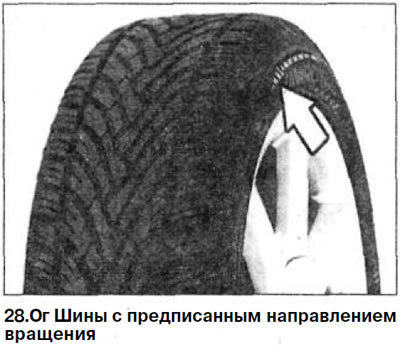
This ensures optimum tyre performance in terms of aquaplaning, road grip, driving noise and wear.
If it is necessary to install a spare wheel with the prescribed direction of rotation instead of a "flat" one, but the prescribed direction will not be maintained, then such a replacement should be temporary. In this case, it is recommended, especially on a wet road, to observe the speed limit.
Removal the wheel
4. Mark the position of the wheel on the hub with paint if the wheel is to be re-installed. Thanks to the marks, the balanced wheel can be installed in its original position.
5. Position the vehicle so that it does not roll away when the wheel is removed. To do this, apply the parking brake and set the gearshift lever to reverse or engage first gear. For vehicles with an automatic transmission, move the gearshift control lever to position P. In addition, place a chock under the wheel located at the opposite end of the diagonal from the wheel being removed.
6. Loosen the wheel bolts of the vehicle while it is parked by 1/2 turn.
7. Jack up the car so that the wheel being removed does not touch the ground or floor.
8. Unscrew the mounting bolts and remove the wheel.
Wheel installation
9. Lubricate the wheel hub centering seat with a thin layer of bearing grease.
10. Clean dirty wheel bolts and bolt hole threads. Do not lubricate wheel bolts.
11. Install the wheel in accordance with the marks made before removal
12. Screw in the wheel mounting bolts and tighten them in a crosswise pattern without applying significant force.
13. Lower the car onto its wheels.
14. Tighten the wheel bolts in a crisscross pattern in several passes. Always use a torque wrench to tighten the wheel bolts. This ensures that the bolts are tightened securely and to the specified torque. The tightening torque for both steel and aluminum wheel bolts is 110 Nm.
15. Secure the wheel cap first near the tire valve, and then press down on the cap until it locks onto the wheel.
Wheel rims and wheel bolts are matched to each other.
If the tires are being remounted on other rims, for example from aluminum rims to steel rims, the wheels must be secured with bolts designed for steel rims and vice versa. The fastening of the wheels and the functioning of the braking system depend on the wheel bolts.
Attention! Wheels made of light metal alloys are covered with a transparent varnish to protect against corrosion. When replacing wheels, do not damage this protective varnish layer. If necessary, paint over the damaged area with transparent varnish.
If, when changing tires, it turns out that the wheel bolts are rusty and difficult to tighten, they should be replaced with new ones as soon as possible. Before replacing such bolts, drive at a medium to moderate speed.
Caution! Unilateral or uneven tightening of wheel bolts may cause the wheel or hub to seize.
After changing tires, be sure to check the pressure and, if necessary, bring it up to normal.
Anti-skid chains
The use of anti-skid chains is permitted only on the front wheels. Before installing the chains, it is necessary to remove the caps and reinstall them after removing the chains.
The speed of movement with anti-skid chains should not exceed 50 km/h. On roads without snow drifts and ice, the chains must be removed.
Some recommendations for tire care
Tires have a kind of "memory", and improper handling of them, and this includes, for example, fast or frequent driving over curbs or rails, often results in their failure. Moreover, this happens only some time later and at the most inopportune moment.
Tire cleaning
Do not wash your tires with a steam jet. If the nozzle of this device is held too close to the tire, its rubber layer is irreversibly destroyed within a few seconds, which cannot be corrected even with cold water.
Tires cleaned in this way must be replaced for safety reasons. Tires that have been in contact with oil or grease for a long time must also be replaced.
In this case, the tire first swells and then takes its normal shape and looks undamaged, but the load-bearing capacity of the tire is reduced.
Tire storage
Tires should be stored in a cool, dark and dry place. They should not come into contact with lubricants, oils or fuel. Store wheels lying down or hanging on rims in the garage or basement. If the tires are not mounted on rims, they should be stored standing up. Increase the tire pressure slightly before removing the wheels (approximately 0.3-0.5 bar). For winter tires, use your own rims, since remounting tires to summer rims is not justified in terms of savings.
Tire running-in
New tires have a particularly smooth surface. This is due to the manufacturing process. For this reason, new tires, including a new spare tire, must be run in.
During the running-in process, as a result of the abrasion that has begun, the smooth surface becomes rough. Before running new tires for the first 300 km, the driver must be especially careful when driving on wet roads.
Incorrect tire wear
First of all, you need to maintain the prescribed pressure in your tires. Moreover, the pressure should be checked at least once every four weeks and without fail - before each long trip.
Check the pressure only when the tires are cold. When driving fast, it increases due to the heating of the tires. However, you should certainly not deflate heated tires. For the front wheels, slightly greater wear of the tread shoulder compared to the wear of its middle part is normal.
Moreover, due to the slope of the road, the shoulder of the tread facing the middle of the road wears out (for the left wheel - the outer shoulder, for the right - the inner shoulder), may be more pronounced.
Uneven tire wear is mostly caused by too little or too much tire pressure. Uneven wear can be caused by improper wheel alignment, poor wheel balancing, and defective shock absorbers and rims.
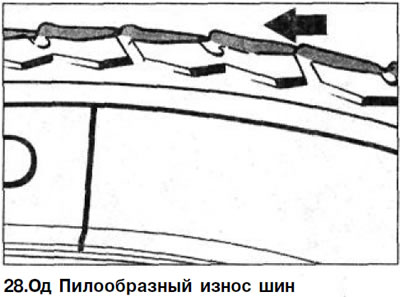
If the pressure is too high, the middle of the tread wears more, because the tread bends under the high internal pressure. If the pressure is too low, the tread shoulder bears more load, and the middle of the tread bends inward, which causes more wear on the tread shoulders. Saw-tooth tread wear is usually caused by overloading the vehicle.
Tire sealant TIREFIT - checking expiration date
Depending on the vehicle's equipment, a can of TIREFIT tire sealant may be installed instead of the spare wheel.
16. Open the boot and remove the boot floor covering for the A-Class. For the VANEO, open cover 1 on the left side of the boot (see illustration).
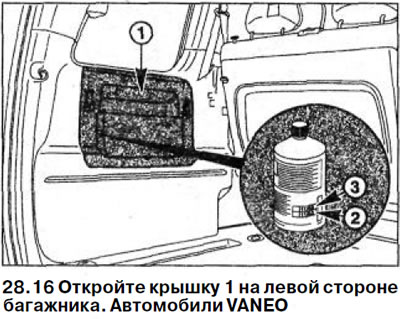
17. Remove the can of sealant and check the expiration date 2 (see illustration 28.16).
The shelf life of the sealant is three years, counting from the production date, which is indicated on the label. If the shelf life has expired, the sealant should be replaced with a new one.
18. Replace the can of sealant, lay the boot floor covering or close the side cover and close the boot.
Checking the tire valve
Special tools required:
- metal valve key cap or HAZET 666-1.
Examination
19. Unscrew the protective cap of the tire valve.
20. Lubricate the valve opening with soapy water or spit on it. If a bubble forms, tighten the valve 3 with the other end of the protective cap 2 (see illustration).
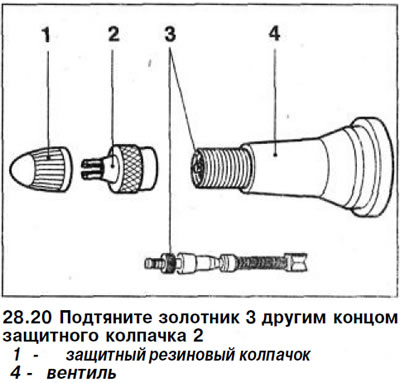
Attention! To tighten the valves, use only metal protective caps 2 valves. Metal protective caps can be purchased at petrol stations. To tighten the valves, you can use the HAZET 666-1 device.
21. Check the valve again. If bubbles still form and the valve no longer tightens, replace it. Have the work done by a workshop.
22. Screw on the protective cap.