



Contents: Necessary tool ↡ Necessary spare parts and consumables ↡ Draining engine oil ↡ Replacing the oil filter ↡ Filling with fresh engine oil ↡
Warning! Prolonged skin contact with used engine oil is quite dangerous. Use a protective cream and wear gloves during this procedure. Change oil-soaked clothing immediately.
Note: Regular and frequent engine oil changes are the most important preventative maintenance procedure available to the amateur mechanic. Over time, oil is susceptible to dilution and contamination, leading to premature engine wear.
1. If necessary, engine oil can be pumped out using a special probe (can usually be borrowed at gas stations) through the guide tube of the measuring probe.
Attention! Never pour used oil down the drain!
2. It is advisable to attach a label to the engine after changing the oil indicating the type of oil added and the date the procedure was performed.
3. Using different types of oils will adversely affect engine performance. Mixing oils of different brands is also not allowed under any circumstances. In some situations (in particular, in the off-season) it is permissible to mix engine oils of different viscosity, provided that they match in type and brand.
Necessary tool
- Inspection pit/overpass/hydraulic lift (if the oil is not pumped out from the top);
- Drain plug remover head;
- Special tool for unscrewing the filter (filter wrench, strap wrench or HAZET 2172 tool);
- Oil collection container (if the oil is not sucked out) with a volume of at least 6 liters.
Necessary spare parts and consumables
- Aluminum or copper sealing washer for drain plug - sometimes supplied with oil filter (if the oil is not pumped out from the top);
- Replacement oil filter;
- The required amount of Mercedes-Benz approved engine oil.
Draining engine oil
Note: Engine oil can also be removed by suction, using a probe, through the dipstick hole.
Material taken from a web resource MercedesMAN
1. Warm up the engine to operating temperature (oil temperature +60°C).
2. Jack up the car and place it horizontally on supports.
3. Place a container under the oil pan to collect the used oil.
4. Remove the drain plug (1) from the oil pan and drain the oil completely. If the drain plug does not fit at the bottom of the engine oil pan, use a special device to pump out the oil.
Caution! If the used oil contains a large amount of metal shavings and wear products, this indicates the presence of scoring, for example, in the crankshaft bearings and connecting rod bearings. To avoid damage after the repair, it is necessary to thoroughly clean the oil channels and hoses. Additionally, it is necessary, if any, to replace the oil radiator.
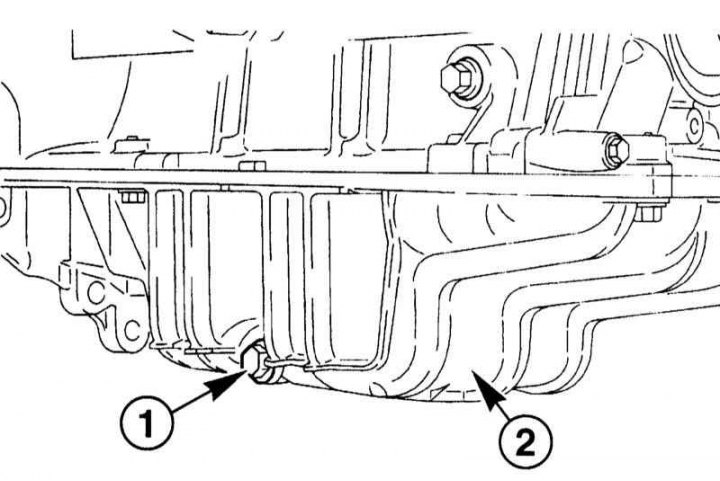
Location of drain plug (1) of oil pan (2)
5. Then screw in the drain plug with a new sealing ring. Do not exceed the tightening torques specified in the Specifications, otherwise this may lead to leakage and damage.
6. Lower the car onto its wheels.
Replacing the oil filter
Note: See also Sections Maintenance of the lubrication system and Maintenance of the lubrication system.
1. To unscrew the oil filter located on top of the engine, use a special socket wrench.
2. Wipe the mounting flange on the engine block with a rag soaked in fuel, then remove all traces of the old gasket material from its surface.
3. Before installation, lubricate the gasket of the replaceable oil filter with a thin layer of engine oil.
4. When installing the replacement filter, tighten it manually until the gasket is pulled to the mounting flange, then another half turn - also read the information provided directly on the filter housing.
5. Make sure the drain plug is tightened to the required torque - do not forget to replace the sealing washer.
Filling with fresh engine oil
Caution! When starting the turbodiesel for the first time after changing the oil, it is necessary to ensure that the engine first runs at idle speed until the oil pressure indicator lamp goes out. Only after reaching the required oil pressure can the gas be increased. If the gas is given when the indicator lamp is lit, the turbocharger may be damaged due to insufficient oil.
1. Oil is added through a special filler neck equipped with a cap in the cylinder head cover.
2. When changing the oil, use new oil of the same type and, if possible, the same brand as that drained from the engine. Use a funnel to minimize splashing. Each time you change the oil, attach a label to the engine indicating the type and brand of oil added, as well as the date the change was made.
3. At the first stage, fill in 0.5 l less oil than indicated in the Specifications, then warm up the engine and, after a few minutes, check the level and, if necessary, make the appropriate adjustment, bringing the level to the MAX mark on the dipstick blade.
Note: Excess oil must be pumped out of the engine to avoid the risk of damage to engine seals and failure of the catalytic converter.
4. After a test drive, check the tightness of the drain plug and oil filter,
5. After 3 minutes from stopping the engine, measure the oil level again and make the appropriate adjustments if necessary.