
Cars BMW Cars Volkswagen Cars Chevrolet Cars Land Rover Cars Lada Cars Honda Cars Peugeot
English Русский
Български
Беларускі
Український
Српски
Hrvatski
Română
Polski
Slovenský
Magyar
Bookmark News and articles Sitemap Feedback Site search
MercedesMan.ru


A-Class C-Class E-Class G-Class M-Class S-Class Others
W463 (1999-2019)
  • Main
  • G-Class
  • W463 (1999-2019)
  • General information
  • Introduction to the guide
  • Starting the engine from an auxiliary power source

Starting the engine from an auxiliary power source (Mercedes-Benz G-Class W463)

0
Using an auxiliary power source will help start the engine in an emergency, but then you should find out and eliminate the cause of the battery discharge. The most common causes include:
  • Making repeated unsuccessful attempts to start the engine, or leaving the lights on for a long time with the engine off;
  • Malfunction of the charging system (the alternator drive belt is loose or broken, the connecting wiring is damaged, or the alternator itself is faulty);
  • Malfunction of the battery itself (the electrolyte level has dropped or the battery's service life has expired).

When performing engine starting from an external power source, attention should be paid to observing some special precautions:
  • Do not attempt to start the engine from a frozen battery - warm it up first;
  • On models with a gasoline engine, starting the engine from an auxiliary power source should only be carried out when the power unit and catalytic converter are cold;
  • Do not use a battery booster charger to jump start the vehicle;
  • Before connecting the auxiliary battery, make sure the ignition is off;
  • Use only cables of sufficient cross-section with insulated terminal clamps;
  • Make sure that all electricity consumers (lighting and heating devices, windshield wipers, etc.) were also turned off;
  • Wear protective gloves and glasses;
  • Make sure that the auxiliary battery matches the voltage output of the battery installed in your vehicle;
  • If a battery installed in another vehicle is used as an auxiliary power source, make sure that the vehicles NEVER come into contact with each other;
  • The engine of the car, from the battery of which the starting is performed, must be running at idle speed;
  • Make sure that the transmission is in neutral (manual transmission) or in position "P" (automatic transmission);
  • Remove the ventilation caps from the discharged battery and cover the holes with a rag.

In the models considered in this Manual, the battery is located in the rear of the car, and the terminals for emergency engine starting are located in the left rear corner of the engine compartment. The positive terminal is equipped with a protective cover (1), which must be removed beforehand - connect the end of the red wire from the special kit to the positive terminal (2), connect its other end to the positive terminal of the auxiliary battery; connect one end of the black wire to the negative terminal of the auxiliary battery, and the other to the negative terminal (3).


On the models in question, the terminals for emergency engine starting from an auxiliary power source are located in the left rear corner of the engine compartment
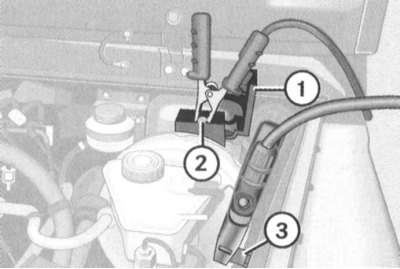
1 - Positive terminal protective cover

1 - Positive terminal protective cover
2 - Positive terminal (+)
3 - Negative terminal (-)


Make sure that the connecting wires do not come into contact with moving components in the engine compartments of both vehicles (fan impeller, drive belts, etc.).

Perform the standard engine starting procedure. Leave the engine running at idle speed. To prevent voltage surges when disconnecting the wiring, turn on the rear window defroster and heater fan, then disconnect the wires in the reverse order of their connection. When the procedure is complete, turn off unnecessary electrical consumers.
This article is available at: russian, bulgarian, belarusian, ukrainian, serbian, croatian, romanian, polish, slovak, hungarian
The article has been verified: Polyakov Zakhar Grigorievich
Share with friends:
◀ Previous
G-Class W463 / Introduction to the guide
Next ▶

Transportation of a damaged vehicle
Hanging the car
Jacking up with a standard jack when changing wheels
Purchase of spare parts
Vehicle Identification Numbers
Car fault diagnostics
More similar articles for repairing other models

☛ Starting the engine using an auxiliary battery Mercedes W168 (1997-2004)
☛ Starting the engine from an auxiliary battery Mercedes W202 (1993-2000)
☛ Starting the engine from an external power source Mercedes W210 (1996-2002)
☛ Starting the engine from an auxiliary power source Mercedes W163 (1997-2005)
☛ Starting the engine from an auxiliary power source Mercedes W140 (1991-1998)
☛ Starting the engine of a car with an automatic transmission by towing Mercedes Sprinter (1995-2000, diesel)
Link in different formats to this article
Comments and feedback from visitors
No comments yet


How much will 13 + 23 ?


W463 (1999-2019) 
  • General information
  • Introduction to the guide
  • Controls and instruments
  • Driving and operation
  • Maintenance
  • Power unit
  • Engine repair
  • Cooling system
  • Heating and ventilation
  • Power system (gasoline)
  • Fuel system (diesel)
  • Exhaust system
  • Ignition and control system
  • Charging and starting system
  • Transmission
  • Automatic gearbox
  • Transfer case
  • Axles front and rear
  • Chassis
  • Brake system
  • Front suspension
  • Rear suspension
  • Steering
  • Body
  • Exterior (external elements)
  • Interior (internal elements)
  • Doors, locks and windows
  • Electrical equipment
  • Equipment and devices
  • Switches in salon
  • Headlights and lighting
  • Audio system and navigation
  • Electrical circuits
 
MercedesMan.ru © 2017–2026 · Mobile version · Read about Mercedes · Sitemap: EN BG BY UA RS HR RO PL SK HU · Feedback · Site search · Bookmark A-Class (W168) · C-Class (W201) · C-Class (W202) · C-Class (W203) · E-Class (W123) · E-Class (W124) · E-Class (W210) · G-Class (W463) · M-Class (W163) · S-Class (W116, petrol) · S-Class (W126, petrol) · S-Class (W140) · S-Class (W220) · Sprinter · Vito 1 · Vito 2 · Vario 814D ·
 
We only use cookies without which some of the site's features may not be available.