



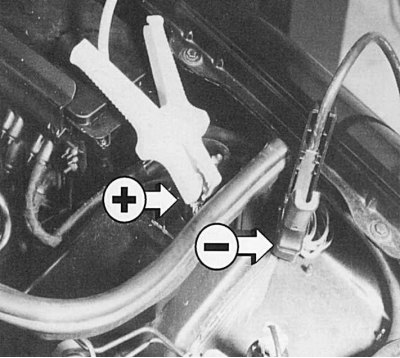
Fig. 9.9. To start the engine of a car with a discharged battery using an auxiliary battery, it is not necessary to connect the starter wire to the terminals of the auxiliary battery - in the engine compartment of the Mercedes E-class it is much easier to do this
Sequence of works


1. Position the vehicle from which the engine will be started so that the battery terminals of both vehicles can be connected with wires.
2. Turn off all energy consumers in the vehicle.
3. Connect the positive terminals of the batteries by first attaching the wire terminal to the discharged battery, then to the charged battery.
4. First connect the second wire to the negative terminal of the car with a charged battery, and then to the negative terminal of the discharged battery.
5. Start the engine on a car with a charged battery and let it run at high speed so that the generator provides sufficient voltage.
6. Start the engine of your car. If the engine does not start immediately, pause between attempts to allow the starter to cool. The engine of the first car should continue to run: the discharged battery will be recharged.
7. Remove the wires in the following order: first from the negative terminal of the "donor" battery, then from yours. Remove the wire from the positive terminals: first from the car with the charged battery, then from the discharged one.
8. After starting the engine, let it run at high speed for a while so that the generator can recharge the battery.
Starting the engine by towing the car
This method is not suitable for a car with a faulty ignition system. Work should be done with an experienced assistant. Remember that when the engine is not running, the brake booster does not work.
1. Turn on the ignition and 2nd gear and press the clutch pedal.
2. The towing vehicle should move slowly.
3. At a speed of about 15 km/h, slowly release the clutch pedal. Be prepared to brake (right foot over the brake pedal).
4. If the engine starts, press the clutch pedal and then the accelerator pedal.
5. Sound the horn to the driver of the towing vehicle and bring both vehicles to a smooth stop.
Push Starting
This method is preferable if the engine and starter are in good condition. You should avoid pushing if the engine does not start due to problems with the ignition system: unburned residues of the fuel mixture can ignite and damage the catalytic converter.
1. Turn on the ignition and put it in 1st gear. In higher gears the alternator will not spin fast enough to provide high voltage.
2. Press the clutch pedal, start pushing the car until it starts rolling.
3. Quickly release the clutch pedal - the engine crankshaft will turn, the engine should start. If it starts, quickly press the clutch pedal, and then the accelerator pedal.