



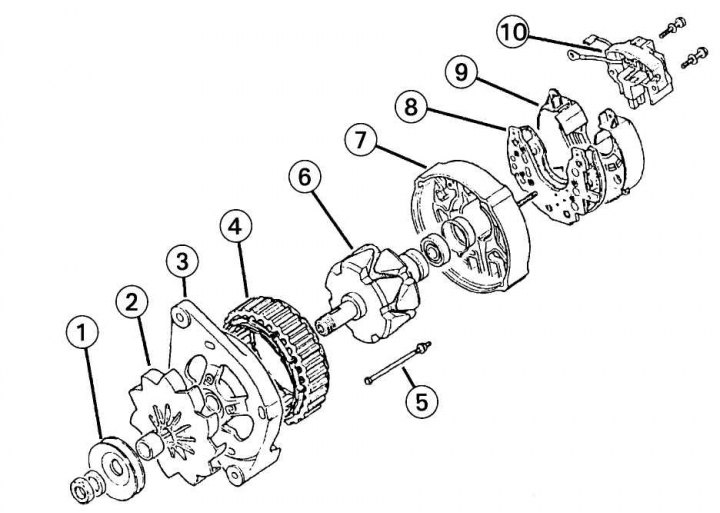
Fig. 9.4. Generator device: 1 – belt drive pulley; 2 – fan; 3 – Generator support cover on the drive side; 4 – stator; 5 – connecting bolt; 6 – rotor with slip rings; 7 – rear support cover; 8 – rectifier block with diodes; 9 – plastic cover; 10 – voltage regulator with brush holder
The generator is the source of energy in the car (Fig. 9.4). When the engine is running, it supplies electricity to all units and charges the battery. Depending on the model and configuration, alternating current generators of varying power can be installed on E-class cars.
The power is indicated on the generator label. It is driven by a belt from the engine. The generator produces alternating current. Since direct current is needed to charge the battery, a block of semiconductor diodes is installed to convert it into direct current. The latter are very sensitive to high voltage.
High Power Liquid Cooled Generator
Some changes have also affected the generator. Liquid-cooled generators are installed on the CDI diesel engines of the E-class model for the first time. During operation, the generator gives off thermal energy to the surrounding coolant, which reduces noise and increases thermal power together with an additional electric heater.
Voltage regulator
The faster the generator armature rotates, the higher the voltage. However, the energy consumers in the car are not adapted to voltage surges. Therefore, the regulator installed on the generator limits the voltage and at the same time prevents the voltage from exceeding the battery charging voltage. The regulator is attached to the generator and regulates the voltage in the on-board network depending on the ambient temperature and the battery within 13.8–14.5 V. The generator does not require maintenance, since it has no lubrication points. Its brushes are designed for a mileage of 100,000 km. To repair the generator, contact the Bosch technical center or service station.
Information copied from the website [MercedesMAN.ru]