
Cars BMW Cars Volkswagen Cars Chevrolet Cars Land Rover Cars Lada Cars Honda Cars Peugeot
English Русский
Български
Беларускі
Український
Српски
Hrvatski
Română
Polski
Slovenský
Magyar
Bookmark News and articles Sitemap Feedback Site search
MercedesMan.ru


A-Class C-Class E-Class G-Class M-Class S-Class Others
W123 (1976-1985) W124 (1984-1995) W210 (1996-2002)
  • Main
  • E-Class
  • W210 (1996-2002)
  • Electrical equipment
  • Power devices
  • Battery — General Description

Battery — General Description (Mercedes-Benz E-Class W210)

0
Contents: Battery ↡ Battery - energy storage ↡
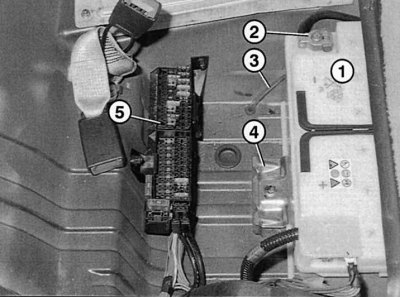
Fig. 9.1. Battery location under the rear seat on the right side in the T-model (station wagon)…

Fig. 9.1. Battery location under the rear seat on the right side in the T-model (station wagon) similar to the arrangement in the sedan: 1 – battery; 2 – negative terminal, "ground" (–); 3 – ventilation tube; 4 – battery mount; 5 – fuse box


On all E-class cars, the battery is located under the rear seat on the right side. To access the battery, remove the rear seat cushion (sedan) or fold the right rear seat (T-model), the battery itself is covered by an additional cover. In the engine compartment, there is a control contact for checking the battery. It is marked with the "+" symbol (Fig. 9.1).
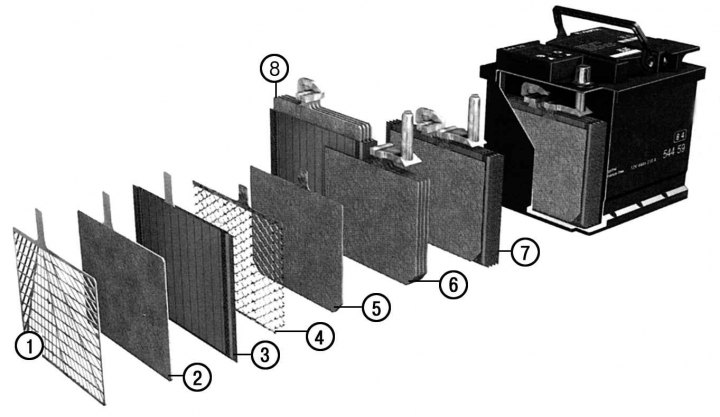
Fig. 9.2. Battery structure: 1 – positive electrode grid; 2 – positive electrode; 3 – separator; 4…

Fig. 9.2. Battery structure: 1 – positive electrode grid; 2 – positive electrode; 3 – separator; 4 – negative electrode grid; 5 – negative electrode; 6 – negative electrode block; 7 – battery section; 8 – positive electrode block


Six batteries connected in series form a battery (12 V) (Fig. 9.2). One battery consists of a block of positive and negative plates, which together create a voltage of 12 V. The plates consist of lead grids, which are filled with an active electrolyte. The positive plates are made of lead dioxide, the negative ones are made of pure lead. A separator is installed between them. It separates the plates, preventing a short circuit, but the electrolyte can pass through its tiny pores. The electrolyte is a conductive liquid, which consists of approximately 37% concentrated sulfuric acid and 63% distilled water.

Battery


Marking. It is located on the battery case and indicates its characteristics. For example, marking "12 V 74Ah 350 A" means the following: 12 V is the nominal voltage; 74 A h — nominal capacity; 350 A is the control discharge current.

The nominal voltage of the battery is 12 V. The actual voltage depends on the state of charge of the battery, it can be higher or lower than the nominal voltage.

Nominal capacity is the current that a fully charged battery can deliver for 20 hours at a temperature of +27°C without a voltage drop at the terminals of at least 10.5 V.

The cold discharge current reflects the capacity output by the current of the battery in a cold state. The discharge current of 12 V, which the battery can output at a temperature of -18°C without the voltage falling below 9 V for 30 s and 6 V for 150 s.

Self-discharge is a chemical process that occurs in a battery and leads to its discharge when no consumers are connected to it. A charged new car battery loses approximately 0.5% of its charge daily. High temperatures, damage or contamination of the battery caps accelerate the self-discharge process.


Battery - energy storage


Chemical processes occur inside the battery, thanks to which it produces and accumulates energy. During current output, the energy of the chemical reaction is converted into electrical energy. The most important function of the battery is to provide the starter with energy to start the engine. Depending on the engine and starter model, the power consumption at the moment of starting can be 5000 W. This is also due to losses in overcoming friction forces to turn the crankshaft of a hot engine - the starter needs only a fifth of this power, consumption increases at low temperatures, since then the lubricants harden.
This article is available at: russian, bulgarian, belarusian, ukrainian, serbian, croatian, romanian, polish, slovak, hungarian
The article has been verified: Polyakov Zakhar Grigorievich
Share with friends:
◀ Previous
E-Class W210 / Power devices
Next ▶

 
Starter — design description
Generator — design description
Checking the electrolyte level in the battery, servicing the contacts
Checking the battery charge
Measuring battery voltage
More similar articles for repairing other models

☛ Starting the engine using an auxiliary battery Mercedes W168 (1997-2004)
☛ Starting the engine from an auxiliary battery Mercedes W202 (1993-2000)
☛ Battery — General information, maintenance recommendations Mercedes W463 (1999-2019)
☛ Battery — General information, maintenance recommendations Mercedes W163 (1997-2005)
☛ Instrument panel — general information Mercedes W140 (1991-1998)
☛ Battery — General Information Mercedes Sprinter (1995-2000, diesel)
Link in different formats to this article
Comments and feedback from visitors
No comments yet


How much will 44 + 18 ?


W210 (1996-2002) 
  • General information
  • Vehicle description
  • Working conditions and tools
  • Car care
  • Diesel engines
  • Engine repair
  • Lubrication system
  • Cooling system
  • Injection system
  • Supply system
  • Exhaust system
  • Gasoline engines
  • Engine repair
  • Lubrication system
  • Cooling system
  • Control system
  • Power and exhaust system
  • Transmission
  • Clutch
  • Mechanical gearbox
  • Automatic gearbox
  • Drive shafts
  • Chassis
  • Car suspension
  • Steering
  • Tires and wheels
  • Brake system
  • Body
  • Exterior (external elements)
  • Interior (internal elements)
  • Doors and windows
  • Heating and ventilation
  • Electrical equipment
  • Equipment and devices
  • Power devices
  • Lighting and signaling
  • Electrical circuits
W124 (1984-1995) 
  • General information
  • Governing bodies
  • Driving and operation
  • Weekly care
  • Maintenance (gasoline)
  • Maintenance (diesel)
  • Troubleshooting
  • Power unit
  • I4 petrol engine
  • V6 petrol engine (SOHC)
  • V6 petrol engine (DOHC)
  • Diesel engines
  • Engine overhaul
  • Cooling system
  • Heating and ventilation
  • Fuel system (carburetor)
  • Injection system «Bosch CIS-E»
  • Injection system «Bosch HFM»
  • Diesel fuel system
  • Supply system
  • Starting and charging system
  • Ignition system (I4)
  • Ignition system (V6)
  • Preheating
  • Transmission
  • Clutch
  • Mechanical gearbox
  • Automatic gearbox
  • Drive shafts
  • Chassis
  • Brake system
  • Car suspension
  • Steering
  • Body
  • Exterior (external elements)
  • Interior (internal elements)
  • Doors, locks and windows
  • Electrical equipment
  • Equipment and devices
  • Switches
  • Headlights and lighting
  • Electrical circuits
W123 (1976-1985) 
  • General information
  • Introduction to the guide
  • Power unit
  • Engine device
  • Repair M102 engines
  • Repair M110 and M123 engines
  • Cooling and lubrication (M102)
  • Cooling (M110 and M123)
  • Ignition system
  • Power system «Stromberg»
  • Power system «Solex 4A1»
  • Fuel injection «K-Jetronic»
  • Fuel injection «L-Jetronic»
  • Transmission
  • Clutch
  • Mechanical gearbox
  • Automatic gearbox
  • Cardan and rear axle
  • Chassis
  • Front suspension
  • Rear suspension
  • Steering
  • Brake system
  • Body
  • Exterior (external elements)
  • Interior (internal elements)
  • Doors, locks and windows
  • Electrical equipment
  • Equipment and devices
  • Power devices
  • Electrical circuits
 
MercedesMan.ru © 2017–2026 · Mobile version · Read about Mercedes · Sitemap: EN BG BY UA RS HR RO PL SK HU · Feedback · Site search · Bookmark A-Class (W168) · C-Class (W201) · C-Class (W202) · C-Class (W203) · E-Class (W123) · E-Class (W124) · E-Class (W210) · G-Class (W463) · M-Class (W163) · S-Class (W116, petrol) · S-Class (W126, petrol) · S-Class (W140) · S-Class (W220) · Sprinter · Vito 1 · Vito 2 · Vario 814D ·
 
We only use cookies without which some of the site's features may not be available.