



Note: Individual characteristics are also given in the text of the Chapter and, if their implementation is mandatory, are highlighted in bold.
| Type | 5-speed, with electronic gear shift control. |
| Designation | |
| S280 | (W5A330) 722.617 |
| S320 | (W5A330) 722.618 |
| S430 | (W5A580) 722.632 |
| S500, S55AMG | (W5A580) 722.633 |
| S600 | (W5A580) 722.649 |
| Gear ratios and engagement of AT elements | |
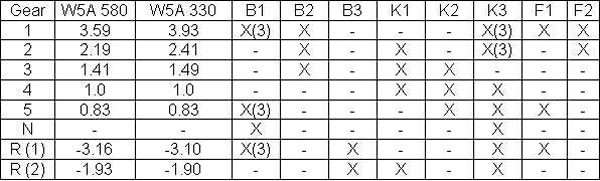 | |
| (1) Program switch in position S | |
| (2) Program switch in position W | |
| (3) Shift actuators only when coasting | |
| W5A 580, Main Gear | 2.82 |
| W5A 330, Main gear | 3.07 |
| Liquid used | |
| S 280, S 320 | 7.0 l, MB No.001 989 21 03 10 |
| S 420, S 500, S 600 | 9.0 l, MB No.001 989 21 03 10 |
| The diagnostic codes of the electronic control system of the automatic transmission, retrieved with the help of the OBD II scanner, are described in the specifications to Chapter Engine electrical equipment. | |
| Tightening force of threaded connections, Н·м | |
| Oil plug AT | 20 |
| Oil plug of the torque converter AT | 16 |
| AT pan bolts | 8 |
| AT selector rod lock screw | 12 |
| Wheels | 150 |
| Bolt for fastening the torque converter to the drive disk, M8 | 42 |
| Drain plug in the transmission pan | 20 |
| Nut for fastening the cardan shaft to the gearbox, M12 | 60 |
| Bolt securing the electromagnetic valve to the gear shift plate | 8 |
| Bolt for fastening valve body cover to valve body, M6x30 | 8 |
| Bolt for fastening the side cover to the valve body cover and valve body, M4x12 | 4 |
| Bolt for fastening the transmission housing to the torque converter housing | 20 |
| Bolt for fastening the pan to the transmission housing | 8 |
| Output shaft flange fastening nut | 200 |
| Bolt for fastening the electrohydraulic control unit to the transmission housing | 8 |
| Bolt for fastening the multi-disc brake B2 to the transmission housing | 16 |
| Bolt securing the pawl to the gear selector lever | 8 |
| Torque converter drain plug | 16 |
Automatic transmission section
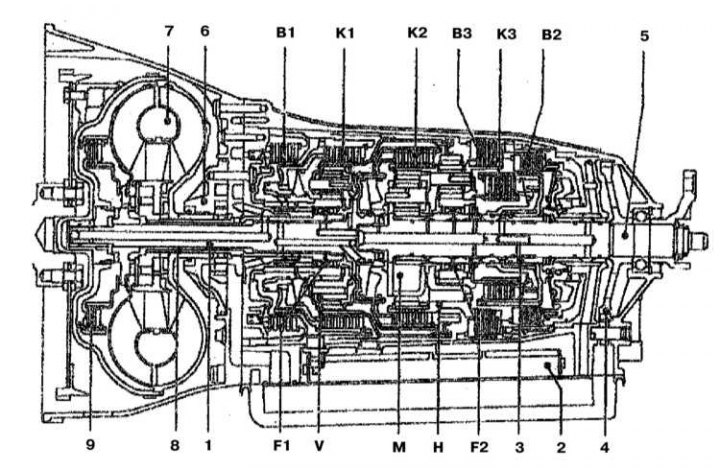
1 - Input shaft; 2 - ECU; 3 - Intermediate shaft; 4 - Parking lock gear; 5 - Output shaft; 6 - Oil pump; 7 - Torque converter; 8 - Reactor shaft; 9 - Torque converter lock-up clutch; B1 - Multi-disc brake assembly B1; B2 - Multi-disc brake assembly B2; B3 - Multi-disc brake assembly B3; F1 - Flywheel F1; F2 - Flywheel F2; H - Rear planetary assembly; K1 - Multi-disc clutch K1; K2 - Multi-disc clutch K2; K3 - Multi-disc clutch K3; M - Central Planetary Assembly; V - Front planetary assembly
Rotation transmission diagram in position "1" of the AT selector
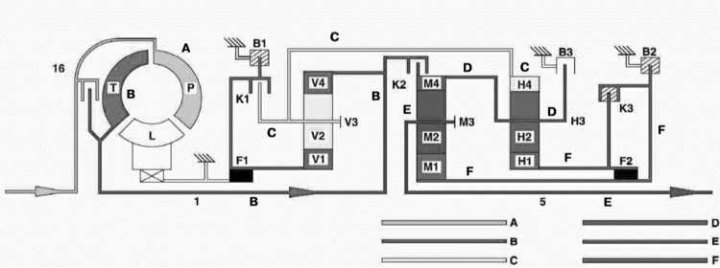
1 - Input shaft; 2 - Output shaft; 16 - Torque converter lock-up clutch; A - Crankshaft speed; B - Transmission, Input Speed; C - 1st gear ratio; D - 2nd gear ratio; E - 3rd gear ratio; F - Fixed parts; H - Rear planetary gear set; L - Stator; M - Planetary gear center set; P - Impeller; T - Turbine wheel; V - Front planetary gear set
Automatic transmission control unit
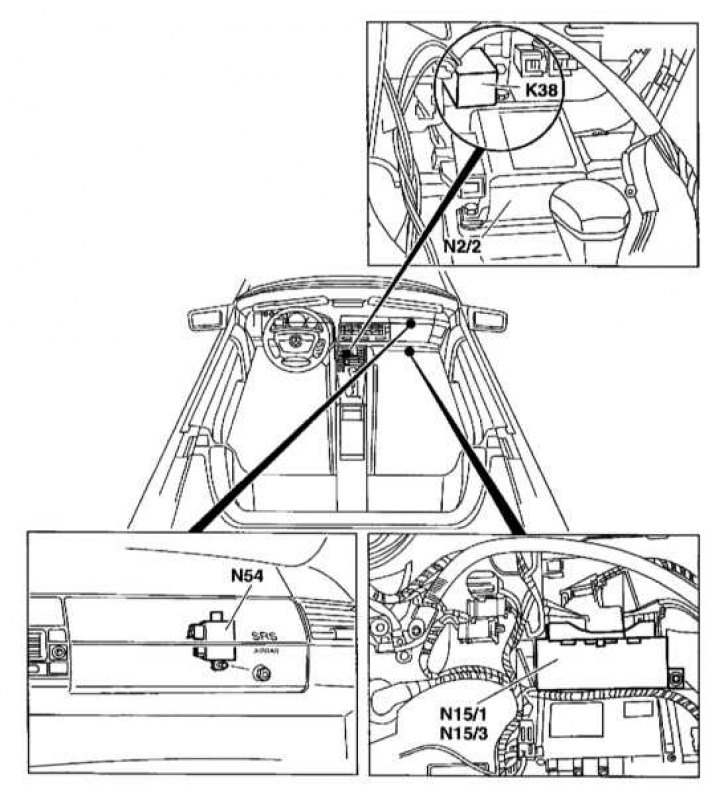
K38 - Starter interlock relay module; N₂/2 - SRS control module; N15/1 - 5-speed automatic transmission control module (TCM); N15/3 - Transmission Control Module (TCM); N54 - RCL Control Module
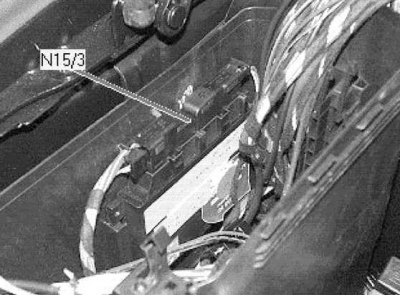
Automatic Transmission Control Module Location
[Publication taken from an online resource MercedesMan.ru]
An automatic transmission, when starting off, performs the function of a regular clutch, and during movement, it performs the work of shifting gears.
The main units of the AT are: torque converter, planetary gearbox and hydraulic or electronic control system. To switch to another gear ratio in the planetary gearbox, hydraulically driven disc brakes and disc clutch are used.
The torque converter functions like a hydraulic clutch. Its job is to provide clutch when starting off and changing gears.
The principles and schemes of construction and operation of AT are considered in detail in the manual "Automatic transmissions of modern passenger cars" published by ARUS.
Transmission control system (known as electronic synchronous switching system) is a component of the modified engine management system. The control system can operate in a special safe mode, which it switches to when any malfunction is detected. In this case, the transmission operating modes are limited, and the car can be driven to a repair shop under its own power. When the control system switches to safe mode, a control lamp lights up on the instrument panel (refer to Chapter User manual). By analyzing information coming from various sensors (not only sensors that are directly related to the transmission), the control system selects the optimal gearbox operating mode in terms of economy, smoothness, etc. At a certain position of the throttle valve, the control system can block the torque converter in such a way that only the fourth and fifth gears are engaged. This achieves a significant reduction in fuel consumption.
The only regular maintenance procedure for the box is checking the working fluid level (refer to Section Checking the Automatic Transmission Oil Level). There is no need to change the transmission fluid regularly.
A transmission fluid cooler is installed next to the cooling system radiator.
There is no traditional switch for the Kick-Down mode. This mode is activated directly by the transmission control system after processing information from the throttle position sensor.
There are several transmission operating modes, each of which can be engaged by moving the selector to one of the following positions: P, R, N, D, 1, 2, 3, 4 (refer to Chapter User manual).
The engine can only be started if the selector is in position P or N. This is done to prevent the car from moving when trying to start it (if the selector is set to one of the other positions). By analyzing the information coming from the sensors, the control system allows or prohibits the engine from starting. The locations of the various relays are indicated in Chapter On-board electrical equipment.