



The main components of the AT are: torque converter (torque converter), planetary gearbox and hydraulic or electronic control unit. To change the gear ratio in the planetary gearbox, hydraulically driven disc brakes and disc clutch are used.
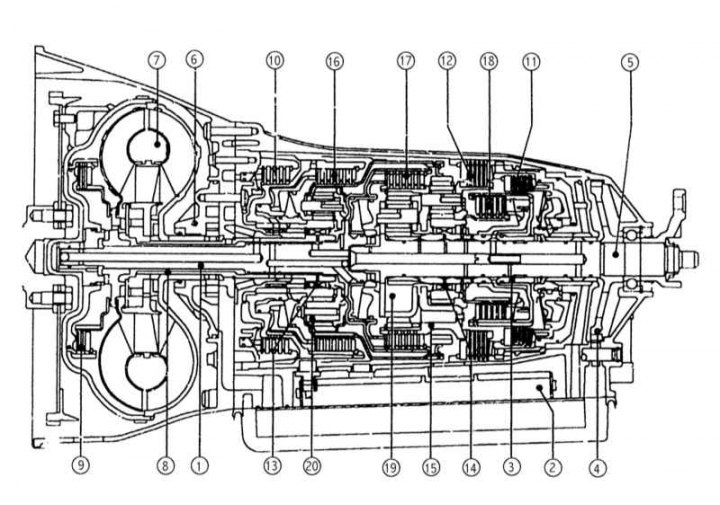
Typical AT design
1 - Input shaft; 2 - Electro-hydraulic shift control unit; 3 - Intermediate shaft; 4 - Parking lock gear; 5 - Output shaft; 6 - Oil (ATF) pump; 7 - Torque converter; 8 - Reactor shaft; 9 - Torque converter lock-up clutch; 10 - Multi-disc brake assembly B1; 11 - Multi-disc brake assembly B2; 12 - Multi-disc brake assembly B3; 13 - Overrunning clutch F1; 14 - Overrunning clutch F2; 15 - Rear planetary assembly H; 16 - Multi-disc clutch K1; 17 - Multi-disc clutch K2; 18 - Multi-disc clutch K3; 19 - Central Planetary Assembly M; 20 - Front Planetary Assembly V
The torque converter functions like a hydraulic clutch. Its job is to provide clutch when starting off and changing gears.
Transmission control system (also known as electronic synchronous switching system) is a component of a modified engine management system, installed only on models with AT. The control system can operate in a special emergency (safe) a mode with a limited switching range, which it switches to when any malfunction is detected (the relevant information is displayed on the multifunctional display screen). Switching to emergency mode allows you to drive the car under its own power to a service station for detailed diagnostics and necessary repairs. Based on the analysis of data coming from various information sensors (not necessarily directly related to the functioning of the transmission itself), the transmission control module (TCM/ETC) selects the optimal AT operating mode in terms of economy, smoothness of shifting, etc. At a certain throttle position, the TCM can issue a command to lock the torque converter, which leads to limiting the AT shifting to the range of only 4th and 5th gears, which helps to significantly reduce fuel consumption.
The only AT maintenance procedure that must be performed on a regular basis is checking the ATF level, the procedure for which is described in Chapter Routine care and maintenance. There is no need for regular replacement of ATF.
An ATF cooler is installed next to the engine cooling system radiator.
Based on data received from the traditionally installed under-the-gas-pedal kickdown switch sensor, the TCM switches the transmission to a gear adjacent to the one currently in use when the pedal is fully depressed, which significantly improves the vehicle's dynamic performance, for example when overtaking.
There are several transmission operating modes, each of which can be engaged by moving the selector to one of the following positions: "P", "R", "N", "D", "1", "2", "3", "4". Electronic selector modules with the function of sequential selection of driving mode ranges "D" began to be installed on models of recent years of production (1, 2, 3 and 4), when the AT is switched to the switching range limitation mode (4, 3, 2 and 1) is carried out by lateral pressing of the lever (D+/D-) (see Section Starting the movement and switching the automatic transmission).
Thanks to the use of a special N/P switch sensor, the engine can only be started when the AT selector lever is in the "P" or "N" position, which prevents accidental starting of the car when trying to start it.
This chapter covers only the most general AT maintenance procedures that are within the skill level of the average amateur mechanic. More detailed information on the design, operating principles, and maintenance of the AT series 722.6 can be found in Manuals 179 ("Automatic Transmissions of Modern Passenger Cars") and 187 ("Mercedes C-Class W-203") published by ARUS.