



Contents: Disconnecting the negative cable ↡ Removal the battery ↡ Purchasing a new battery ↡ Charging the battery ↡ Basic programming procedures ↡
The 12-volt battery installed in the car consists of six cans, in which positive and negative plates (lamellas) are placed, immersed in a solution of sulfuric acid. The main task of the battery is to generate the current necessary for starting the engine, ignition/activation of glow plugs and for lighting, as well as to provide power to other on-board or auxiliary consumers of electrical energy.
100% battery efficiency occurs at an ambient temperature of 27°C, at -18°C the efficiency drops to 40% and slightly more than twice as much energy is required to start the engine.
Starting power (starting current) shows the battery's ability to start a car in very cold weather conditions. It shows the current in amperes that the battery delivers for 30 seconds at -18°C without the voltage dropping below 7.2 volts (the minimum level required for a reliable start). The higher this figure, the greater the starting power of the battery.
The reserve capacity indicates the time in minutes during which the battery delivers a current of 25 Amps at 27°C, i.e. the time during which the battery provides operation of all auxiliary devices in the car at night and in bad weather conditions with a faulty alternator.
In winter conditions, at temperatures below -18°C, the efficiency of battery recharging decreases due to the increase in internal resistance. During short trips in winter, the energy expended by the battery to start the engine does not have time to recover and the battery begins to wear out, gradually discharging and, eventually, failing irreversibly.
During the summer months, the engine heats up considerably during long trips, and it often happens that it is difficult to restart. Such "hot" starts sometimes consume as much energy as the batteries require in frosty weather. This is especially true for high-compression engines with a large cylinder displacement, as well as for models equipped with an air conditioning system.
Disconnecting the negative cable
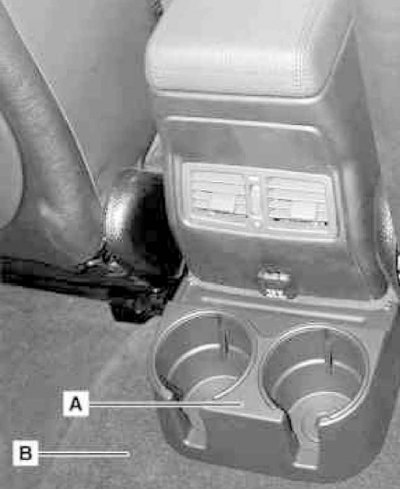
On properly equipped models, the battery access cover (B) is located under the rear cup holder assembly (A)
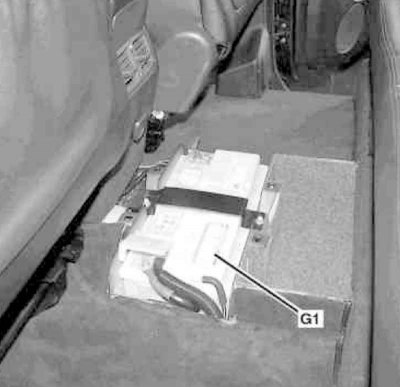
Battery mounting diagram (G 1)
1. Connect the auxiliary battery to the standard battery.
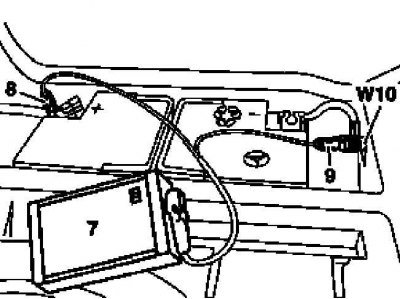
7 - Auxiliary battery
8 — Positive wire terminal of the module
9 — Terminal of the negative wire of the module
W10 - Battery ground
2. For models with the corresponding configuration (code ET2), activate the service mode of the TELE AID emergency call system (see Section Activation/deactivation of the service mode of the TELE AID emergency call system).
3. On models with the corresponding configuration (code FG2), remove the cup holder (A).
4. Remove the access cover (B) in the rear footwell.
5. Disconnect the negative battery cable (G1) negative cable (2).
6. The connection is made in the reverse order. Do not forget to deactivate the service mode of the TELE AID system.
Attention! Refusal to use an auxiliary battery is associated with the need to enter the security code for activating the radio receiver!
Removal the battery
1. Disconnect the negative cable from the battery (see above).
2. Remove the pressure plate.
3. Disconnect the positive cable from the battery.
4. Remove the battery from the mounting niche.
5. Installation is carried out in reverse order.
Purchasing a new battery
The above indicates the importance of choosing the right battery, taking into account the engine parameters and vehicle equipment.
The first thing you should pay attention to when buying a new battery is its performance characteristics. Such characteristics are - three. First: NOMINAL OUTPUT VOLTAGE, which has the same value (12 V) for all those used in passenger cars, which virtually eliminates the possibility of error.
Note: When purchasing, it is advisable to test the battery with a load fork.
Second: CAPACITY, measured in Ampere/hours (A/h) and, roughly speaking, determining the reserve of electric energy contained in the battery. The choice of the value of this parameter determines how long the battery is able to provide the ability to turn the engine with the starter, or more precisely, how many attempts to start the engine can be made. The price of a battery is almost directly proportional to its capacity. And third characteristic: STARTING CURRENT, measured in Amperes (A), i.e. the current supplied to the starter when starting the engine. The value of the starting current on batteries can be specified according to four different standards: GOST (for domestic batteries), EN (standard of the United Europe), SAE (american standard) and DIN (Germany). The latter, German standard, is the closest to our GOST and is indicated "by default" on most European-made batteries, i.e. when the standard system is not specified. The higher the starting current, the higher the speed of the starter and the greater the torque it can transmit to the engine flywheel.
Ideally, the replacement battery purchased should fully comply with the operating characteristics specified in the vehicle's operating instructions, which will ensure its maximum service life. Buying a battery with a smaller capacity can hardly be considered a good way to save money, as it will last significantly less and, in addition, may lead to unpleasant troubles associated with starting the engine in winter. You should not buy a battery with an excessively high starting current - such a hobby is associated with the risk of starter failure. If the standard battery does not provide proper engine cranking, it would be better to first change the engine oil - which will most likely lead to automatic elimination of the problem.
Recently, the country's market has been overflowing with low-quality goods and fakes. Battery packs are no exception. There are several signs by which you can distinguish the original from the fake with a fair degree of probability.
First and, perhaps most importantly: the country of manufacture and the manufacturing plant must be indicated on the battery case, preferably with the address.
Second: the date of manufacture must be indicated, which is of particular importance for sealed batteries (unattended) type. The delivery set must necessarily include a technical passport, while the presence of instructions is not strictly required, which is due to the fact that in the West, batteries are practically not available for retail sale, and their installation on a car is usually carried out by car service specialists.
Third: high-quality batteries have a good appearance. The case should have smooth edges, be equipped with reliable plugs and smooth terminals covered with protective caps, which are often coated with a layer of special anti-corrosion grease.
Charging the battery
Charging a failed battery should be done in accordance with the charger manufacturer's instructions.
Basic programming procedures
After restoring the on-board power supply, the following basic programming procedures must be performed.
1. Turn on the ignition, then activate the side window lifters one by one, raising them fully and holding the corresponding switch buttons pressed for about 1 second. Turn off the ignition.
2. When the on-board power supply is disconnected, the ESP control module switches to emergency mode, which is accompanied by the display of a message on the multi-function display screen "EL. STAB. PROGRAM GO TO GARAGE". To return the ESP system to working mode, it is necessary to activate the steering wheel angle sensor: start the engine at idle speed, then turn the steering wheel from lock to lock, finally returning it to the neutral position - the message should disappear from the screen. Switch off the ignition.
3. Turn on the ignition and move the electric front seat forward as far as it will go - continue to hold the corresponding switch pressed for about 1 second. Repeat the same procedure with the head restraint, raising it to its highest position. Turn off the ignition.