



Contents: Checking the electrolyte level in…↡ Cleaning the battery terminals ↡ Battery conservation ↡
Checking the electrolyte level in the battery
Warning: Do not look into the battery using an open flame source. Battery explosion is possible!
The electrolyte level in the battery should be between the minimum and maximum level marks (see arrows).
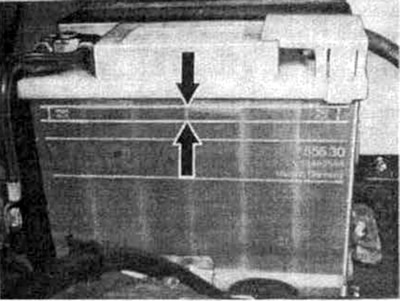
If the electrolyte level in the battery cannot be determined visually, you need to unscrew the caps of the various elements. The normal electrolyte level should be 6 mm above the plates, including the separators. If there is an electrolyte level mark, then the level of the electrolyte being checked should be adjusted to this mark.
Caution: Use only distilled water to restore electrolyte levels.
If the electrolyte level or separators in the various elements are not visible when the covers are removed, distilled water should be added to the level where: 1 - air injection channel, 2 - air cushion.
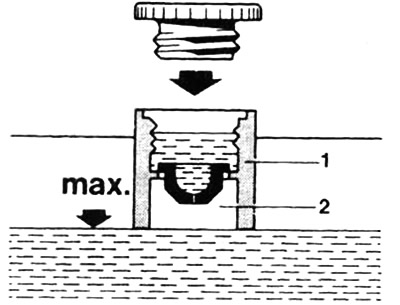
Batteries with high electrolyte levels may boil over when charged too heavily (in hot weather). Insufficient electrolyte level leads to a reduction in the service life of the battery.
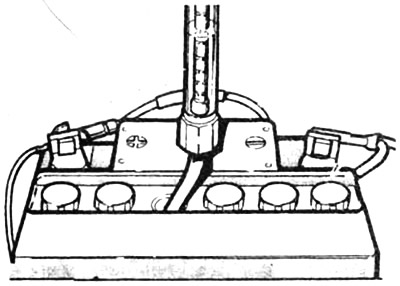
The density of the electrolyte, along with the results of voltage measurements, gives an accurate idea of the state of charge of the battery. An inexpensive hydrometer is suitable for checking the density. The higher the density (concentration) electrolyte in the battery, the higher the float density meter floats. The electrolyte density value can be read on the device scale either in the form of density units or in Baum degrees (Baume degrers) (+Be). In this case, the following values of electrolyte density can be obtained.
| Battery charge level | Zones with normal climatic conditions | |
| bohm degrees | g/ml | |
| Completely discharged battery | 16 | 1,12 |
| Half charged battery | 24 | 1,2 |
| Fully charged battery | 32 | 1,26 |
Note: In batteries with cell necks that drain the electrolyte, insert the hydrometer through the three-cell membrane and draw in the electrolyte.
Cleaning the battery terminals
General vehicle maintenance also includes cleaning the battery terminals and connectors and then applying an acid-resistant lubricant such as petroleum jelly to the cleaned parts.
Battery conservation
An unused battery will eventually discharge itself. If the vehicle is not going to be used for some time, the following steps should be taken.
Check the battery charge level and recharge it if necessary.
Disconnect the ground wire from the battery to prevent it from discharging into constant power consumers, such as an electric clock.
After three months, recharge the battery again.
Warning: Depending on the battery's lifespan, the degree of contamination may be checked more frequently. Do not leave the battery uncharged, as permanent defects may appear on its plates.