



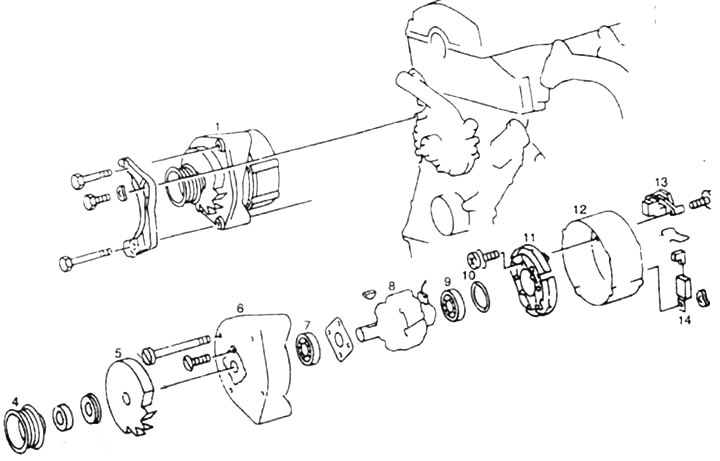
I. Alternator. 4. Pulley. 5. Fan. 6. Front holder (bracket). 7. Drive bearing. c. Rotor. 9. Rear bearing. 10. Washer. 11. Diode board. 12. Rear holder. 13. Voltage regulator. 14. Capacitor for suppressing electrical interference.
The Mercedes car is equipped with a three-phase alternator. The generator is driven by the crankshaft via a fan belt, and the generator rotor rotates together with the generator winding inside the stationary stator winding at approximately double the speed (number of revolutions per minute).
Electric voltage is applied to the generator winding via carbon brushes and current collectors, resulting in the formation of a magnetic field. The position of the magnetic field constantly changes in relation to the stator windings due to the rotation of the rotor. This, in turn, leads to the formation of a three-phase current in the stator winding.
Since the battery can only be charged with direct current, the three-phase current is converted to direct current using a rectifier assembled on a diode board. The voltage regulator converts the charging current by switching the generator current on and off depending on the battery charging conditions. At the same time, the voltage regulator maintains a constant generator voltage level (approximately 14 V) regardless of engine speed.
Caution: A three-phase alternator should never be run without a battery. Never run the engine without a battery.