
Cars BMW Cars Volkswagen Cars Chevrolet Cars Land Rover Cars Lada Cars Honda Cars Peugeot
English Русский
Български
Беларускі
Український
Српски
Hrvatski
Română
Polski
Slovenský
Magyar
Bookmark News and articles Sitemap Feedback Site search
MercedesMan.ru


A-Class C-Class E-Class G-Class M-Class S-Class Others
W163 (1997-2005)
  • Main
  • M-Class
  • W163 (1997-2005)
  • Transmission
  • Clutch
  • Description of the clutch design

Description of the clutch design (Mercedes-Benz M-Class W163)

0
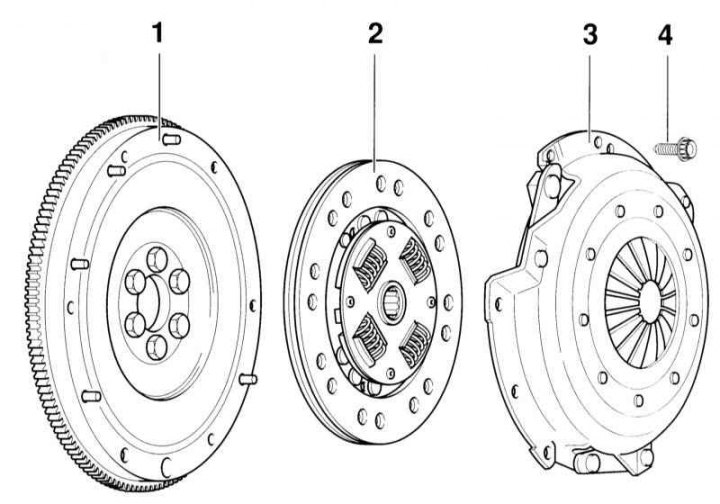
The models in question are equipped with a single-disc dry clutch with a diaphragm spring.

Single-plate dry clutch design with diaphragm spring

Single-plate dry clutch design with diaphragm spring
1 - Flywheel; 2 - Clutch slave disc; 3 - Clutch basket with pressure plate; 4 - Mounting bolt (internal hexagon)


The clutch consists of a basket with a pressure plate, a driven plate, and a release bearing (Manual transmission 717.4)/central operator (Manual transmission 716.6), fork-type clutch release lever (Manual transmission 717.4) and hydraulic drive.

The clutch basket is bolted to the flywheel, which is secured to the engine crankshaft. Between the pressure plate and the flywheel, there is a driven clutch disc equipped with friction linings, which is pressed against the working surface of the flywheel by diaphragm springs of the pressure plate. The driven clutch disc is centered relative to the input shaft of the manual transmission by means of a splined connection.

When the clutch pedal is depressed, the release bearing, under the force developed by hydraulic pressure through the fork-type clutch release lever, presses on the diaphragm spring of the pressure plate, ensuring the release of the driven plate, which stops being pressed against the working surface of the flywheel and, accordingly, transmitting the torque developed by the engine to the input shaft of the gearbox.


The clutch drive on all models is hydraulic. The working fluid is brake fluid, taken from a reservoir shared with the brake system.

Each engagement of the clutch is associated with wear of the friction linings of the driven disk, which is one of the consumable components of the assembly. The average service life of the driven disk is over 100,000 km. The intensity of wear depends on the operating conditions of the vehicle (driving with a trailer) and the owner's driving style. On models equipped with a two-section flywheel with a spring-damping unit that dampens torsional vibrations, the clutch adjustment is performed automatically and there is no need for additional adjustments.

Note: The driven clutch disc on models with a two-section flywheel is not equipped with torsion springs.


Another advantage of cars equipped with two-section flywheels is reduced noise levels at low engine speeds.

(Publication reprinted from this resource mercedesman.ru)
This article is available at: russian, bulgarian, belarusian, ukrainian, serbian, croatian, romanian, polish, slovak, hungarian
The article has been verified: Panova Maya Vladimirovna
Share with friends:
◀ Previous
M-Class W163 / Clutch
Next ▶

Transmission Line Specifications
Assessing the degree of wear of the driven clutch disc
Removal, installation and testing of the clutch
Removal and installation the master cylinder
Removal and installation the clutch slave cylinder
Bleeding air from the clutch hydraulic circuit
More similar articles for repairing other models

☛ General description of the clutch Mercedes W168 (1997-2004)
☛ Clutch design and description Mercedes W202 (1993-2000)
☛ Clutch design and specifications Mercedes W123 (1976-1985)
☛ Transfer case design Mercedes W463 (1999-2019)
☛ Description of the clutch design Mercedes W126 (1979-1991, petrol)
☛ Changes in the design of the cylinder block introduced as a result of… Mercedes Sprinter (1995-2000, diesel)
Link in different formats to this article
Comments and feedback from visitors
No comments yet


How much will 43 + 12 ?


W163 (1997-2005) 
  • General information
  • Introduction to the guide
  • Controls and instruments
  • Driving and operation
  • Maintenance
  • Power unit
  • Gasoline engines
  • Diesel engines
  • Cooling system
  • Heating and ventilation
  • Power system (gasoline)
  • Fuel system (diesel)
  • Exhaust system
  • Ignition and control system
  • Charging and starting system
  • Transmission
  • Mechanical gearbox
  • Automatic gearbox
  • Clutch
  • Drive shafts and cardan
  • Transfer case
  • Chassis
  • Brake system
  • Front suspension
  • Rear suspension
  • Steering
  • Suspension geometry
  • Body
  • Exterior (external elements)
  • Interior (internal elements)
  • Doors and locks
  • Electrical equipment
  • Equipment and devices
  • Drive motors
  • Lighting and signaling
  • Audio system
  • Electrical circuits
 
MercedesMan.ru © 2017–2026 · Mobile version · Read about Mercedes · Sitemap: EN BG BY UA RS HR RO PL SK HU · Feedback · Site search · Bookmark A-Class (W168) · C-Class (W201) · C-Class (W202) · C-Class (W203) · E-Class (W123) · E-Class (W124) · E-Class (W210) · G-Class (W463) · M-Class (W163) · S-Class (W116, petrol) · S-Class (W126, petrol) · S-Class (W140) · S-Class (W220) · Sprinter · Vito 1 · Vito 2 · Vario 814D ·
 
We only use cookies without which some of the site's features may not be available.