



Caution! Since the working fluid of the clutch hydraulic drive is brake fluid, before proceeding with the procedure, read the precautions set out in Chapter Brake and auxiliary systems. Remember that brake fluid is toxic and chemically aggressive!
Air must be removed from the clutch hydraulic drive if the clutch pedal does not return to its original position when released, or returns with a delay, as well as if the clutch disengagement function is faulty and after opening the hydraulic tract.
Removal air without using a special device
Caution! If it is not possible to completely remove air from the clutch drive path during the procedure (a grinding noise is felt and the quality of clutch disengagement is impaired), the system should be bled at a service station using a special device (see below).
1. Check the level in the brake fluid reservoir and make the appropriate adjustments if necessary (see Chapter Checking fluid levels, leak control).
Attention! During the procedure, the fluid in the master cylinder reservoir should not drop excessively - periodically adjust its level by adding fresh fluid!
2. Jack up the car and place it on supports.
3. Remove the crankcase guard.
4. Remove the dust cap from the bleeder valve on the slave cylinder. Attach a piece of transparent hose to the valve and lower the free end into a drain container partially filled with brake fluid to prevent air from being sucked in during bleeding.
Note: The accompanying illustration is for informational purposes only and may not fully correspond to the models described.
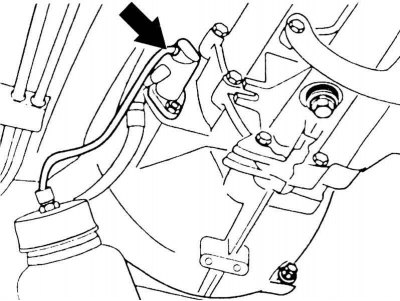
Location of the bleeder valve on the clutch slave cylinder
5. Using a spanner, carefully loosen the valve.
6. Ask your assistant to press the clutch pedal all the way down about 10 times and then lock it in the lower position.
7. Open the valve - the brake fluid will start to flow into the drain container. When the pressure weakens, close the valve and repeat the procedure.
8. Continue bleeding until the fluid being pumped out of the system is completely free of air bubbles/fresh fluid starts to be pushed out of the hose (in case of its replacement), - do not forget to check and, if necessary, adjust the fluid level in the master cylinder reservoir.
9. Once bleeding is complete, tighten the valve, remove the hose and replace the dust cap.
10. Install the crankcase guard.
11. Correct the fluid level in the master cylinder reservoir (see Chapter Checking fluid levels, leak control).
12. Check the proper functioning of the brake system and clutch.
Removal air using a special device
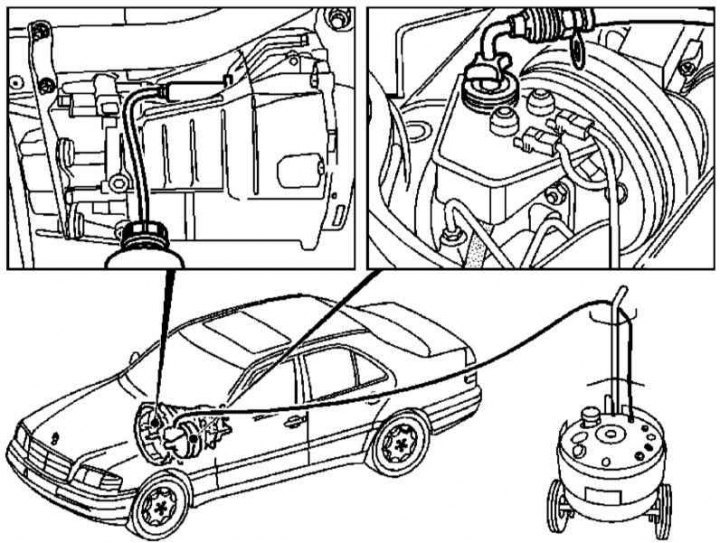
Bleeding the hydraulic circuit of the clutch drive using a special device
1. At the service station, air is removed from the clutch system, as a rule, using a special device that provides the necessary fluid pressure in the hydraulic tract. Below are listed only deviations from the standard procedure described above.
2. Following the manufacturer's instructions strictly, connect the device to the brake master cylinder reservoir.
Full article available on the resource: www.MercedesMan.ru
3. Follow the procedure in paragraph 4 (see above).
4. Open the valve and keep it open until the air release stops/fresh liquid starts to come out (when replacing the last one).
5. After tightening the valve, disconnect the hose and install the dust cap.
6. Disconnect the device.
7. Adjust the level in the master cylinder reservoir and close the latter.
8. Finally, make sure that the brake system and clutch are functioning properly.