



Caution: Since the hydraulic clutch system operates on brake fluid, please read the relevant provisions of Chapter "Bleeding the brake system". Remember that brake fluid is poisonous and can damage paintwork.
Attention! Below is the procedure for removing air from the clutch hydraulic drive without using a special device. In this case, some air may remain in the system. The fact that air remains in the system can be recognized by characteristic scratching sounds, in addition, the separation of the clutch will occur with deviations from the norm. If these signs occur after bleeding the system, it is recommended to immediately repeat the bleeding, but this time in a workshop using a special device.
Removal air without a special device
1. Check the brake fluid level in the expansion tank. Top up if necessary.
Attention! Do not allow the fluid level in the expansion tank to drop significantly when bleeding the system. Constantly replenish the fluid volume.
2. Place the vehicle on jack stands.
Warning! Jacking up the vehicle and placing it on stands may pose a risk of injury. Read the safety precautions in the chapter "Jacking up a car".
3. Remove the mudguard (protection) on vehicles with a diesel engine.
Publication reprinted from this resource: MercedesMan.ru
4. Remove the dust cap from the bleed nipple on the slave cylinder (see arrow in illustration). Place a transparent hose on the bleed nipple located on the working cylinder (see illustration).
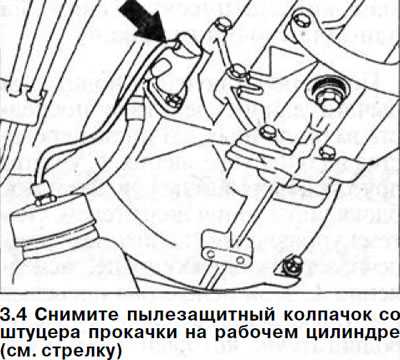
Please note: The illustration shows a vehicle that does not belong to the A-class.
5. Carefully loosen the nipple using an Allen key.
6. Place and hold the free end of the hose in a container half filled with brake fluid.
The end of the hose must be kept in brake fluid at all times to prevent air from being sucked into the system.
7. Ask an assistant to slowly depress the clutch pedal all the way down about 10 times, and then hold it in the depressed position.
8. Open the bleed nipple to start the fluid flowing out. After air bubbles stop appearing in the outgoing brake fluid, tighten the nipple.
Attention! Monitor the fluid level in the brake system and top it up.
9. Release the clutch pedal, then depress it again about 10 times and leave it pressed.
10. Open the bleeder nipple, let a small amount of brake fluid flow out, and close the nipple again. Repeat this procedure until there are no air bubbles in the flowing brake fluid. At the same time, constantly add brake fluid to the expansion tank.
Attention! If it is necessary to completely drain the fluid from the system, continue bleeding until newly poured brake fluid, which is lighter in color than the previous one, begins to flow into the hose.
11. Remove the hose from the bleed nipple and close it with a dust cap.
12. Reinstall the engine splash guard.
13. Add brake fluid to the expansion tank up to the MAX mark and close the tank with the cap.
14. Check the operation of the clutch and brake system.
Removal air using a special device
In workshops, air is removed from the clutch hydraulic drive using a special device that creates pressure in the system.
15. Place the vehicle on jack stands and remove the engine splash guard.
16. Remove the cap from the brake fluid expansion tank.
17. Connect the bleeding device to the system according to the device manufacturer's instructions.
18. Remove the dust cap from the bleed nipple on the slave cylinder and place a transparent hose on the bleed nipple. Place the free end of the hose in a container half filled with brake fluid.
19. Open the bleed screw and keep it open until no more air bubbles are released from the escaping brake fluid.
Attention! If it is necessary to completely drain the fluid from the system, continue bleeding until newly poured brake fluid, which is lighter in color than the previous one, begins to flow into the hose.
20. Remove the hose from the bleed nipple and close it with a dust cap.
21. Disconnect the special device for bleeding the clutch hydraulic drive.
22. Add brake fluid to the expansion tank up to the MAX mark and close the tank with the cap.