



- clutch control unit consisting of a control mechanism, an actuator motor and a clutch actuator cylinder;
- angle sensors to determine the direction of rotation and gear shift mechanism;
- central hydraulic clutch release with hydraulic cylinder;
- clutch disc;
- self-adjusting pressure plate (see illustration 4.0).
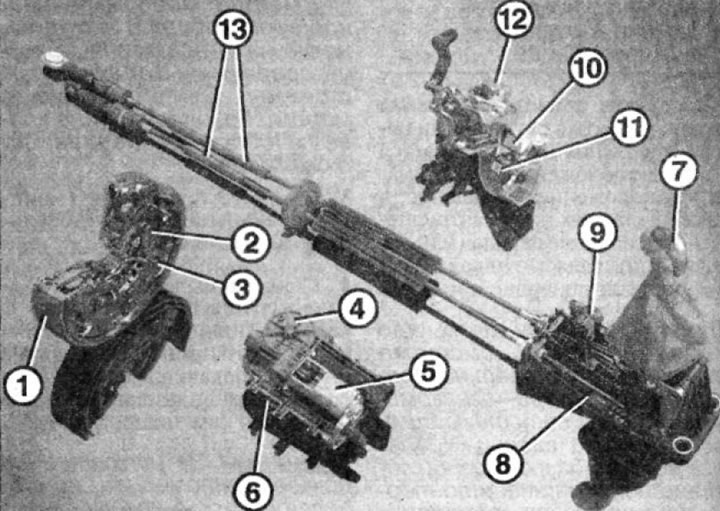
4.0 Automatic transmission control mechanism
1 - flywheel
2 - driven clutch disc
3 - self-adjusting pressure plate
4 - clutch drive
5 - actuator electric motor
6 - control unit
7 - gear shift lever
8 - gear shift mechanism
9 - steering angle sensor on the gear shift mechanism
10 - steering angle sensor on gear shift rods
11 - steering angle sensor on gear selection rods
12 - switching module
13 - cable traction
Instead of the usual clutch rods, there is a hydraulic element (drive) under the shift lever, consisting of an actuator with a cylinder, which is controlled by an electronic unit.
The hydraulic unit performs the function of a regular clutch.
Gear shifting and clutch mechanics are largely similar to models with a manual transmission. The self-adjusting pressure plate compensates for clutch disc wear and maintains the kinematic connection at a constant level.
After the driver switches the lever, this action is transmitted to the control unit via various sensors. Taking into account other information received from the engine control unit, the clutch control system ensures the regulation of the clutch process. To this end, it sends impulses to the actuator motor, which ensures the clutch process via the central hydraulic clutch.
The hydraulic clutch system is supplied with brake fluid from the brake system expansion tank.
The automatic clutch control unit has a self-diagnostic function, which makes it possible to read fault codes registered by the unit.
Codes can be read and printed using a special diagnostic tester. Diagnostics and repair of the clutch should be entrusted to specialists of the appropriate workshop.