



The pressure plate is rigidly screwed to the flywheel, which in turn is flanged to the engine crankshaft. Between the pressure plate and the flywheel is the driven clutch disc, which is pressed toward the flywheel by the pressure plate.
The driven clutch disc is centered by the primary shaft of the gearbox, to which it is connected by gear engagement (see illustration 1.0).
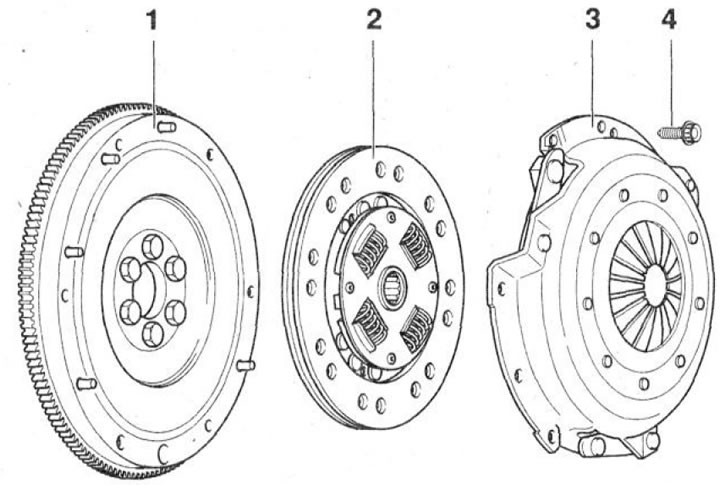
1.0 Main Clutch Components
1 - flywheel. There should be no grooves, oil or grease on the flywheel surface where the friction lining of the driven clutch disc is adjacent. Pay attention to the tightness of the centering pins.
2 - clutch driven disc. Do not change the mounting position. The spring housing of the damper must face the pressure plate. Caution! Clean the splines of the primary shaft and the used clutch driven disc, remove corrosion
3 - pressure plate
4 - Pressure plate mounting bolt with Allen key head. Tightening torque 25 Nm. Tighten or loosen the bolts in a crosswise order.
The tightening torque for the disc bolts on vehicles with automatic clutch is 10 Nm.
When pressing the clutch pedal (clutch release) hydraulic or mechanical pressure is applied to the clutch release fork lever, and the clutch release bearing is pressed against the pressure plate spring.
As a result, the pressure plate is released and the clutch slave disc is no longer pressed towards the flywheel.
The power connection between the engine and gearbox is interrupted.
The clutch drive of all Mercedes A-class cars is hydraulic. The hydraulic clutch system operates on brake fluid and is supplied with it from a common brake fluid expansion tank.
Each time the clutch is engaged and disengaged, friction gradually wears away the friction lining of the clutch disc. Thus, the clutch disc is a wearable part, but it lasts on average for more than 100,000 km.
The degree of wear depends mainly on the load (operation with a trailer) and from the driving style. The clutch itself does not require maintenance, as it is self-regulating.
The Mercedes A 190, as well as all diesel-powered vehicles, are equipped with a so-called composite flywheel, which consists of two disks connected to each other. Such a flywheel has a mechanism for damping torsional vibrations, which reduces vibrations that occur when the engine rotates, and also helps reduce the noise level when the engine is running at low and medium speeds.