



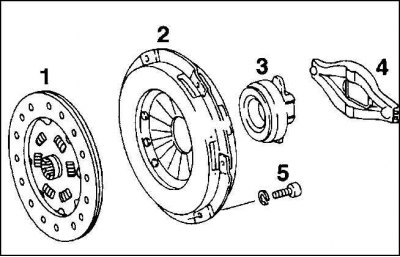
1. Clutch disc; 2. Pressure disc; 3. Clutch release bearing; 4. Clutch release fork; 5. Hexagon socket head cap screw, 25 Nm.
The clutch consists of a clutch pressure plate, a clutch disc (slave disk) and hydraulic control system. The pressure and driven disks are located on the engine flywheel.
The clutch pressure plate is connected to the flywheel, which is screwed to the engine crankshaft. Between the clutch pressure plate, which is pressed by the clutch pressure plate to the flywheel. The driven disk is centered by the gearbox primary shaft.
When you press the clutch pedal with your foot (squeezing the clutch) the pressure is generated by means of a sensor cylinder and transmitted via a hydraulic line to the clutch distributor cylinder, which is screwed to the transmission mechanism. The piston of the distributor cylinder, via the clutch release fork, presses the bearing of the clutch release coupling towards the disc spring of the pressure plate and lifts it slightly. Due to this, the clutch disc between the flywheel and the pressure plate becomes free, and thus the connection between the engine and the gearbox is eliminated.
If the clutch pedal returns back to the upper position (clutch engagement), the pressure plate presses the driven clutch disk toward the flywheel. Again, a force closure is formed, since the pressed driven clutch disk is rigidly connected to the gearbox shaft by means of a toothed engagement.
When the clutch is engaged and disengaged, the friction lining of the driven disk wears out slightly due to the easy slipping process. Therefore, the driven clutch disk is a fast-wearing part, but its average service life is more than 100,000 kilometers of vehicle mileage. Wear depends largely on the load (for example, operating a vehicle with a trailer) and from the driving mode. The clutch does not require maintenance.
The 2.0 l engines with air conditioning, as well as the 2.2 l and 2.8 l engines, are equipped with a twin-housing flywheel. The twin-housing flywheel has a spring-damper system to reduce the transmission of torsional vibrations generated by the engine. This additionally reduces the transmission of noise in the lower speed range. The clutch disc for this flywheel additionally consists of a hub, a clutch plate and a friction lining of the clutch. The pressure plate and the clutch release bearing are also adapted to the changed placement conditions.