
Cars BMW Cars Volkswagen Cars Chevrolet Cars Land Rover Cars Lada Cars Honda Cars Peugeot
English Русский
Български
Беларускі
Український
Српски
Hrvatski
Română
Polski
Slovenský
Magyar
Bookmark News and articles Sitemap Feedback Site search
MercedesMan.ru


A-Class C-Class E-Class G-Class M-Class S-Class Others
W123 (1976-1985) W124 (1984-1995) W210 (1996-2002)
  • Main
  • E-Class
  • W210 (1996-2002)
  • Chassis
  • Car suspension
  • Rear suspension — design description

Rear suspension — design description (Mercedes-Benz E-Class W210)

0
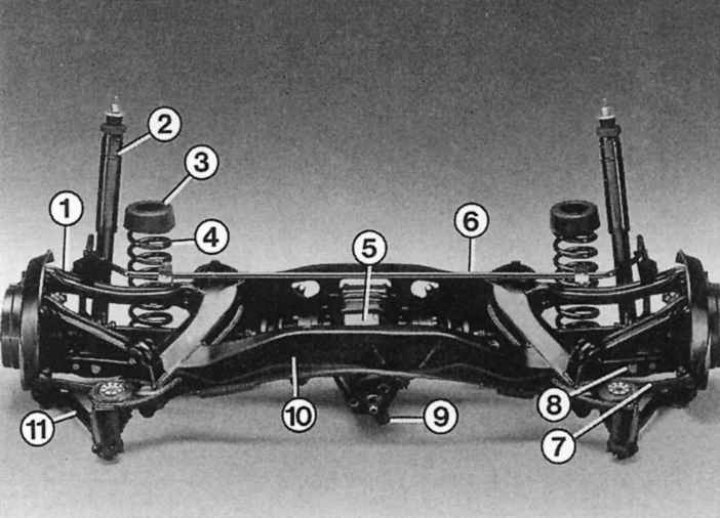
Each rear wheel is controlled by five independent space levers. These levers only allow wheel movements that do not impair driving performance. By placing the levers in a certain way, the designers have a wide range of options for achieving a compromise between high driving performance and comfort. This is not so simple, since if the suspension is set too softly, driving performance is impaired due to the so-called steering effect (co-management) rear wheels. On the contrary, passengers always complain if the suspension is too stiff.

Fig. 7.5. Rear suspension: 1 – camber lever; 2 – shock absorber; 3 – upper spring support; 4 –…

Fig. 7.5. Rear suspension: 1 – camber lever; 2 – shock absorber; 3 – upper spring support; 4 – spring; 5 – differential; 6 – stabilizer; 7 – diagonal lever; 8 – spring lever; 9 – cardan shaft flange; 10 – rear suspension subframe; 11 – pushing lever


All rear suspension parts are secured to a wide subframe 10 (Fig. 7.5), which is secured to the body bottom on four large rubber supports. The differential 5 is secured to the subframe in the middle. All five levers (spring, pull, push, camber and diagonal) on both sides they are attached via elastic connections to the subframe and wheel suspension.


Advantages of the rear suspension with spatial levers:

1. Together with the front suspension on double wishbones, it provides driving performance that is minimally dependent on the impact of lateral, braking and drive forces.

2. Although the suspension has a long travel, there are practically no side effects until its middle (widening the track or changing the toe angle). The result is excellent linearity of movement.

3. Negative camber value provides good lateral wheel slip. Throughout the entire suspension operation, the camber angle does not take a positive value.

[Publication reprinted from this resource: MERCEDESMAN.ru]

4. The vibrations of the rear part of the body that occur during braking and acceleration are leveled by 60%. Thanks to this, it does not rise during braking and does not sag during acceleration.

5. Thanks to three-stage insulation using elastic rubber elements between the wheels and the body, the noise from the chassis is practically inaudible in the cabin.

6. Reduced reactions to load changes. For example, when suddenly releasing the "gas" in a turn, there is resistance to reducing the turning radius.

7. Wheel alignment is adjustable using adjustable levers.
This article is available at: russian, bulgarian, belarusian, ukrainian, serbian, croatian, romanian, polish, slovak, hungarian
The article has been verified: Polyakov Zakhar Grigorievich
Share with friends:
◀ Previous
E-Class W210 / Car suspension
Next ▶

Front suspension — design description
General information about the suspension
Chassis of the T-model with a station wagon body
Ground clearance adjustment
Checking the wheel installation
Checking the condition of shock absorbers
Checking mudguards and play in steering rod ends
More similar articles for repairing other models

☛ Rear Suspension Trailing Arm Support Play — Check Mercedes W168 (1997-2004)
☛ Rear suspension design Mercedes W202 (1993-2000)
☛ General information about the rear suspension Mercedes W463 (1999-2019)
☛ Checking the condition of suspension and steering components Mercedes W163 (1997-2005)
☛ Rear suspension design of a car Mercedes W140 (1991-1998)
☛ Front and rear suspension — general information Mercedes Sprinter (1995-2000, diesel)
Link in different formats to this article
Comments and feedback from visitors
No comments yet


How much will 15 + 19 ?


W210 (1996-2002) 
  • General information
  • Vehicle description
  • Working conditions and tools
  • Car care
  • Diesel engines
  • Engine repair
  • Lubrication system
  • Cooling system
  • Injection system
  • Supply system
  • Exhaust system
  • Gasoline engines
  • Engine repair
  • Lubrication system
  • Cooling system
  • Control system
  • Power and exhaust system
  • Transmission
  • Clutch
  • Mechanical gearbox
  • Automatic gearbox
  • Drive shafts
  • Chassis
  • Car suspension
  • Steering
  • Tires and wheels
  • Brake system
  • Body
  • Exterior (external elements)
  • Interior (internal elements)
  • Doors and windows
  • Heating and ventilation
  • Electrical equipment
  • Equipment and devices
  • Power devices
  • Lighting and signaling
  • Electrical circuits
W124 (1984-1995) 
  • General information
  • Governing bodies
  • Driving and operation
  • Weekly care
  • Maintenance (gasoline)
  • Maintenance (diesel)
  • Troubleshooting
  • Power unit
  • I4 petrol engine
  • V6 petrol engine (SOHC)
  • V6 petrol engine (DOHC)
  • Diesel engines
  • Engine overhaul
  • Cooling system
  • Heating and ventilation
  • Fuel system (carburetor)
  • Injection system «Bosch CIS-E»
  • Injection system «Bosch HFM»
  • Diesel fuel system
  • Supply system
  • Starting and charging system
  • Ignition system (I4)
  • Ignition system (V6)
  • Preheating
  • Transmission
  • Clutch
  • Mechanical gearbox
  • Automatic gearbox
  • Drive shafts
  • Chassis
  • Brake system
  • Car suspension
  • Steering
  • Body
  • Exterior (external elements)
  • Interior (internal elements)
  • Doors, locks and windows
  • Electrical equipment
  • Equipment and devices
  • Switches
  • Headlights and lighting
  • Electrical circuits
W123 (1976-1985) 
  • General information
  • Introduction to the guide
  • Power unit
  • Engine device
  • Repair M102 engines
  • Repair M110 and M123 engines
  • Cooling and lubrication (M102)
  • Cooling (M110 and M123)
  • Ignition system
  • Power system «Stromberg»
  • Power system «Solex 4A1»
  • Fuel injection «K-Jetronic»
  • Fuel injection «L-Jetronic»
  • Transmission
  • Clutch
  • Mechanical gearbox
  • Automatic gearbox
  • Cardan and rear axle
  • Chassis
  • Front suspension
  • Rear suspension
  • Steering
  • Brake system
  • Body
  • Exterior (external elements)
  • Interior (internal elements)
  • Doors, locks and windows
  • Electrical equipment
  • Equipment and devices
  • Power devices
  • Electrical circuits
 
MercedesMan.ru © 2017–2026 · Mobile version · Read about Mercedes · Sitemap: EN BG BY UA RS HR RO PL SK HU · Feedback · Site search · Bookmark A-Class (W168) · C-Class (W201) · C-Class (W202) · C-Class (W203) · E-Class (W123) · E-Class (W124) · E-Class (W210) · G-Class (W463) · M-Class (W163) · S-Class (W116, petrol) · S-Class (W126, petrol) · S-Class (W140) · S-Class (W220) · Sprinter · Vito 1 · Vito 2 · Vario 814D ·
 
We only use cookies without which some of the site's features may not be available.