



Contents: Transverse levers ↡ Lower ball joint ↡ Shock absorber ↡ Stretcher ↡ Rack and pinion steering ↡ Suspension Geometry Terms ↡ New steering ↡
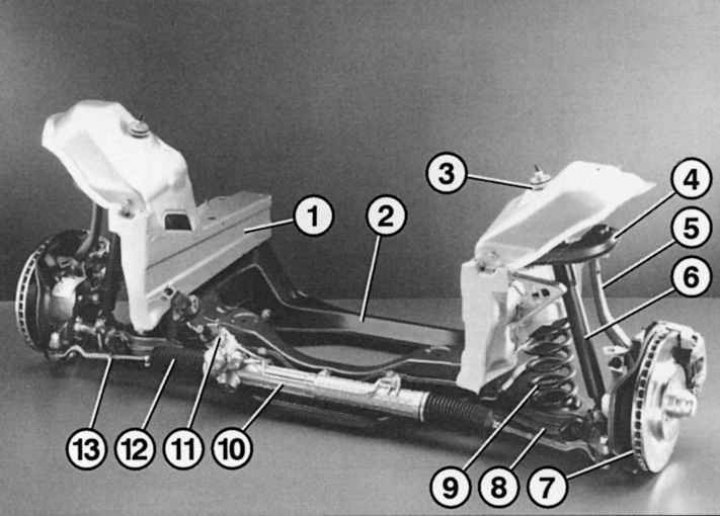
Fig. 7.1. Front suspension: 1 – body side member; 2 – supporting beam; 3 – shock absorber cup; 4 – upper transverse arm; 5 – steering knuckle; 6 – shock absorber; 7 – brake disc with caliper; 8 – lower wishbone; 9 – coil spring; 10 – steering rack housing; 11 – steering shaft with gear; 12 – steering rod mudguard; 13 – left steering rod
The design of the front suspension of the Mercedes E-class is shown in Fig. 7.1. The use of a modern double wishbone design has improved comfort, the guiding function of the suspension and the turning ability of the car. Each front wheel has an independent suspension to the body.
Front suspension on double wishbones. This design replaced the shock absorber strut on the previous model. It is also used on the S- and C-class models. With this design, the shock absorber and spring are installed separately. Thanks to the double wishbones, the shock absorbers are freed from the function of directing the front wheels, which allows them to better perform their main task - damping vibrations.
Transverse levers
Each front wheel is steered by two (upper and lower) triangular wishbones. Upper arm 4 (see fig. 7.1) connected directly to the body via a large rubber-metal hinge, and the lower arm is fixed to the load-bearing beam 2 of the front suspension.
Lower ball joint
The coil spring 9 and the shock absorber 6 rest on the body through the so-called lower ball joint, which has a variable elasticity characteristic and becomes more rigid with increasing damping force.
Shock absorber
The separate location of the shock absorber determines the precise behavior of the wheel when working out road irregularities. The result of the separate position of the spring and shock absorber is clearly visible in practice. For example, when driving straight ahead or in a crosswind. The Mercedes E-Class does not deviate to every rut on the road and only slightly deviates from the course with a sudden gust of wind.
Computer-calculated rubber elements of the front suspension with a double wishbone design (latin designation DQ) allow the wheels to change direction only within certain limits and thereby significantly improve the stability of the vehicle's behavior when braking and cornering. Thus, during shock absorption, the camber and toe-in angles of the wheels do not change significantly, which has a positive effect on the rolling resistance characteristic and tire wear. The suspension geometry in combination with the elastokinematics of the double wishbone design guarantee neutral or easily correctable vehicle cornering, which is an immutable principle of Mercedes-Benz when designing the chassis to ensure active safety.
Stretcher
Unlike other Mercedes passenger cars, the lower wishbones and steering gear of the E-Class are mounted on a supporting beam of the front suspension, which has the shape of a frame. This so-called subframe is in turn bolted to the front side members of the body and makes it easier to install the engine and front suspension during vehicle assembly. In addition, it increases passenger protection in the event of a frontal impact and serves to separate the chassis from the body. Thus, thanks to the subframe, vibrations and noise are transmitted less to the passenger compartment during movement. The engine mounts and steering are mounted on the subframe itself.
Rack and pinion steering
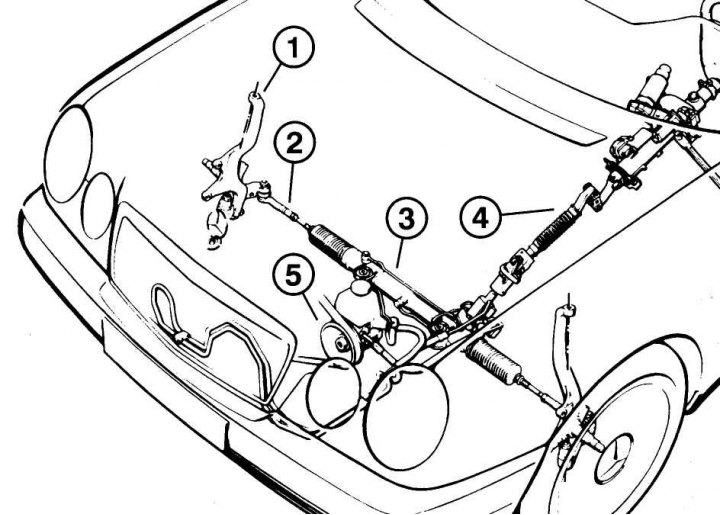
Fig. 7.2. Steering: 1 – steering knuckle; 2 – right steering rod; 3 – toothed rack housing; 4 – steering shaft (from two parts); 5 – power steering pump
A new feature in the design is the installation of the lower transverse levers in the forward direction. In addition, another modernization was made - rack and pinion steering with hydraulic booster replaced the previous "screw-and-nut" steering system, which no longer corresponded to the promising concept of Mercedes-Benz for lightweight design. The new design of the steering (Fig. 7.2) no longer has a pitman arm, intermediate levers, a stiffening plate and fastening elements. The steering rods are connected to the steering mechanism without intermediate bypass elements. The design thus ensures correct and precise control.
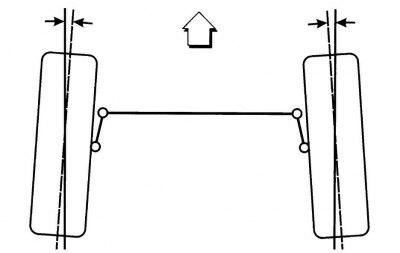
Fig. 7.3. Schematic representation of wheel alignment
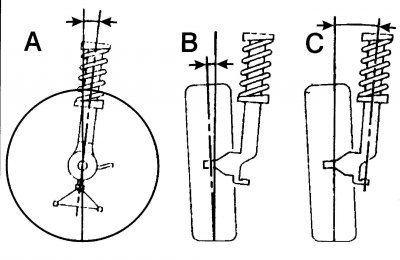
Fig. 7.4. Wheel installation angles: A – longitudinal tilt angle; B – camber angle; C – angle of transverse inclination
(Article borrowed from the web portal: MERCEDESMAN.ru)
Suspension Geometry Terms
Wheel alignment. The steering wheels are more closely aligned at the front than at the rear (have a kind of counter rolling motion) (Fig. 7.3). This equalizes the friction force between the road surface and the wheel, which tends to direct the left wheel to the left side and the right wheel to the right. Toe-in prevents wheel vibration and one-sided tire wear. When cornering, the inner wheel is pushed more in the direction of the turn to support the turning motion and experiences a greater load from the effect of the turning force than the outer wheel, thus the toe-in angle changes to the opposite (the wheels are brought closer together at the rear).
Collapse. Determines the tilt of the front wheels in the vertical plane (fig. 7.4, B). Wheel camber reduces the impact of road irregularities on steering, reduces steering effort and reduces the friction force of the wheels on the road surface.
Angle of transverse inclination of the wheel pivot axis. The angle between the axis of rotation of the wheel and the vertical (see Fig. 7.4, C). If you continue the line of this axis to the ground and determine the distance from it to the central point of contact of the wheel with the road, you get the rolling shoulder. It should be as small as possible to reduce the influence of side forces on control. The angle of transverse inclination together with the angle of longitudinal inclination affect the fact that when the wheels are turned, the car rises slightly, and when the steering wheel is released, the front wheels themselves return to the middle position.
Angle of longitudinal inclination of the wheel rotation axis. The angle between the axis of rotation of the wheel when viewed from the side and the vertical (fig. 7.4, A). Due to the longitudinal inclination angle, a traction force is applied to the front wheels rather than a pushing force. This is why the wheels tend to maintain a straight-line position.
New steering
The new steering design no longer has a pitman arm, intermediate lever, stiffening plate or fastening elements. The steering rods are connected to the steering gear without intermediate bypass elements. This not only simplifies installation, but also reduces weight. The design ensures correct and precise control. By attaching the steering to the subframe via elastic elements, the transmission of road surface irregularities to the steering wheel is significantly reduced, so that the new design, in addition to other advantages, also increases comfort. Since the steering gear is located rather in the inner part of the subframe, Mercedes engineers developed a steering shaft with two cross joints. They equalize some axial displacement between the steering gear and the steering shaft, and also serve to reduce vibrations, which are damped by a torsional vibration damper built into the first joint. The second joint with a cross is a rocking joint, which allows individual adjustment of the position of the steering column in length and height, which is also equipped with an electric drive.