



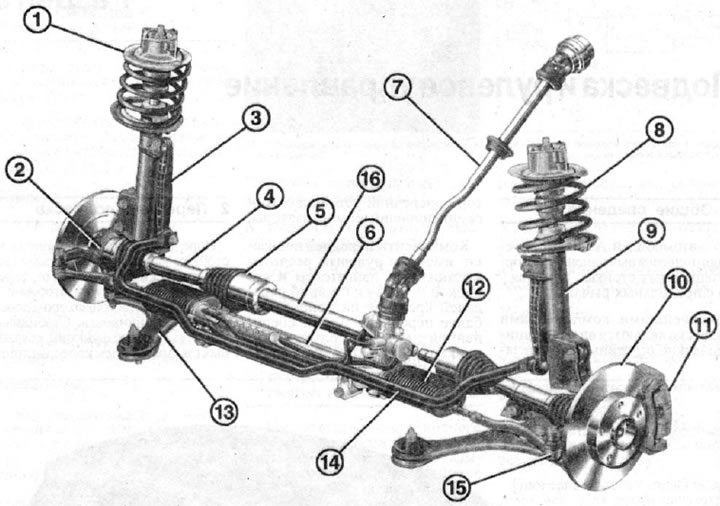
2.0 Front Suspension
1 - shock absorber strut, which is a shock absorber with a coil spring
2 - steering knuckle
3 - connecting strut of the anti-roll bar on the shock absorber
4 - half shaft
5 - inner joint (CV joint)
6 - rack and pinion steering mechanism
7 - steering column
8 - coil spring of shock absorber strut
9 - telescopic shock absorber
10 - brake disc
11 - brake caliper
12 - steering gear cuff
13 - independent suspension triangular arm
14 - torsion bar anti-roll bar
15 - Tie rod end
16 - intermediate drive shaft
The front suspension is made on MacPherson struts with coil springs, telescopic shock absorbers and a torsion stabilizer bar. The stabilizer does not perform functions related to the direction of the wheels, it is only connected by the corresponding struts to the shock absorber struts. The function of guiding the wheels is performed by two triangular levers of the independent suspension. The suspension components, together with the steering rack, engine and transmission, are mounted on the front axle cross member, which is connected to the body (see illustration 2.0).
Optimal driving characteristics and minimal tire wear are ensured by perfect wheel installation. If tires show abnormal wear or their camber and toe are set incorrectly, you should immediately contact a workshop to correct the camber and toe. Wheel alignment angles cannot be set independently, without a special device. The front wheel alignment angle for A-class cars is 0°29'10'.
The engine torque is transmitted to the front wheels via two axle shafts, each with two constant velocity joints. The front axle is maintenance-free.
Attention! Welding and straightening work on the load-bearing and guide elements of the front suspension is prohibited. When carrying out repair work, always replace self-locking nuts, as well as rusted bolts and nuts with new ones.