



All suspension mounting points are made on silent blocks (rubber-metal bushings). The steering knuckle is connected to the suspension arms via sealed ball joints (ball joints). The front wheel hub has adjustable tapered bearings.
| Characteristic | Meaning |
| Axial clearance of wheel bearing, mm | 0,01—0,02 |
Suspension springs
Depending on the model and configuration, several types of cylindrical springs are installed on vehicles in combination with upper support cups of varying thickness.
Suspension spring characteristics
| Spring type | Spring number | Wire diameter, mm | Draft (P=100 kgf) | Length (P=0 kgf) |
| 1 | 123.321.3704 | 14,3 | 27,0 | 460 |
| 2 | 123.321.3904 | 14,7 | 25,0 | 460 |
| 3 | 123.321.2104 | 14,75 | 23,3 | 447 |
| 4 | 123.321.2704 | 15,0 | 23,3 | 463 |
Upper Spring Support Cup Characteristics
| Letter index | Thickness of the bottom of the support cup, mm | Number of protrusions around the circumference of the cup |
| a | 8 | 1 |
| b | 13 | 2 |
| c | 18 | 3 |
| d | 23 | 4 |
Selection of suspension spring with upper support cup
There are four types of springs and support cups used in the front suspension of cars. The selection of the spring and support cup is made at the factory and must be maintained throughout the entire service life to avoid deterioration of the stability and controllability characteristics of the car.
When replacing a spring or support cup, be sure to install parts identical to the previous ones.
The spring for the support cup is selected based on the sum of points. This sum consists of the model point and the points of additional equipment.
Model | Spring No | Thickness of the bottom of the support cup, mm |
Car without air conditioning | ||
| "200" | 123.321.3704 | 13, 18 23 |
"230" | 123.321.3704 | 13, 18, 23 |
123.321.3904 | 8, 13, 18, 23 | |
| "250" | 123.321.2104 | 8, 13, 18, 23 |
| "280", "280E" | 123.321.2704 | 8, 13, 18, 23 |
Car with air conditioning | ||
| "200" | 123.321.3904 | 8, 13, 18, 23 |
"230" | 123.321.3904 | 8, 13, 18, 23 |
| 123.321.2704 | 8, 13 | |
"250" | 123.321.2104 | 8, 13, 18, 23 |
| 123.321.2704 | 8, 13, 18 | |
"280", "280E" | 123.321.2704 | 13, 18, 23 |
123.321.3904 | 8, 13 | |
Each type of equipment installed on order also corresponds to a certain number of points:
- 7 - air conditioning
- 4 (5) — automatic transmission
- 4 - additional heater
- 4 - equipment for taxi
- 3 - sunroof
- 3 - anti-lock wheel system
- 3 - with separately increased useful mass
- 2 - body position regulator or limited-slip differential
- 2 - high-capacity battery
- 1 - 5-speed manual transmission
- 1 - airbag
- 1 - additional protection for the bottom of the car
- 1 - headlight washers
- 1 - front seats with electrical adjustment
- 1 - on-board telephone.
Petrol engine cars with standard and reinforced suspension
Total points | Spring type | Height of support cup | |
ordinary | reinforced | ||
| 13 | 1 | 8 (a) | 13 (b) |
| 15—19 | 1 | 13 (b) | 18 (c) |
| 20—24 | 1 | 13 (b) | 23 (d) |
| 25—29 | 2 | 8 (a) | 13 (b) |
| 30—34 | 2 | 13 (b) | 18 (c) |
| 35—39 | 2 | 18 (c) | 23 (d) |
| 40—44 | 3 | 8 (a) | 13 (b) |
| 45—49 | 3 | 13 (b) | 18 (c) |
| 50—54 | 3 | 18 (c) | 23 (d) |
| 55—60 | 4 | 8 (a) | 13 (b) |
| 61—66 | 4 | 13 (b) | 18 (c) |
| 67—72 | 4 | 18 (c) | 23 (d) |
Characteristic | Meaning |
Numbers of support cups for front springs height, mm | |
| 8 |
| 13 |
| 18 |
| 13 |
Shock absorbers
The cars use gas-filled shock absorbers, which serve to dampen vibrations of the front wheels. They are connected to the body and suspension arms.
Control parameters of front shock absorbers
Number | Color marking (design execution) | Piston stroke, mm | |
new | acceptable | ||
123.323.1700 | One longitudinal stroke is white (with separating piston) | 0 +2 | 32,0 |
123.323.2000 | One cross stroke is white (without separating piston) | 0 +2 | 0,0 |
Additional shock absorber spring combination
Engine model | Spring No | Shock absorber no |
Without body level adjustment | ||
| "200" | 123.321.3704 | — |
| "230" | 123.321.3904 | — |
| "250" | 123.321.2104 | 123.323.1700 |
| "280" | 123.321.2704 | 123.323.2000 |
With adjustable body level | ||
| "200" | 123.321.3704 | — |
| "230" | 123.321.3904 | 123.323.1700 |
| "250" | 123.321.2104 | — |
| "280", "280E" | 123.321.2704 | 123.323.2000 |
Anti-roll bar
Characteristic | Meaning |
Stabilizer bar diameter, mm | |
| 24 |
| 26 |
Front wheel hubs
The front wheel hub is mounted on two tapered roller bearings.
Characteristic | Meaning |
Axial clearance in hub bearings, mm | |
| 0,01—0,02 |
| 0,05 |
| Axial runout of the inner flange of the hub, no more than, mm | 0,03 |
| Permissible radial runout in the area of the wheel rim seat, mm | 0,05 |
Front wheel bearing | |
| M 48548S / 10, No.001.982.902 |
| M 12649/10, No.006.981.6305 |
| Radial runout of the bearing seats of the steering knuckle, no more than, mm | 0,05 |
Tightening torques of main threaded connections, kgf·m
Connection type | Meaning |
| Fastening the telescopic stand to the lower support | 1,9 |
| Stabilizer bar tip bolt | 6,5 |
| Stabilizer bar mounting bracket | 1,9 |
| Shock absorber mounting nut to the body | 2,0 |
| Upper control arm | 8,0 |
| Lower suspension arm | 17,9 |
Ball joint | |
| 4,1 |
| 8,0 |
| Suspension support pipe | 3,4 |
| Spring support cup | 1,9 |
| Nut for fastening the eccentric bolt of the suspension arm | 12,0 |
| Steering arm to steering knuckle mounting bolt | 8,0 |
| Brake caliper to steering knuckle mounting bolt | 11,5 |
| Hub Nut | 1,2 |
| Wheel mounting bolt | 11,0 |
Front suspension
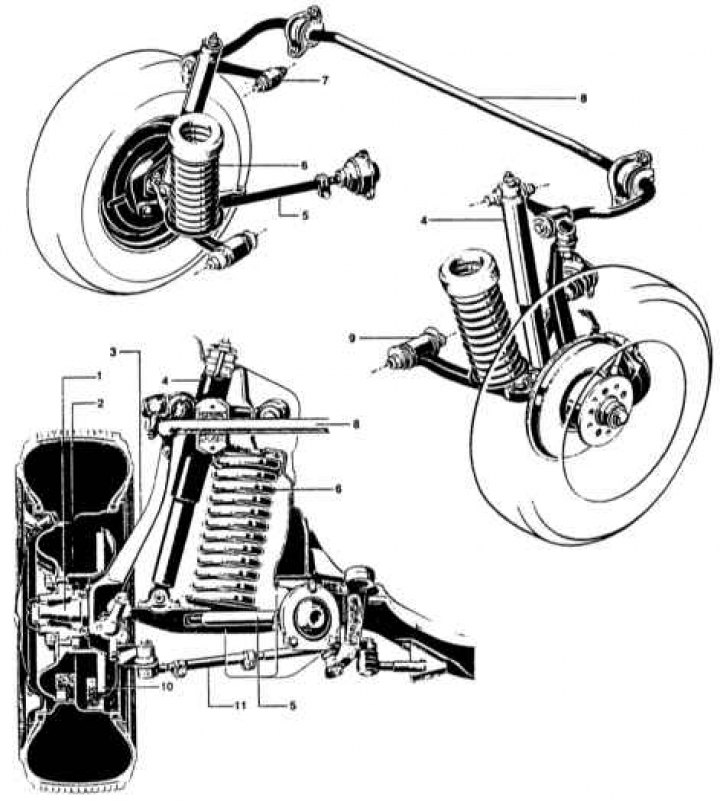
1 - wheel hub; 2 - wheel bearing; 3 - steering knuckle; 4 - shock absorber; 5 - barbell; 6 - suspension spring; 7 - upper arm; 8 - stabilizer; 9 - lower arm; 10 - brake disc; 11 - steering gear transverse rod