
Cars BMW Cars Volkswagen Cars Chevrolet Cars Land Rover Cars Lada Cars Honda Cars Peugeot
English Русский
Български
Беларускі
Український
Српски
Hrvatski
Română
Polski
Slovenský
Magyar
Bookmark News and articles Sitemap Feedback Site search
MercedesMan.ru


A-Class C-Class E-Class G-Class M-Class S-Class Others
W123 (1976-1985) W124 (1984-1995) W210 (1996-2002)
  • Main
  • E-Class
  • W123 (1976-1985)
  • Chassis
  • Front suspension
  • Removal and installation the front anti-roll bar

Removal and installation the front anti-roll bar (Mercedes-Benz E-Class W123)

0
Stabilizer bar

Stabilizer bar


1. Apply the parking brake, raise the front of the vehicle and support the lower control arms. Remove the front wheels.

2. Unscrew the mounting bolts of both stabilizer rod ends. Fix the relative position of the washers and rubber bushings.

3. Remove the brake master cylinder and vacuum booster (see Master brake cylinder and Vacuum brake booster).

4. If necessary, drain the coolant, remove the engine cooling system hoses, rods, vacuum line and wires that interfere with access to the stabilizer bar.

5. Unscrew the fastening nuts on the partition and remove the brackets.

6. Remove the rubber bushings from the stabilizer bar, remove the end caps from the body.

7. Remove the stabilizer from one side of the car. Remove the rubber bushings from both ends of the stabilizer bar.

8. Conduct defect detection of rubber products and replace them if necessary.

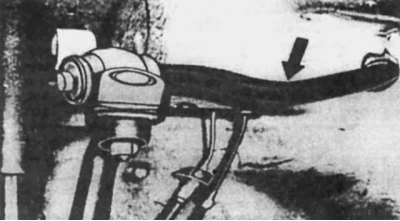
9. Install in the reverse order of removal. In this case, the bending points of the rod (marked with an arrow) should be positioned as shown in the photo, and the grooves of the clamps should be located above the grooves of the rubber bushings.

10. Do not fully tighten the mounting bolts and nuts until the suspension is loaded with the full weight of the vehicle.
This article is available at: russian, bulgarian, belarusian, ukrainian, serbian, croatian, romanian, polish, slovak, hungarian
The article has been verified: Levin Kirill Glebovich
Share with friends:
◀ Previous
E-Class W123 / Front suspension
Next ▶

Checking, removing and installing shock absorbers
Removal and installation front suspension springs
Design and technical characteristics of the front suspension
Removal and installation the front suspension assembly
Removal, installation and adjustment of the hub and front wheel bearings
Removal, disassembly and installation of the steering knuckle
Removal and installation the upper suspension arm
Removal and installation the lower arm of the front suspension
More similar articles for repairing other models

☛ Front catalytic converter — removal and installation Mercedes W168 (1997-2004)
☛ Front suspension anti-roll bar — removal and installation Mercedes 190 (W201) (1982-1993)
☛ Removal and installation the front anti-roll bar Mercedes W463 (1999-2019)
☛ Access to the right front seat storage compartment Mercedes W163 (1997-2005)
☛ Front anti-roll bar Mercedes W220 (1998-2005)
☛ Removal and installation the front anti-roll bar Mercedes Sprinter (1995-2000, diesel)
Link in different formats to this article
Comments and feedback from visitors
No comments yet


How much will 16 + 11 ?


W210 (1996-2002) 
  • General information
  • Vehicle description
  • Working conditions and tools
  • Car care
  • Diesel engines
  • Engine repair
  • Lubrication system
  • Cooling system
  • Injection system
  • Supply system
  • Exhaust system
  • Gasoline engines
  • Engine repair
  • Lubrication system
  • Cooling system
  • Control system
  • Power and exhaust system
  • Transmission
  • Clutch
  • Mechanical gearbox
  • Automatic gearbox
  • Drive shafts
  • Chassis
  • Car suspension
  • Steering
  • Tires and wheels
  • Brake system
  • Body
  • Exterior (external elements)
  • Interior (internal elements)
  • Doors and windows
  • Heating and ventilation
  • Electrical equipment
  • Equipment and devices
  • Power devices
  • Lighting and signaling
  • Electrical circuits
W124 (1984-1995) 
  • General information
  • Governing bodies
  • Driving and operation
  • Weekly care
  • Maintenance (gasoline)
  • Maintenance (diesel)
  • Troubleshooting
  • Power unit
  • I4 petrol engine
  • V6 petrol engine (SOHC)
  • V6 petrol engine (DOHC)
  • Diesel engines
  • Engine overhaul
  • Cooling system
  • Heating and ventilation
  • Fuel system (carburetor)
  • Injection system «Bosch CIS-E»
  • Injection system «Bosch HFM»
  • Diesel fuel system
  • Supply system
  • Starting and charging system
  • Ignition system (I4)
  • Ignition system (V6)
  • Preheating
  • Transmission
  • Clutch
  • Mechanical gearbox
  • Automatic gearbox
  • Drive shafts
  • Chassis
  • Brake system
  • Car suspension
  • Steering
  • Body
  • Exterior (external elements)
  • Interior (internal elements)
  • Doors, locks and windows
  • Electrical equipment
  • Equipment and devices
  • Switches
  • Headlights and lighting
  • Electrical circuits
W123 (1976-1985) 
  • General information
  • Introduction to the guide
  • Power unit
  • Engine device
  • Repair M102 engines
  • Repair M110 and M123 engines
  • Cooling and lubrication (M102)
  • Cooling (M110 and M123)
  • Ignition system
  • Power system «Stromberg»
  • Power system «Solex 4A1»
  • Fuel injection «K-Jetronic»
  • Fuel injection «L-Jetronic»
  • Transmission
  • Clutch
  • Mechanical gearbox
  • Automatic gearbox
  • Cardan and rear axle
  • Chassis
  • Front suspension
  • Rear suspension
  • Steering
  • Brake system
  • Body
  • Exterior (external elements)
  • Interior (internal elements)
  • Doors, locks and windows
  • Electrical equipment
  • Equipment and devices
  • Power devices
  • Electrical circuits
 
MercedesMan.ru © 2017–2026 · Mobile version · Read about Mercedes · Sitemap: EN BG BY UA RS HR RO PL SK HU · Feedback · Site search · Bookmark A-Class (W168) · C-Class (W201) · C-Class (W202) · C-Class (W203) · E-Class (W123) · E-Class (W124) · E-Class (W210) · G-Class (W463) · M-Class (W163) · S-Class (W116, petrol) · S-Class (W126, petrol) · S-Class (W140) · S-Class (W220) · Sprinter · Vito 1 · Vito 2 · Vario 814D ·
 
We only use cookies without which some of the site's features may not be available.