



Use a charged battery when testing.
Set the ammeter to the largest scale (from 0.5 mA to 0.5 A). Remove the ground wire from the battery. Place the ammeter between the negative battery terminal and the ground wire. Connect the positive terminal of the ammeter to the removed battery ground wire, and the negative terminal of the ammeter to the negative battery terminal.
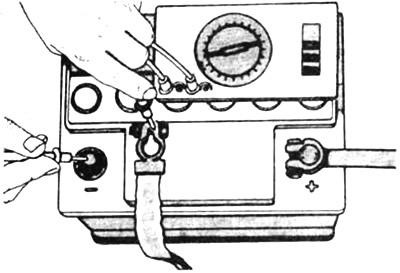
Note: This test can also be performed using a test lamp. If the lamp connected between the removed grounded battery wire and the negative terminal of this battery does not light, you will also need to use an ammeter.
Turn off all electrical consumers, disconnect the electric clock and close the car doors.
Switch from the ampere scale to the milliamp scale until a reading is obtained (leakage current of 1-3 mA is allowed). Remove fuses one after another, interrupting various circuits. If the ammeter reading becomes zero when removing any of the fuses, it will be clear that the leak is in the circuit that is currently broken. The sources of the malfunction may be rusty and dirty contacts, wires with worn braiding, internal short circuits in the blocks.
If no current is observed in the electrical circuit, then the connections of non-insulated elements should be removed: this could be the starting device (starter), alternator or ignition system.
Reconnect the battery.
[Article text obtained from the website: MercedesMAN]