



Contents: Electrolyte level ↡ State of charge ↡ Charging the battery ↡ Removal and installation the battery ↡ Battery disposal ↡ Starting the engine with a…↡ Launch with a tug ↡ If the engine does not start ↡ With a manual transmission installed ↡ With automatic transmission installed ↡
Electrolyte level
The battery is maintenance-free. It is filled with an electrolyte - a solution of sulfuric acid in distilled water. Since water may evaporate from the solution, you need to check the electrolyte level from time to time and add distilled water. The electrolyte level should be between the marks on the battery case. The factory installed battery is protected against overflow. To add water, unscrew the cap on top of the battery and pour in distilled water until the electrolyte is visible.
State of charge
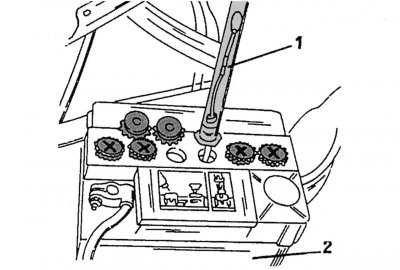
Figure 303. Checking the density of the electrolyte: 1 - hydrometer; 2 — electrolyte level mark
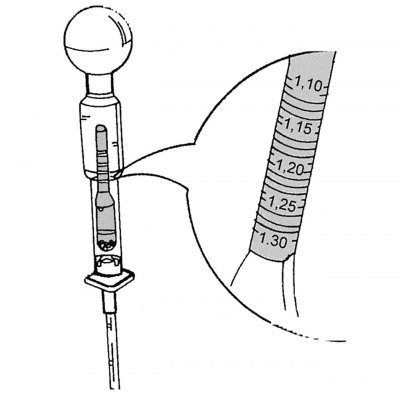
Figure 304. Measuring the density of the electrolyte
A hydrometer is used for testing. Unscrew the cap on top of the battery and push the tip of the device through the rubber overflow protection (figure 303). Using the rubber bulb of the hydrometer, pump out enough electrolyte so that the float of the device floats freely in the liquid (figure 304). Depending on the battery charge level, the electrolyte has a different density, which is determined by the immersion level of the device's float. At a value of 1.28 the battery is fully charged, at a value of 1.12 it is fully discharged. Intermediate values indicate the corresponding state of charge.
Charging the battery
Distilled water can be added to a deeply discharged battery only after charging. When charging, the electrolyte level rises, so a fully charged battery can therefore "boil". The charging current should initially not exceed 10% of the battery capacity. Depending on the charger used, the charging current will gradually decrease. The battery is fully charged when the specific gravity of the electrolyte does not change for 2 hours.
The battery caps must be removed and placed on the filler holes to allow the explosive gas formed from oxygen and hydrogen to escape. Since it can be difficult to avoid electrolyte splashes during charging, it is recommended to cover the surface around the battery, for example with a newspaper. When charging, the closed room must be ventilated. Under no circumstances should you use open fire.
When using a household charger, the battery does not need to be removed from the car and the wires do not need to be disconnected. When using a fast charger, it is necessary to disconnect both battery terminals to avoid damaging the generator diodes, electronic devices, radio, etc. In this case, the charging current should not exceed 50% of the battery capacity, the charging time should not exceed 30 minutes.
Removal and installation the battery
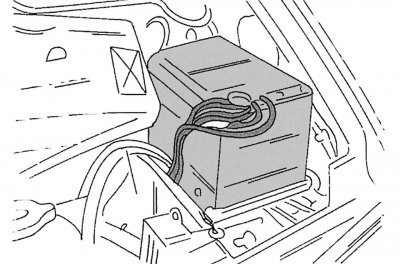
Figure 305. Battery location
The battery is installed in the engine compartment in the location shown in the figure 305. Before removing the battery, turn off the ignition. Remove the side and top plastic protective covers. Unscrew and remove the negative and positive terminals. Loosen the battery holder bolts, remove them, and then remove the battery. The negative terminal should be disconnected first. Before installation, first clean the terminals and lubricate with terminal compound. First, connect and screw on the positive wire. Tighten the battery mounting bolts to 20 Nm.
Note: If your vehicle has a radio with anti-theft code protection, you will be required to enter the code after removing the battery.
If the car is not used for a long time, it is necessary to disconnect the negative cable so that such consumers of electricity as, for example, a clock, do not discharge the battery. The battery must be charged at least once every 3 months, as a discharged battery fails faster.
Battery disposal
When replacing a battery, the old one must be disposed of. The battery must not be disposed of with household waste. You should find a place that accepts used batteries. When transporting the battery in a car, care must be taken to ensure that it does not tip over. In this case, the electrolyte will leak and the car will be damaged. After working with the battery, you must wash your hands - do not wipe them on your clothes.
Starting the engine with a discharged battery
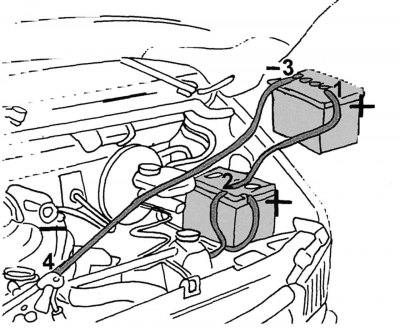
Figure 306. Connection order during "lighting": 1 - positive terminal of the battery, from which the car is "jump-started"; 2 - positive terminal of the discharged battery; 3 - negative terminal of the battery, from which the car is "lit"; 4 - connection to the "ground" on the cylinder block
The easiest way is to use jumper cables, which should have sufficient cross-section and reliable terminals. It is better to buy more expensive copper wires. The insulation on cheaper aluminum wires gets hot, so you can burn your fingers when removing the terminals. First connect the positive wire to both positive terminals, then the negative. Figure 306 shows how the wires should be connected.
The following precautions should be taken into account:
- the voltage and capacity of the batteries must be the same;
- to avoid short circuits with the "ground", the cars should not touch each other;
- turn off all electricity consumers;
- do not connect the negative wire from the donor battery to the negative terminal of the battery being charged. In Figure 306 this wire is connected to the cylinder block;
- the engine of the car from which the "lighting" is done must be stopped!
Launch with a tug
Careless towing may cause serious damage. Remember that when the engine is not running, neither the brake booster nor the power steering operates. For this reason, it is not recommended to use this method. In case of emergency, the following precautions must be strictly observed:
- the battery must be installed and connected;
- if the engine does not start immediately, the catalytic converter may be damaged;
- a reliable towing bar should be used for towing;
- the preheating system indicator light should go out;
- engage 2nd or 3rd gear;
- after starting to move, slowly release the clutch pedal and press the accelerator pedal.
You can also start the engine by towing a car with an automatic transmission. In this case, you must adhere to the following precautions:
- turn the ignition key to position 2 and wait until the preheating device lamp goes out;
- move the gearshift lever to position N;
- start towing (a reliable towing rod is a must). When the gearbox is cold, do not tow at a speed of more than 25 km/h, when it is warmed up - more than 40 km/h. Maintain this speed for about 2 minutes so that the necessary pressure is built up in the gearbox;
- move the gearshift lever to position 2;
- do not press the gas pedal until the transmission has cranked the engine. After the engine starts, immediately move the gearshift lever to position N.
If the engine does not start
In this case, the car must be towed, taking into account the following:
- the brake booster and power steering do not function when the engine is not running;
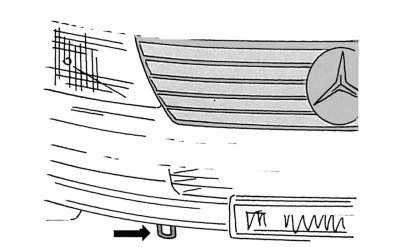
Figure 307. Towing eye
- for towing, use only a reliable towing bar, the location of which is shown in the figure 307.
With a manual transmission installed
Towing is permitted for no more than 100 km without removing the propeller shaft. Set the gearshift lever to neutral position. If the towing distance is longer, remove the propeller shaft.
With automatic transmission installed
[Original article is on the portal: MercedesMan.ru]
Towing is permitted for no more than 50 km without removing the drive shaft. Do not exceed 40 km/h. If the towing distance is longer, remove the propeller shaft.