



2. Clean the brake lines with a low temperature cleaner.
Caution! The brake lines are coated with a synthetic polymer film to protect against corrosion. If the film is damaged, this may lead to corrosion of the lines. For this reason, do not clean the brake lines with a wire brush, file or screwdriver.
3. Using a lamp, check the brake lines from the master cylinder to the individual wheel cylinders. The master cylinder is located in the engine compartment under the brake fluid reservoir.
Caution! The brake lines must not be bent or compressed. They must also be free of corrosion pits and abrasion points. Otherwise, the line leading to the nearest disconnection point must be replaced.
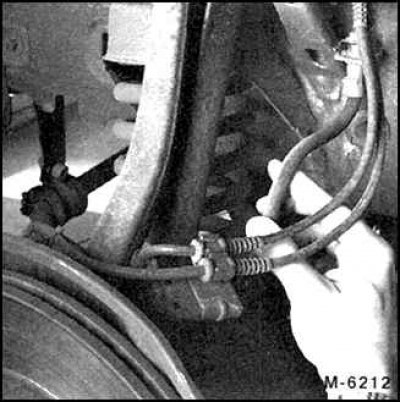
Caution! Brake hoses connect the brake lines to the wheel brake cylinders on the moving parts of the vehicle. They are made of high-pressure-resistant material, but over time it can become porous, swollen or cut by sharp objects. In this case, these lines must be replaced immediately.
Original can be found on the website [www.mercedesman.ru]
Caution! Manually bend the brake hoses back and forth to determine if there is damage. These hoses must not be twisted. Pay attention to the color marking strip!
4. Turn the steering wheel left and right until it stops. The brake hoses should not touch any parts of the car in any position.
5. The connection points of the brake drive pipes and brake hoses must not be wetted with protruding brake fluid.
Caution! If the reservoir and seals are wet with escaping brake fluid, this does not necessarily indicate a faulty master cylinder. Most likely, brake fluid may be leaking through the vent in the cap or through the seal in the cap.
6. Lower the car.
7. Turn the steering wheel fully left and right again and check to see if the brake hoses are in any way touching the vehicle parts.