



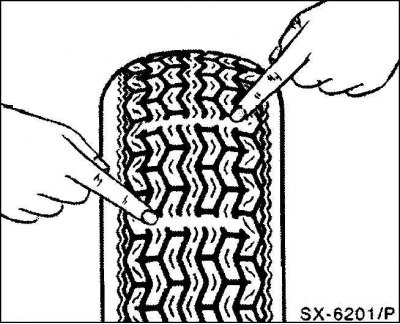
Tires of balanced wheels wear approximately evenly over the entire tread path, provided that the prescribed inflation pressure is strictly observed, the wheels are correctly positioned, and the shock absorbers are functioning normally. If tires wear unevenly, see the technical diagnostics of faults in the relevant chapter. It is impossible to draw a definite conclusion about the durability of tire products, since their service life depends on various factors:
- road surface;
- air pressure in inflated tires;
- driving mode;
- weather (meteorological conditions).
First of all, when driving in a sporty mode, with sharp acceleration and strong braking, the tires are subject to rapid wear.
Attention! The State Traffic Safety Inspectorate requires that tires wear only to a tread groove depth of 1.6 mm, namely, the tread grooves must have a depth of at least 1.6 mm along the entire tread. However, for safety reasons, we recommend replacing tires when the tread depth is at least 2 mm.
If the tread depth approaches the expected permissible tread groove depth, i.e. if the wear indicator located at any point on the tire circumference no longer records the tread pattern, then the tires must be replaced.
Attention! M+S – passenger car tires for driving on dirty and snowy roads with a special tread pattern have sufficient impact on dirt and snow only if their tread pattern still has a depth of at least 4 mm.
Warning! Examine the tire for cuts and use a small screwdriver to determine the depth of the cuts. If the cuts reach the tire frame, the steel cord of the radial tire is subject to corrosion due to penetrating water. Due to this, under certain conditions, the tread pattern is torn off from the frame and the tire breaks. Therefore, for safety reasons, replace the tire if there are deep cuts in the tread pattern.