



Warning! The brake fluid used in the hydraulic clutch system is poisonous, so if it gets on your skin, immediately rinse the area with plenty of water. If the fluid gets into your eyes or inside your body, you should immediately consult a doctor. Some fluids are highly flammable and can catch fire even from contact with hot vehicle components. In addition, the fluid used in the hydraulic clutch system dissolves paint and plastic, so if the fluid gets on your vehicle's paintwork, rinse it with plenty of water. This fluid is also hygroscopic, i.e. it absorbs moisture from the air, and therefore it is not recommended to use the fluid if it has been stored in an open container for a long time.
Warning! When brake pads are in operation, brake dust is formed, which contains asbestos, which is harmful to health. Therefore, when cleaning brake pads, do not use compressed air and do not inhale the dust.
Removal
Caution: When installing the rear brake caliper, new mounting bolts must be used.
1. Raise the rear of the vehicle and secure it on stands. Remove the corresponding rear wheel.
2. To reduce brake fluid loss, remove the cap from the brake system's refill reservoir, cover the reservoir neck with polyethylene and screw the cap back on. This is necessary so that the cap seals the refill reservoir. Alternatively, use a clamp to pinch the brake hose going to the caliper.
3. Clean the area around the brake hose connector and the caliper. Loosen the connector that secures the brake hose to the caliper.
4. Remove the brake pads.
5. Unscrew the caliper mounting bolts, then unscrew the caliper from the brake hose and remove it from under the car.
Caliper repair
Piston location in the rear brake caliper
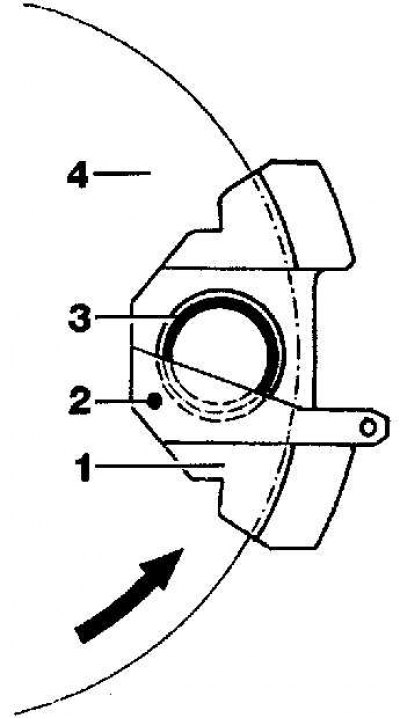
1 – support;
2 – measuring template;
3 – piston;
4 – brake disc
1. Carefully clean the caliper of brake dust and dirt.
Original article is on the portal: www.mercedesman.ru
2. Mark the location of the pistons in the caliper so that they can be installed correctly in their places.
3. Remove the pistons from the caliper, which can be done by using low-pressure air supplied to the brake cylinder through the brake hose hole. In this case, install a wooden block instead of brake pads. Remove the dust covers from the pistons.
4. Using a small screwdriver, remove the O-rings from the grooves in the caliper bores.
5. Wash all parts in methylated spirits or clean brake fluid and wipe them dry. Use compressed air to clean pipes and holes.
6. Check the condition of all caliper parts and replace worn or damaged parts.
7. Pay special attention to the cylinder and piston. If there are scratches, marks, wear or pitting, the piston and cylinder must be replaced, which means the caliper assembly must be replaced.
8. Regardless of the condition, replace all rubber seals.
9. When installing, make sure all parts are clean and dry and that each piston fits into its own hole.
10. Dip the pistons and new piston seals in brake fluid and apply a thin layer of brake fluid to the piston bores in the caliper.
11. Install the sealing rings into the caliper holes.
12. Before installing the piston in the caliper, turn it so that the protrusion on the piston flange is on top. Mercedes-Benz recommends using a special template to check the correct installation of the piston in the caliper (see picture). This arrangement of the piston eliminates squealing when the brakes are applied.
Installation
1. Using a suitable tap, clean the holes for the caliper mounting bolts.
2. Screw the caliper onto the brake hose coupling.
3. Install the caliper in place and secure with bolts, tightening them to the required torque.
4. Tighten the brake hose coupling to the caliper to the specified torque.
5. Install the brake shoes and bleed the hydraulic brake system. If all precautions have been taken when working on the hydraulic brake system, it is sufficient to bleed only the corresponding rear brake.
6. Install the wheel, then lower the vehicle to the ground and tighten the wheel mounting bolts to the specified torque. Check the brake fluid level.