



Warning! When brake pads are in operation, brake dust is formed, which contains asbestos, which is harmful to health. Therefore, when cleaning brake pads, do not use compressed air and do not inhale the dust.
Examination
Attention! If it is necessary to replace the brake disc, it is also necessary to replace the second brake disc to ensure uniform braking. When replacing the brake discs, it is also necessary to replace the brake pads.
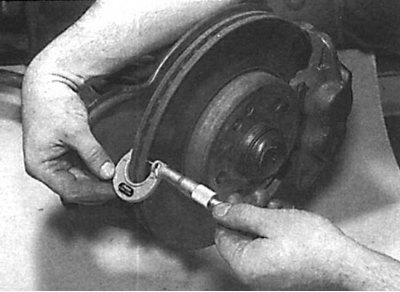
Using a micrometer to measure the thickness of the working part of the brake disc
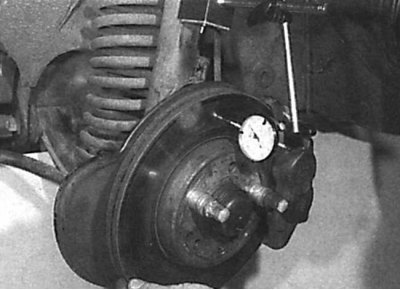
Using a dial indicator to check brake disc runout
1. Apply the handbrake, then raise the front of the car and secure it on stands. Remove the relevant front wheel.
2. Place a 10mm thick washer on the wheel mounting bolt and screw the mounting bolt into the hole located on the opposite side of the brake disc mounting screw. 3. Slowly rotate the brake disc so that it can be viewed from both sides. The wear of the brake disc from the pads should be within acceptable limits. If there are cracks on the disc, the disc must be replaced.
4. Using a micrometer, measure the thickness of the brake disc (see Fig. Using a micrometer to measure the thickness of the working part of the brake disc).
5. Use a dial indicator to check the runout of the brake disc. Attach the dial indicator to any convenient location and, by rotating the brake disc, determine its runout at a distance of 10 mm from the outer edge (see Fig. Using a dial indicator to check brake disc runout).
6. Before checking the brake disc runout, make sure the hub bearing is in good condition.
7. Check the brake disc for cracks, especially around the wheel bolt holes, and for wear or mechanical damage, and replace it if necessary.
Removal
Attention! When installing the brake disc, it is necessary to use new mounting bolts and new brake disc mounting screws.
[Article borrowed from the web portal: mercedesman]
Removal the front brake caliper
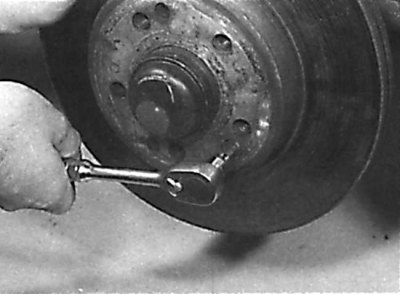
Unscrewing the screw that secures the brake disc to the hub
1. Remove the wheel mounting bolt with the thick washer that was installed when checking the disc runout.
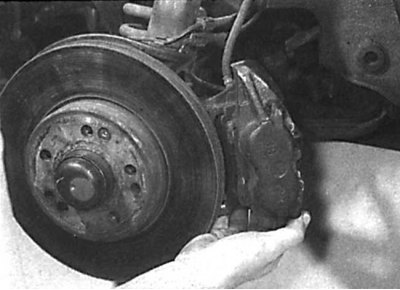
2. Unscrew the two bolts and remove the front brake caliper together with the brake pads and, using soft wire, tie it to the front strut. Do not stretch or twist the brake hose. When installing the caliper, you must use new bolts for its fastening.
3. Unscrew the screw that secures the brake disc to the hub. When installing the brake disc, you must use a new screw to secure it.
4. Remove the brake disc from the hub, noting the location of the mounting pins. If the brake disc fits tightly on the hub, tap it with a mallet from the back of the disc.
Installation
Installing a new front brake disc mounting screw
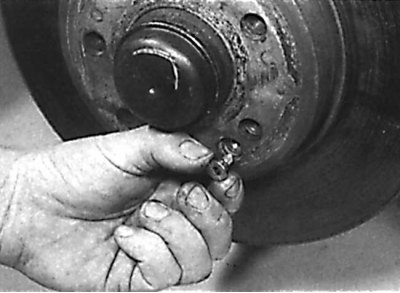
1. Before installing the brake disc, use a suitable tap to clean the threads in the hole for the caliper mounting bolts to the steering knuckle. Also clean the threads in the hole for the brake disc mounting screw to the hub.
2. Check and, if necessary, clean the mating surfaces of the brake disc and hub, and check that the mounting pins are in place. When installing a new disc, remove the protective coating from its surface.
3. Install the brake disc on the hub, making sure it is firmly secured with the mounting pins. Secure the brake disc with a new screw, tightening it to the required torque.
4. Reinstall the brake caliper and secure it with two new bolts, tightening them to the specified torque.
5. Install the wheel, then lower the car to the ground and tighten the wheel mounting bolts to the specified torque. Press the brake pedal several times to press the brake pads against the brake disc.