



Warning! The brake fluid used in the hydraulic clutch system is poisonous, so if it gets on your skin, immediately rinse the area with plenty of water. If the fluid gets into your eyes or inside your body, you should immediately consult a doctor. Some fluids are highly flammable and can catch fire even from contact with hot vehicle components. In addition, the fluid used in the hydraulic clutch system dissolves paint and plastic, so if the fluid gets on your vehicle's paintwork, rinse it with plenty of water. This fluid is also hygroscopic, i.e. it absorbs moisture from the air, and therefore it is not recommended to use the fluid if it has been stored in an open container for a long time.
Removal
1. Remove the ground cable from the battery.
2. Disconnect the electrical connector from the brake fluid level sensor.
3. Press the brake pedal several times to fill the brake booster with air or relieve pressure in the servomotor hydraulic unit.
4. Remove the brake fluid reservoir cap and use a syringe to pump out the brake fluid. Alternatively, unscrew any bleeder nipple and, while pressing the brake pedal, drain the brake fluid through a plastic pipe into a suitable container.
5. Disconnect the hose supplying fluid to the hydraulic clutch system from the brake system replenishment reservoir and close it with a plug.
6. Pull the reservoir up and off the master cylinder. Remove the reservoir rubber seal from the master cylinder and plug the holes.
7. Clean the brake pipe connections to the master cylinder. Label the brake pipes that go to the master cylinder. Place a clean rag under the master cylinder, unscrew the brake pipe mounting nuts and move the brake pipes away from the master cylinder. Close the ends of the pipes with the appropriate plugs.
8. Remove the two nuts securing the master cylinder to the brake booster and remove the master cylinder. Remove the O-ring from the rear of the master cylinder.
Caution! Remove the master brake cylinder only after disconnecting it from the brake booster pushrod, otherwise the brake booster will be damaged.
Repair
Please note: There are two types of brake cylinders installed on vehicles, so please consider the type of brake cylinder when purchasing parts.
Teves Master Brake Cylinder
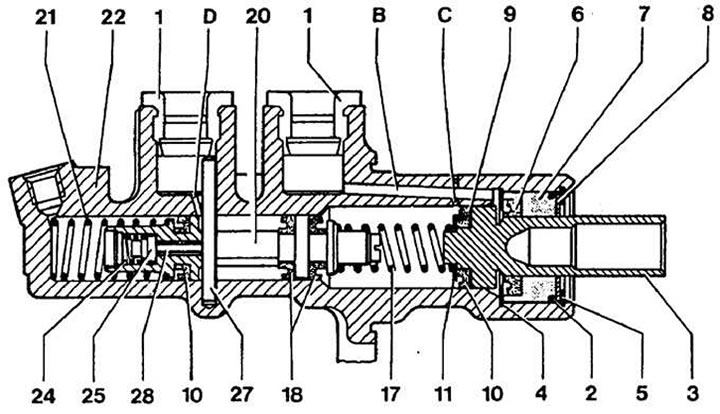
1 – sealing bushings for fastening the refill tank; 2 – sealing ring; 3 – primary piston; 4 – thrust washer; 5 – retaining ring; 6 – sealing ring; 7 – bushing; 8 – washer; 9 – sealing ring; 10 – sealing ring; 11 – spring seat; 17 – spring; 20 – secondary piston; 21 – spring; 22 – main brake cylinder housing; 24 – valve spring; 25 – valve seal; 27 – secondary piston mounting pin; 28 – valve pin; B – liquid supply hole; C – compensation holes; D – holes for liquid supply and compensation
1. Clean all dirt from the master cylinder housing.
2. Mark the location and remove the reservoir seals from the master cylinder (see picture).
3. Carefully secure the master cylinder body in a soft jaw vice. Using a steel bar, push the piston into the master cylinder and remove the secondary piston retaining pin.
4. Re-press the piston into the master cylinder and remove the snap ring, washer and O-ring from the rear of the master cylinder.
5. While noting the location of the parts, remove the primary piston assembly and spring from the master cylinder.
6. Tap the rear of the master cylinder housing on a board and remove the secondary piston assembly and spring from it.
7. Using methylated spirits, clean all the parts of the master cylinder. Do not use gasoline, which dissolves the rubber parts of the brake system. Using compressed air or a clean rag, dry or wipe the parts of the master cylinder dry.
8. Check the condition of the master cylinder components and replace if necessary. Pay particular attention to the condition of the master cylinder channels and pistons. If there are scratches, marks, wear and traces of pitting, replace the master cylinder assembly.
9. Regardless of condition, replace all rubber sealing rings.
10. Dip the primary and secondary pistons and new O-rings in brake fluid and apply a thin film of brake fluid to the piston bores in the master cylinder.
11. Install the spring onto the secondary piston assembly and, using care and rotation, install the secondary piston into the master cylinder bore.
12. Check that the secondary piston groove is correctly positioned relative to the master cylinder body, then press the piston and secure it with the pin.
13. Install the spring onto the primary piston assembly and, using care and rotation, install the primary piston into the master cylinder bore.
14. Using a steel rod, push down on the primary piston and install a new O-ring, washer and snap ring. Make sure the snap ring is seated securely in the groove of the master cylinder.
15. Install new refill tank mounting seals.
Installation
1. Clean the mating surfaces of the master cylinder and brake booster and install a new O-ring on the rear of the master cylinder.
2. Install the brake master cylinder onto the brake booster. The brake booster pushrod should fit into the primary piston hole. Screw on the brake master cylinder mounting nuts and tighten them to the specified torque.
3. Wipe the brake pipes, install them in their places in the master cylinder and secure them with the union nuts, tightening them to the required torque.
4. Install the brake fluid reservoir onto the master cylinder and connect the clutch fluid supply hose to it.
5. Fill the brake fluid reservoir with brake fluid and bleed the brake system.