



Contents: Pneumatic idle speed increase system ↡ Checking the pneumatic system idle…↡ Electronic idle speed control ↡ Checking the electronic idle speed…↡
Pneumatic idle speed increase system
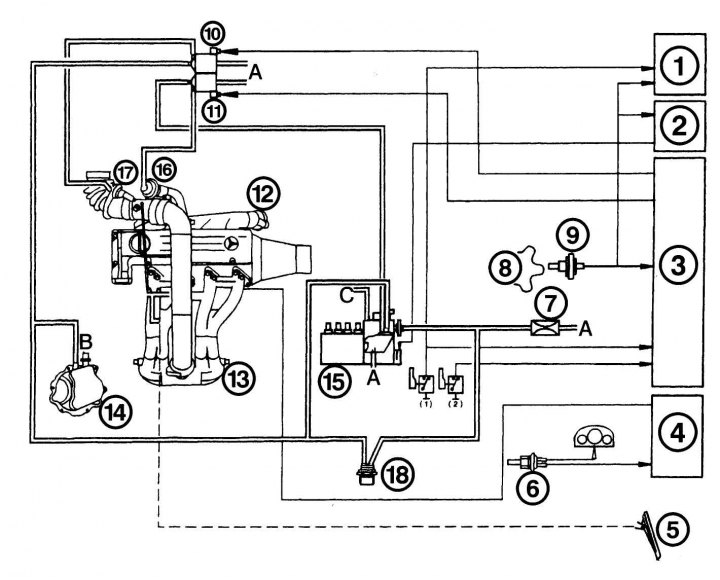
Fig. 4.73. Vacuum lines and valves diagram: 1 – control module of the air conditioning compressor; 2 – Shift Ride Awareness (ARA) control module; 3 – exhaust gas flow control module (ARF); 4 – Heating system control module; 5 – gas pedal; 6 – coolant temperature sensor; 7 – throttle with filter; 8 – flywheel; 9 – starter gear speed sensor; 10 – pressure regulation bypass valve; 11 – exhaust gas bypass valve; 12 – exhaust manifold; 13 – suction pipe; 14 – vacuum pump; 15 – Fuel injection pump; 16 – exhaust gas bleed valve; 17 – pressure control valve body; 18 – thermal valve; A - blowing; B - secondary consumers; C – engine stop
The system acts via a vacuum chamber on the idle speed regulator in the high-pressure fuel pump. At a coolant temperature below +30°C, the idle speed increases by approximately 100 min⁻¹. The diagram in Fig. 4.73 shows the operation of the thermal valve. When the valve is open, a vacuum acts on the diaphragm. The idle speed remains constant. When the valve is closed, the vacuum chamber communicates with the atmosphere via a ventilated tube, and the speed increases.
Checking the pneumatic system idle speed
The test consists of checking the tightness of individual pipelines by blowing. If the vacuum chamber is damaged, it must be replaced.


(Full article available on the resource mercedesman.ru)
1. Disconnect the pipeline from the vacuum chamber. If the diaphragm is in good condition, purging and suction are not possible.
2. At a coolant temperature below 30°C the valve should be slightly open, at a higher temperature – closed. The valve is located on the left side of the cylinder head.
3. When applying a pressure of 0.5 bar to the pipeline to the vacuum chamber, the idle speed should increase by 100 min⁻¹.
Electronic idle speed control
To regulate the idle speed, the sensor on the starter gear measures the exact number of revolutions of the crankshaft and sends a signal to the control unit. The control unit monitors the difference between the required and current values and regulates the number of revolutions depending on the engine load. At a coolant temperature below +60°C, the number of idle revolutions increases according to the specified parameters. For this purpose, an electromagnetic pulse-voltage-controlled device acts on the fuel injection pump regulator. To protect against voltage surges, a 10-amp fuse is installed in the control unit.
Checking the electronic idle speed control
If the idle speed does not operate correctly or if it stops after starting the engine, check the electronic control system


1. Make sure that the accelerator drive is installed correctly - when the pedal is released, the drive (cable) of the steering lever should be free.
2. Leave the warmed-up engine running in idle mode and disconnect the solenoid plug for about 3 seconds. When disconnecting the plug, the speed should increase briefly.
3. If the number of revolutions has not changed, briefly connect 12 V voltage to the electromagnet (maximum 3 sec to avoid coil burnout). If the speed does not increase, replace the solenoid.