



Contents: Swirl chamber injection system ↡ Pre-chamber injection system…↡ Direct injection ↡ Common Rail System ↡ High pressure fuel pumps (HPFP) ↡ Distribution type fuel injection pump ↡ In-line fuel injection pumps ↡ Speed controller ↡ Reducing engine noise levels ↡
If a petrol engine is supplied with a fuel-air mixture, which is subsequently ignited by a spark plug, then in a diesel engine this occurs under the influence of high air temperature. At the end of the compression stroke, the air pressure in the cylinder reaches 28 bar, and the temperature is about +700°C. The fuel ignites under the influence of hot air, and the pressure in the combustion chamber reaches 145 bar (D, TD) or 1350 bar for CDI. In a diesel engine, the atomized fuel burns instantly. When and how much fuel should be injected into the chamber is determined by the adjustment and installation of the injection.
Swirl chamber injection system
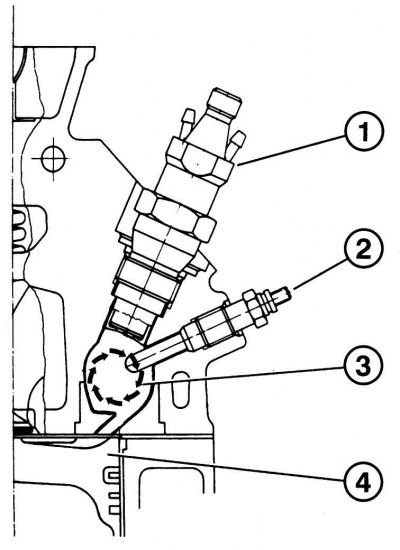
Fig. 4.60. Sectional view of cylinder head with swirl chamber: 1 – nozzle; 2 – glow plug; 3 – swirl chamber with inlet channel; 4 – cylinder
In diesel engines with a swirl system (Fig. 4.60), the combustion chamber is divided. The swirl chamber is connected to the above-piston space, and when the piston approaches the top point, a swirl flow is created in it, which effectively mixes the fuel with air. The mixture, having ignited, passes into the main combustion chamber. Engines with a swirl chamber have proven themselves well, especially at high speeds (more than 5000 min⁻¹).
Pre-chamber injection system (antechamber)
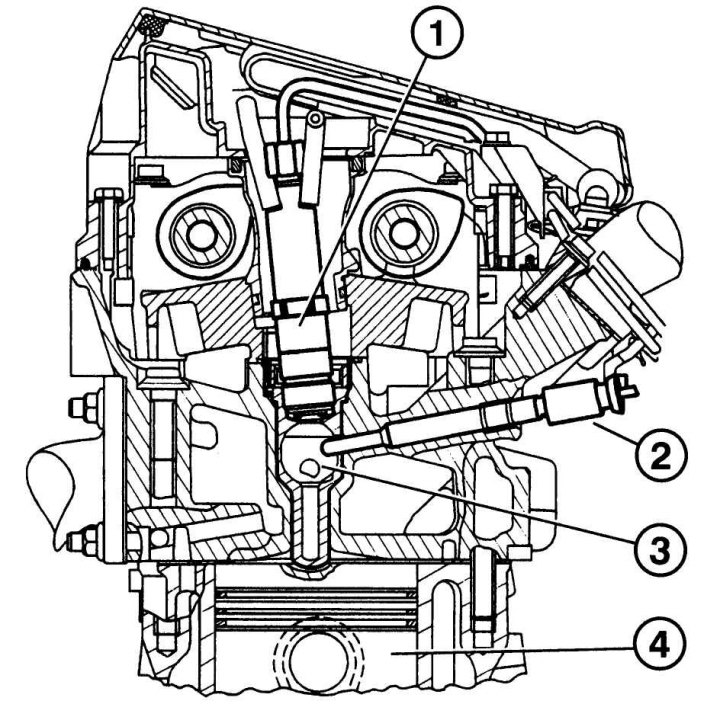
Fig. 4.61. Section of the cylinder head with pre-chamber: 1 – nozzle; 2 – glow plug; 3 – pre-chamber with inlet channel; 4– cylinder
In the pre-chamber system (Fig. 4.61), which is used in Mercedes diesel engines, the working chambers are separated, as in the swirl system. The pre-chamber is located at the top of the cylinder head. Fuel ignition in the combustion chamber occurs through thin nozzles coming from the pre-chamber.
Direct injection
With direct injection, fuel is supplied to the combustion chamber and burns instantly.
This system is highly efficient, but it has its drawbacks: high engine noise, especially when starting and when the revs increase sharply.
Common Rail System
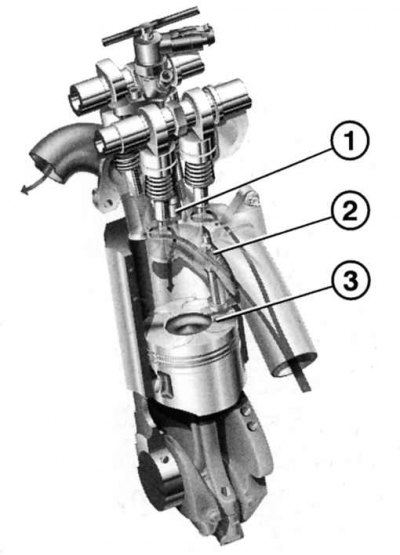
Fig. 4.62. Direct injection in the Common Rail system: 1 – nozzle; 2 – inlet pipe; 3 – piston with a special groove
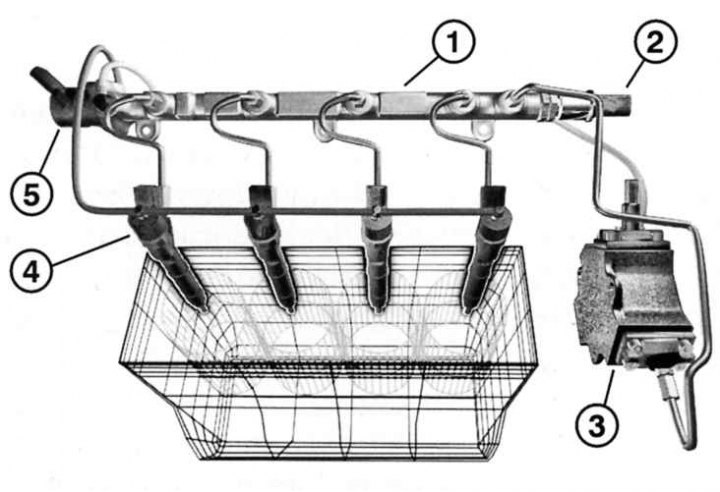
Fig. 4.63. Common Rail system diagram: 1 – common fuel rail; 2 – pressure sensor; 3 – pump; 4 – nozzle; 5 – pressure regulating valve
Common Rail System (fig. 4.62, 4.63, 4.68) not only ensures economy and minimal emissions of environmentally harmful gases, but also surpasses modern diesel engines with pre-chamber injection in terms of comfort and engine noise level. Therefore, CDI diesel engines have taken a key place in the development of Mercedes-Benz engine building.
"Common Rail" means "Common Rail". If in direct injection systems the fuel under pressure was supplied to each injector separately, then in the Common Rail system the fuel, regardless of the injection order, is in the common fuel rail, the so-called accumulator.
Electronic control regulates injection pressure depending on the engine speed and load. Sensors that receive data on the operating mode of the camshaft and crankshaft issue commands for optimal injection according to the engine operating mode. Moreover, fuel supply and injection are independent of each other.
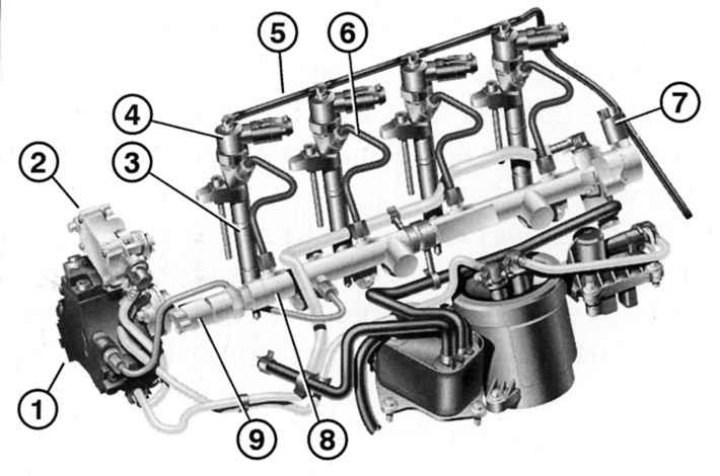
Fig. 4.64. Main elements of the Common Rail system: 1 – high pressure pump; 2 – injection pump; 3 – nozzle; 4 – magnetic valve of the dosing system; 5 – return fuel line; 6 – high pressure pipeline; 7 – fuel pressure sensor; 8 – pressure accumulator; 9 – fuel pressure control valve
The special feature of this development is a special storage device (battery) 8 (Fig. 4.64), in which the pressure of up to 1350 bar is always maintained. This is necessary so that the line that connects the pump to the injectors always contains fuel at the required pressure, ready for injection.
The main line is connected to the injectors. Each injector has a magnetic valve that regulates the pressure and quantity of fuel supplied. A microcomputer controls the valve operation based on the operating mode and engine load. This system has significantly increased the efficiency of the engine and contributed to a significant reduction in the emission of harmful gases into the atmosphere.
High pressure fuel pumps (HPFP)
High-pressure fuel pumps are used to supply diesel fuel to the injectors under high pressure (about 120 bar). 4- and 5-cylinder engines are equipped with a distributor fuel injection pump. The 6-cylinder engine has an in-line fuel injection pump. All fuel injection pumps are located on the left side of the engine and are driven by a chain from the crankshaft. In this case, the rotation speed of the fuel injection pump shaft is half the rotation speed of the crankshaft. The fuel injection pumps have electronic control.
Distribution type fuel injection pump
Engines E 220 D and E 290 TD are equipped with a distributor-type fuel injection pump (fig. 4.64, 4.65). The high-pressure fuel pump has a built-in fuel pump and a temperature sensor, which sends a signal to stop the fuel supply. There are electromagnetic valves on the outside, one to stop the engine, the other to supply fuel. The high-pressure fuel pump supplies fuel through thin channels into the corresponding cylinder.
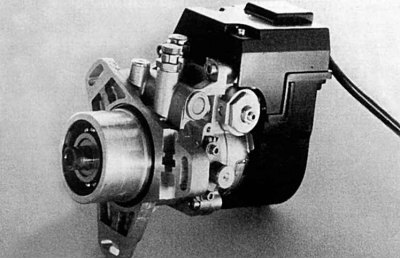
Fig. 4.65. Distribution type fuel injection pump installed on E 220D and E 290 TD models
The pump shaft is connected to the head channel, and the injection pistons are separated from each other by fuel pressure (about 8 bar), until the projections on the cam washer produce force on the bearing ends. During the rotation of the shaft, the discharge channel closes and the high-pressure channel opens.
In the head of the distributor pump there are 4 (or 5 - for a 5-cylinder engine) discharge channels and, accordingly, 4 (5) high-pressure channels. As soon as the cams on the cam washer are aligned with the support projections, the pistons begin to compress the fuel, the pressure increases, and when it reaches about 120 bar, injection occurs.
The amount of fuel injected is determined by the stroke length of the injection piston, which is adjusted by the axial movement of the support projections. The axial position of the distribution pump shaft is adjusted by two magnetic valves and a return spring of the fuel quantity regulator.
The fuel injection advance angle is adjusted by the position of the cam washer relative to the distributor pump head. By turning the washer against the direction of rotation, an earlier injection time is set, and according to the direction of rotation, a later injection time is set. The cam washer is turned around the shaft axis using the adjusting valve and the return spring. When set to the "early" position, the adjusting valve will be open, the pressure will increase, and the adjusting piston will move to the left. When the valve is closed, the pressure decreases, and the piston, under the action of the spring, moves to the right.
Original published on the website www.mercedesman.ru
In-line fuel injection pumps
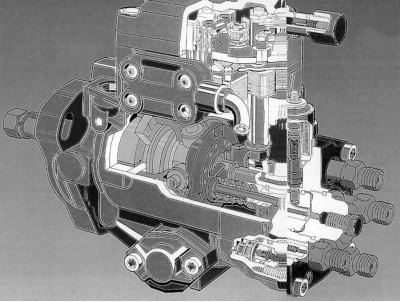
Fig. 4.66. Distribution type fuel injection pump installed on the E 220 D and E 290 TD models, in section
On the E 300 D models, an in-line fuel injection pump (Fig. 4.66) with electronic control is installed - ERE (Elektronisch geregeltes Reien-Einspritzsystem). In-line fuel injection pumps have a separate pump section for each cylinder, which supplies fuel to the corresponding injector via a high-pressure steel pipeline. The main components of the ERE system are the in-line fuel injection pump and the electronic control unit of the injection system.
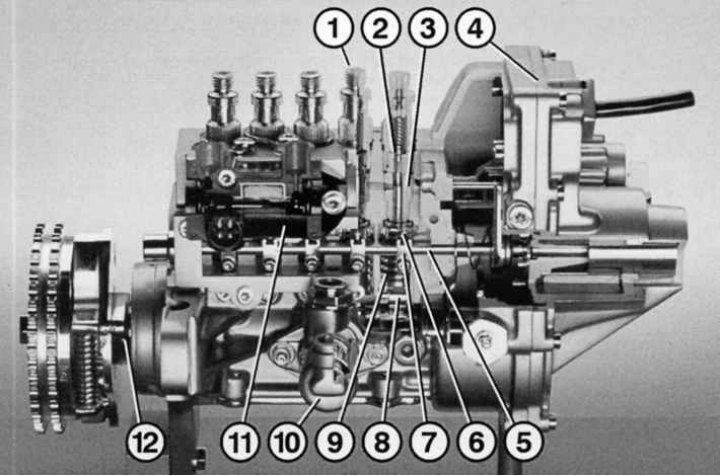
Fig. 4.68. In-line fuel injection pump (ERE) in section: 1 – receiving part for connecting the high-pressure pipeline to the nozzle; 2 – discharge valve; 3 – plunger; 4 – Engine Speed Regulation Mechanism (ERE); 5 – steering rack; 6 – plunger installation lever; 7 – connector; 8 – roller pusher; 9 – plunger spring; 10 – fuel pump; 11 – electrohydraulic regulator; 12 – cam shaft
A cam shaft 12 is installed in the lower part of the pump (Fig. 4.68). Its cams are used to operate the pump sections according to the injection sequence. The main parts of the pump section are: the discharge valve 2, the cylinder and plunger 3, the rotary plunger sleeve and the spring 9.
When the plunger is in the lower position, the cavity above it is filled with fuel through the inlet. The pump shaft cam moves the pusher upward, the plunger spring is compressed, the plunger closes the inlet, the pressure increases.
When the pressure reaches 120 bar, the injector needle rises and fuel enters the pre-chamber. Injection continues until the plunger opens the fuel supply adjustment outlet. At this point, the pressure above the plunger drops sharply, the delivery valve closes, having previously passed a small amount of fuel back into the cylinder. The pressure in the fuel pipe and injector drops sharply. The injector closes.
The plunger has a helical ground channel on its side surface, and depending on the position of the plunger, the fuel supply adjustment outlet remains closed for some time. The path that the plunger travels when the outlet is closed is called the injection stroke. The greater the injection stroke, the more fuel is injected into the engine cylinder.
The rotary bushings of the plungers of all pump sections are connected via a short lever to the control rack. When assembling the pump, the rotary bushings are installed in such a way that all pump sections pump the same amount of fuel.
The fuel supply control rack is an important part of the injection pump, with the help of which the injection fuel is dosed into each cylinder. The control rack is connected to the accelerator pedal via an electronically controlled speed regulator (ERE).
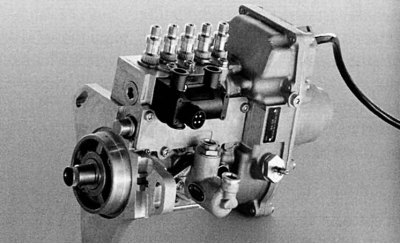
Fig. 4.67. In-line fuel injection pump type ERE, installed on the E 300D model
Speed controller
The electronic speed controller is located at the rear of the fuel pump and controls the rack. The controller is controlled by a rectangular pulse voltage with a frequency of about 190 Hz. Depending on the mode, the force of the actuator magnet changes, and it, overcoming the force of the spring, moves the rack in the direction of "Start" or, respectively, "Volllast" (full load)The rack stroke length is 19.5 mm.
Reducing engine noise levels
In previously used high pressure direct injection fuel pumps (up to 145 bar), the engine noise was much higher than that of pre-chamber models. The Common Rail system injects a small, so-called pilot, dose of fuel before the main portion of fuel, which provides "heating" of the combustion chamber. Due to this, optimal conditions are created for ignition of the main fuel, it ignites much faster, since the pressure and temperature rise smoothly, and not abruptly. This affects not only the reduction of noise, but also the reduction of toxicity of exhaust gases.
Based on this, Mercedes-Benz specialists have taken additional measures to reduce engine noise levels. These include a special noise-absorbing casing (damper) for the cylinder head and intake manifold, reinforcement of the crankcase and camshaft cover.