



Contents: Blow-off air pressure regulator ↡ VTG turbocharger ↡ Charge air cooling radiator ↡ Cleaning the charge air cooling…↡
The turbocharger is flanged to the exhaust manifold and intake system.
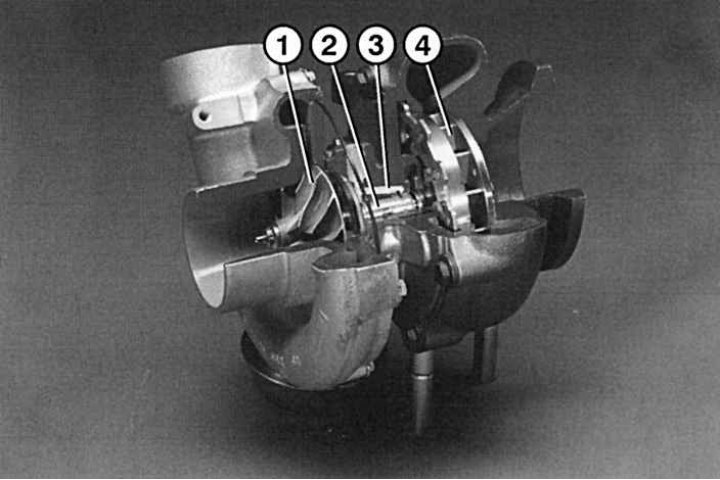
Fig. 4.75. Turbocharger in section (290TD): 1 – turbine; 2 – shaft; 3 – oil channel; 4 – compressor
The turbocharger housing is divided into two sections: turbine 1 (Fig. 4.75) and compressor 4. Each contains an impeller. They are rigidly mounted on one shaft 2. The turbine is driven by the flow of exhaust gases, the compressor forces air, which enters through the pressure control valve housing into the cylinders.
Blow-off air pressure regulator
Both turbine impellers can reach very high speeds, more than 100,000 min⁻¹. At the same time, the pressure of the discharged air can rise above 2 bar. Since this pressure is excessive, an air pressure regulator is installed on the compressor, which performs the function of reducing the pressure.
When the turbine speed reaches approximately 50,000 min⁻¹ and a small pressure is created, the regulator operates in such a way that the pressure is maintained constantly even at low speeds, which helps to avoid "dips" when the speed increases sharply.
If the pressure on the regulator rises above the set value (0.9 bar) under heavy loads, the membrane opens. In this case, only a small part of the exhaust gases will work for the turbine, and the rest will go to the muffler.
To maintain the required pressure of the injected air when driving at any altitude (in the mountains), a "boost" sensor is built into the control unit. When driving in thin air, the sensor sends a signal to increase the compressor pressure and thereby maintains normal mixing of air and fuel.
VTG turbocharger
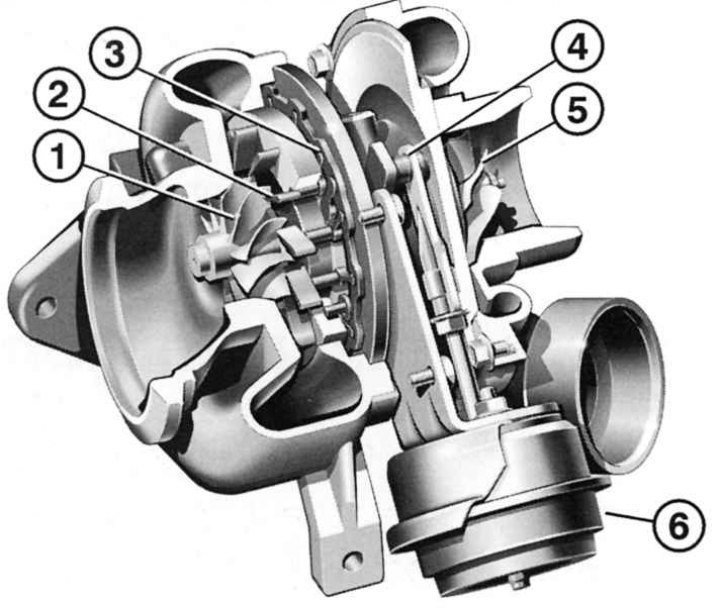
Fig. 4.76. VTG turbocharger in section: 1 – turbine impeller; 2 – adjustable guide blades; 3 – blade adjustment wheel; 4 – rod with adjusting lever; 5 – compressor impeller; 6 – vacuum chamber
4-cylinder engines with the Common Rail system are equipped with so-called VTG turbochargers with variable turbine geometry (Fig. 4.76).
In the VTG compressor, the air flow cross-section changes depending on the engine operating mode, thereby generating the optimum pressure. The optimum pressure is achieved by means of a control unit, depending on the installation characteristics of the turbine guide blades inside the compressor.
At low engine speeds, the blades close, reducing the cross-section of the air flow, and the pressure increases; at high speeds the cross-section increases and the pressure drops.
This achieves a number of advantages:
- 1. Changing the installation of the guide vanes allows for optimal use of the energy of the exhaust gases and achieves high efficiency due to a wide range of control characteristics.
- 2. Increased pressure of the supercharged air at low speeds. The turbocharger works faster, thereby eliminating "dips" when switching from low to high speeds.
- 3. Increased torque due to better filling of the cylinders.
- 4. Reduced smoke emission at full load due to the presence of a reserve of forced air.
- 5. Improved discharge pressure dynamics.
- 6. Failure of the boost pressure control valve (waste gate).
- 7. Increased power due to increased boost pressure at low speeds, resulting in optimal boost control.
1. If the turbocharger does not work, this may be due to the rapid shutdown of a hot engine immediately after a long drive at maximum speed. In this mode, coking of the compressor may occur: the shaft bearings, especially on the exhaust gas turbine side, overheat greatly, the oil burns out in them, and they may stick. If this happens often, the bearings will become unusable and will have to be replaced. Therefore, never turn off the engine immediately after a long drive at maximum loads, let it run for some time at idle speed.
2. Never start the engine without an air filter, small solid particles can damage the compressor (turbine rotation speed around the perimeter is up to 500 m/s). Before changing the compressor, it is necessary to check the operation of the following units (accordingly the reasons for the malfunction): ignition, fuel system, compression, air filter and tightness of connections of the air injection system and exhaust system.
Charge air cooling radiator
The air cooling radiator, located between the turbocharger and the pressure control valve body, is connected to the engine cooling circuit. If the air in the compressor reaches a temperature of +110°C, then, passing through the radiator, it cools to +70°C.
In the mixing chamber located behind the radiator, clean air is mixed with exhaust gases in a computer-calculated proportion to ensure optimum engine performance. For this purpose, the mixing chamber is equipped with a special exhaust gas discharge valve and a throttle valve, which is controlled by an electropneumatic converter. Throttling the air increases the pressure difference between the injected air and the exhaust gases and thus affects the performance of the exhaust gas discharge system.
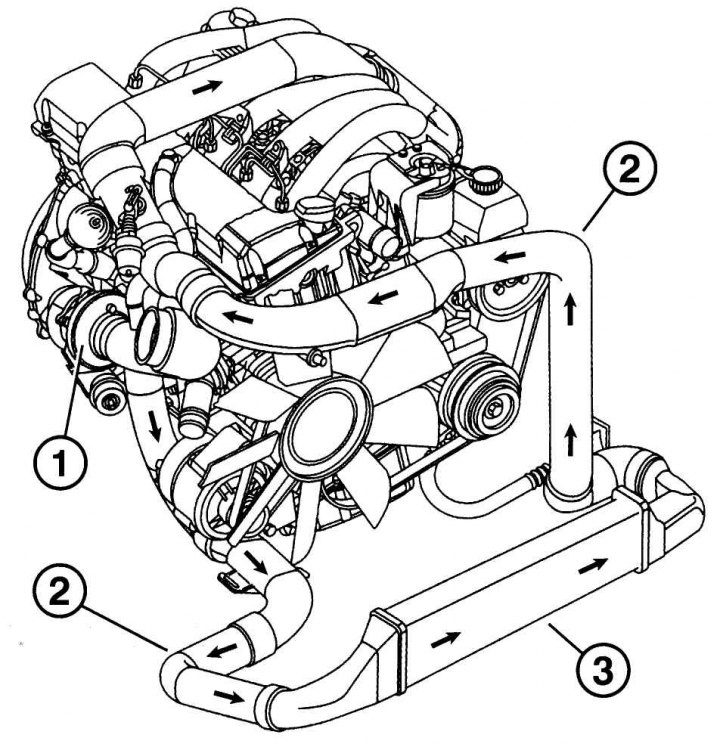
Fig. 4.77. Air flow direction (shown by arrows): 1 – turbocharger; 2 – pipes; 3 – radiator
Cleaning the charge air cooling radiator


"30,000 km"
Clean the charge air cooling radiator during the summer period of vehicle operation. This operation is performed in the same way as with the cooling system radiator.