



When pumping air, the pistons create a strong vacuum, which, when the intake valves are open, causes air movement in the intake system. If the intake valves suddenly close, the air "springs" back - an oscillation occurs in the intake pipe. Its frequency depends on the length of the intake pipe, the engine speed and the engine valve timing. If the oscillations resonate, a certain pumping effect is achieved. With the help of flaps, resonance conditions can be created in a wide range of revolutions.
1. At a speed of up to 2550 min⁻¹ both flaps are closed, the air volume in the intake system can fluctuate in the section up to the pressure control valve.
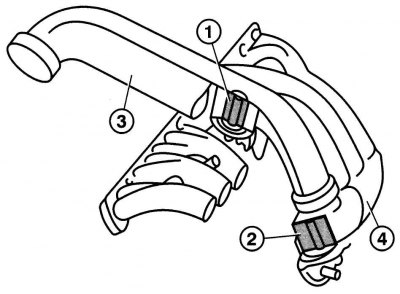
Fig. 4.74. Variable length intake manifold of the E300 Diesel model: 1, 2 – flaps; 3 – intake system; 4 – intake manifold
2. From 2550 to 3350 min⁻¹ damper 1 opens (Fig. 4.74), oscillations stop at damper 1.
[Information copied from the website: MercedesMan.ru]
3. At a speed of more than 3350 min⁻¹, flaps 1 and 2 open, and the vibrations reach the intake manifold.
These changes are only used at full engine load. In order to achieve low fuel consumption and clean combustion at partial load, other combinations of air volume frequencies and engine speeds are required. Therefore, at the calculated time, the electronic control activates both the control valve and the exhaust gas return.