
Cars BMW Cars Volkswagen Cars Chevrolet Cars Land Rover Cars Lada Cars Honda Cars Peugeot
English Русский
Български
Беларускі
Український
Српски
Hrvatski
Română
Polski
Slovenský
Magyar
Bookmark News and articles Sitemap Feedback Site search
MercedesMan.ru


A-Class C-Class E-Class G-Class M-Class S-Class Others
W123 (1976-1985) W124 (1984-1995) W210 (1996-2002)
  • Main
  • E-Class
  • W210 (1996-2002)
  • Diesel engines
  • Injection system
  • Injection system maintenance

Injection system maintenance (Mercedes-Benz E-Class W210)

0
Contents: Visual inspection of the injection…↡ Engine Shutdown System Malfunctions ↡ Checking air connections for…↡ Injector malfunctions ↡
Most work related to the repair and maintenance of the injection system should be carried out by specialists at the service station. They have the necessary diagnostic devices and the corresponding equipment. In case of malfunctions in the electronic control, it is sometimes necessary to conduct a series of specialized tests to find the cause of the malfunction. This is the only way to determine the damage to the corresponding units and parts and avoid more expensive repairs. You can independently check the malfunctions that occurred when the control unit malfunctioned, the condition of the sensors, switches and cable connections.

Sequence of works


1. Check if the fuse is securely installed and if the relay is connected to the connectors and pins.

2. Make sure the heating system is working properly.

3. Check the fuel supply system.

4. Perform a visual inspection of the injection system.
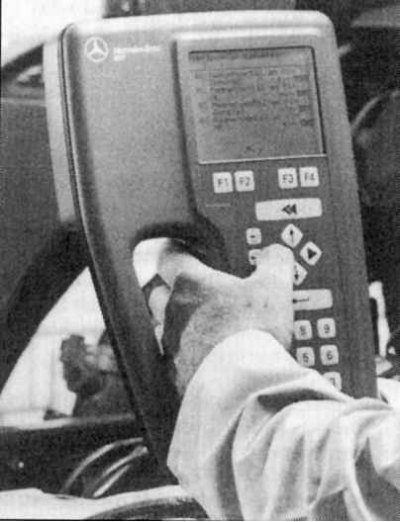
Fig. 4.79. Control unit diagnostics

Fig. 4.79. Control unit diagnostics


5. If this does not bring results, submit the control unit for testing and memory control.

From the point of view of diagnostics, the control unit depends on the engine operating mode. When driving, errors are received in the memory storage device, when stopping and disconnecting the battery, they are deleted. The EDS control system is equipped with an additional source for the memory system, this ensures that even minor faults that occur in a short time are entered into the memory. By comparison, only those faults that must be immediately eliminated are mainly remembered. Minor faults that occur very rarely are erased by the memory. "Reading" of these errors is possible at the Mercedes station using a special tester (HHT) (Fig. 4.79). There is also a set of additional characteristics and tests.

Visual inspection of the injection system


"15,000 km"

1. Check the air hoses for leaks.

2. Check the fit and condition of the brake booster hose.

3. Check the condition of the crankcase ventilation hoses.

4. Check the fuel lines for leaks and the correct connection of the fuel return line.

5. Check all electrical connectors and the reliability of their connection in the injection system wiring.


Engine Shutdown System Malfunctions


If the system is faulty or de-energized, the engine will not turn off. A system fault is also indicated by the fact that the engine does not start even though the injection system is working properly and there is enough fuel.


"15,000 km"

1. Check the reliability of the connection and the wire itself to the engine shutdown system.

2. When turning the ignition key, a click should be heard in the area of the switch unit.

3. If there is no click, this indicates a problem with the power supply or the system itself.

4. Turn on the ignition and check for voltage at the system connector.

5. If there is no voltage, the cable is faulty or the fuse is not installed tightly.

6. If there is voltage, there may be a malfunction in the shutdown system itself.

Checking air connections for tightness


If the connections are loose, so-called extraneous air enters the suction system or, conversely, some air escapes from the injection system into the atmosphere. This leads to a violation of the calculated operating mode and, as a result, to incorrect injection dosing. As a rule, the engine operation with interruptions indicates a leaky connection.


(Material taken from a web resource: «mercedesman.ru»)


"15,000 km"

1. Check the vacuum hoses connected to the intake manifold and injection system for cuts and damage, and for tightness.

2. Warm up the engine and let it idle.

3. Using a spray can, spray fuel onto the intake system flanges, intake duct gaskets, and vacuum line pipes. If the engine speed changes when spraying the specified connections, the connection is not sealed.

Injector malfunctions


The engine runs rough, bearing noise, ringing sounds are heard, and blue smoke comes out of the muffler from time to time. If such signs occur, it is necessary to disconnect the pipes leading to the injectors one by one. If there is no change in engine operation when one of the pipes is disconnected, then presumably this injector is not working. Injector failure may be caused by contamination. After the car has been parked for a long time, the injector needle may "stick" to the body. With long-term use of injectors, their injection pressure decreases. Service stations have a special device that determines the suitability of the injector. If the injector starts working at a pressure below 100 bar, it must be replaced.
This article is available at: russian, bulgarian, belarusian, ukrainian, serbian, croatian, romanian, polish, slovak, hungarian
The article has been verified: Polyakov Zakhar Grigorievich
Share with friends:
◀ Previous
E-Class W210 / Injection system
Next ▶

Engine shutdown
Possible turbocharger malfunctions, their causes and troubleshooting methods
Turbocharger — description and maintenance
Injectors — General Description
Variable length intake manifold
Removal injectors
Disassembling injectors
Accelerator pedal drive
Possible malfunctions of the diesel engine fuel system, their causes and methods of elimination
More similar articles for repairing other models

☛ The principle of operation of the fuel injection system Mercedes W168 (1997-2004)
☛ Elements of the fuel injection system of a diesel engine Mercedes W203 (2000-2007)
☛ The operating principle of the control and injection system of a… Mercedes W463 (1999-2019)
☛ Maintenance of the lubrication system Mercedes W163 (1997-2005)
☛ Fuel injection and fuel supply system of a gasoline engine — general… Mercedes W140 (1991-1998)
☛ General description of the diesel fuel injection system Mercedes Sprinter (1995-2000, diesel)
Link in different formats to this article
Comments and feedback from visitors
No comments yet


How much will 33 + 17 ?


W210 (1996-2002) 
  • General information
  • Vehicle description
  • Working conditions and tools
  • Car care
  • Diesel engines
  • Engine repair
  • Lubrication system
  • Cooling system
  • Injection system
  • Supply system
  • Exhaust system
  • Gasoline engines
  • Engine repair
  • Lubrication system
  • Cooling system
  • Control system
  • Power and exhaust system
  • Transmission
  • Clutch
  • Mechanical gearbox
  • Automatic gearbox
  • Drive shafts
  • Chassis
  • Car suspension
  • Steering
  • Tires and wheels
  • Brake system
  • Body
  • Exterior (external elements)
  • Interior (internal elements)
  • Doors and windows
  • Heating and ventilation
  • Electrical equipment
  • Equipment and devices
  • Power devices
  • Lighting and signaling
  • Electrical circuits
W124 (1984-1995) 
  • General information
  • Governing bodies
  • Driving and operation
  • Weekly care
  • Maintenance (gasoline)
  • Maintenance (diesel)
  • Troubleshooting
  • Power unit
  • I4 petrol engine
  • V6 petrol engine (SOHC)
  • V6 petrol engine (DOHC)
  • Diesel engines
  • Engine overhaul
  • Cooling system
  • Heating and ventilation
  • Fuel system (carburetor)
  • Injection system «Bosch CIS-E»
  • Injection system «Bosch HFM»
  • Diesel fuel system
  • Supply system
  • Starting and charging system
  • Ignition system (I4)
  • Ignition system (V6)
  • Preheating
  • Transmission
  • Clutch
  • Mechanical gearbox
  • Automatic gearbox
  • Drive shafts
  • Chassis
  • Brake system
  • Car suspension
  • Steering
  • Body
  • Exterior (external elements)
  • Interior (internal elements)
  • Doors, locks and windows
  • Electrical equipment
  • Equipment and devices
  • Switches
  • Headlights and lighting
  • Electrical circuits
W123 (1976-1985) 
  • General information
  • Introduction to the guide
  • Power unit
  • Engine device
  • Repair M102 engines
  • Repair M110 and M123 engines
  • Cooling and lubrication (M102)
  • Cooling (M110 and M123)
  • Ignition system
  • Power system «Stromberg»
  • Power system «Solex 4A1»
  • Fuel injection «K-Jetronic»
  • Fuel injection «L-Jetronic»
  • Transmission
  • Clutch
  • Mechanical gearbox
  • Automatic gearbox
  • Cardan and rear axle
  • Chassis
  • Front suspension
  • Rear suspension
  • Steering
  • Brake system
  • Body
  • Exterior (external elements)
  • Interior (internal elements)
  • Doors, locks and windows
  • Electrical equipment
  • Equipment and devices
  • Power devices
  • Electrical circuits
 
MercedesMan.ru © 2017–2026 · Mobile version · Read about Mercedes · Sitemap: EN BG BY UA RS HR RO PL SK HU · Feedback · Site search · Bookmark A-Class (W168) · C-Class (W201) · C-Class (W202) · C-Class (W203) · E-Class (W123) · E-Class (W124) · E-Class (W210) · G-Class (W463) · M-Class (W163) · S-Class (W116, petrol) · S-Class (W126, petrol) · S-Class (W140) · S-Class (W220) · Sprinter · Vito 1 · Vito 2 · Vario 814D ·
 
We only use cookies without which some of the site's features may not be available.